wartime shortages
Pamela's WarWartime shortages are not a single crisis but the cumulative material condition through which the war enters everyday life. Fuel, food, clothing, soap, cosmetics, alcohol, labour, transport, and shelter become scarce or regulated; the resulting inconveniences range from improvised stockings and recycled lipstick to the closure of The Woodman Hotel and a family’s enforced move into bomb-threatened Birmingham. Scarcity demands ingenuity and sacrifice, but it also reveals that money, information, location, and social connections determine who can continue to eat, travel, trade, or maintain the appearance of normality.
Clothing and Personal Appearance
Wartime shortages first alter the ordinary culture of buying and wearing clothes. The family’s shopping expeditions still produce bags of clothes and shoes, but the apparent abundance is temporary: the wardrobe acquired before the full force of couponing takes hold must last for the duration of the war and beyond. Once clothing coupons are introduced, purchases require far greater circumspection, and a winter coat can consume an entire year’s allowance. Clothing therefore ceases to be a routine expression of taste and becomes a long-term calculation of necessity, durability, and entitlement.
The shortage of stockings turns the female body into a site of practical improvisation and social expectation. Unable to obtain stockings, Pamela Wheeler Fellows and Gloria stain their legs brown with liquid leg makeup, then take turns drawing black-pencil seam lines up the backs of their legs. The result is visibly unsteady, but bare legs are considered scandalous for women going to offices, so appearance must be maintained even when the proper garment is unavailable. The episode combines resourcefulness with constraint: cosmetics imitate a missing commodity, while workplace convention continues to police women’s presentation.
Lipstick is treated in the same spirit of reconstruction. Rather than use the recommended beetroot juice, the women scrape the stubs from several exhausted lipstick containers into an eggcup, warm them in a pan of water, and pour the melted mixture back into a container. The improvised lipstick gives poor coverage, feels greasy, and may emerge in an odd colour because different shades have been combined, yet it restores a small element of glamour. Such practices make consumption itself a form of repair, turning depleted objects into temporary replacements and personal style into a modest assertion of control.
Food, Rationing, and Unequal Access
Food rationing follows petrol rationing and is accompanied by clothing controls, shortages of soap, shampoo, and stockings, and a points system that adjusts the number of points required according to availability. A glut lowers the point requirement; a shortage raises it. For those less fortunate, the weekly allowances are stark: one small piece of meat, four ounces of bacon or ham, two ounces of butter, four ounces of margarine or lard, eight ounces of honey or jam, eight ounces of sugar, two ounces of cheese, two ounces of tea, three pints of milk, and some dried egg. School, office, and factory canteens become valuable not merely as places to eat but as means of preserving household coupons.
The rural setting gives the family at The Woodman Hotel an important advantage. Local vegetables, milk, and eggs remain available, and the countryside is more self-sufficient than the town; meanwhile, suburban gardens are converted into vegetable plots through Dig for Victory. Generous catering allowances allow the hotel to serve food without requiring customers to surrender their coupons. That privilege produces resentment because customers with money can eat out while those without it remain confined to basic rations. The resulting inequality is sharpened by the black market, where informed buyers can obtain petrol, food, clothing coupons, or the goods themselves. The account’s blunt conclusion is that money continues to speak even under wartime controls.
The family’s relative advantage does not prevent generosity. Aware that friends and customers are suffering from food shortages, Marie Wheeler sends them home at the end of the evening with butter, bacon, steak, or eggs. At the hotel, ham and egg, steak and chips, and fish and chips are particularly sought after. Fish is not rationed, although inferior cooking fats make many fish-and-chip meals unpleasant and create long queues wherever the food is prepared well. The hotel avoids both problems through good cooking and a dependable supply: twice a week, fresh fish is packed in ice at Birmingham Fish Market, sent to the Midland Red Bus Station, carried roughly fifteen miles by the Clent bus, and delivered by the driver across the road to the hotel’s refrigerator.
Alcohol becomes scarce enough to require private rationing behind the bar. Pamela Wheeler Fellows sometimes has only one bottle of whisky to last the whole week and reserves it for the hotel’s most loyal regular customers, denying that the requested drink exists when necessary. On one occasion, the mirrored decoration of the bar exposes the deception: while she believes the hidden bottle cannot be seen, its reflection gives away the service. Shortage thus produces a small economy of concealment, privilege, and risk inside an otherwise public room.
Fuel, Labour, and the Collapse of the Hotel
Petrol rationing steadily removes the customers on whom The Woodman Hotel depends. At first, people attempting to preserve normality eke out their allowances, even saving fuel by switching off a car engine at the top of a hill and coasting. As the war continues, a drive into the countryside for a leisurely drink becomes indefensible and potentially punishable by imprisonment. Cars are stored rather than used, and performers who once travelled to the rural hotel must stay near the theatres where they work. By 1942, no petrol is available to the general public at all; only emergency, public, and war-related vehicles remain on the roads.
The absence of a railway makes the hotel’s rural position especially damaging. A proposed rail line to Clent, possibly one reason the hotel was built, might have supplied the transport that wartime roads no longer provide. Trains continue to run day and night carrying troops, but no line reaches the hotel. Bus services are reduced to essential journeys to and from work, with evening schedules curtailed to save fuel. The hotel is therefore isolated not by distance alone but by the wartime reclassification of movement: leisure travel disappears while military transport continues.
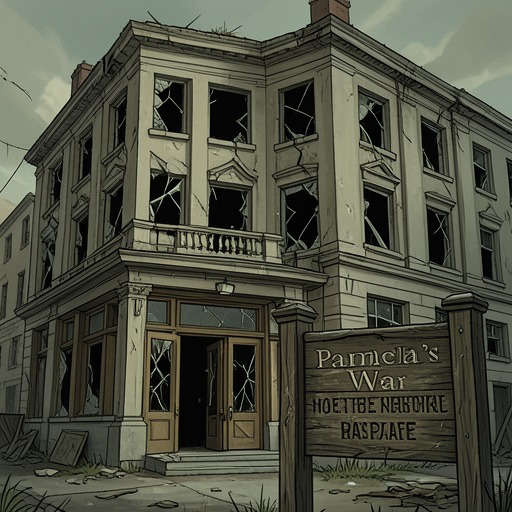
Shortage also removes the workforce. The hotel’s original staff of fourteen are called up to fight for King and Country. Only Jack, Pamela Wheeler Fellows, Marie Wheeler, and Sidney Wheeler remain to keep the business operating, and they must work intensely as custom declines. The building is large, costly to heat and light, and burdened with substantial overheads; a rent manageable in prosperous times becomes impossible when there are few customers. Sidney Wheeler conceals the true financial position for several months, but eventually admits defeat and returns the tenancy to the brewery. The consequence is decisive: the family has to leave The Woodman Hotel, the place where Pamela Wheeler Fellows spent her adolescent years.
Scarcity does not eliminate all forms of service. A battalion of young soldiers stationed about half a mile away operates a searchlight against German bombers but cannot prepare edible meals with its basic equipment and limited culinary experience. Marie Wheeler offers to cook their rationed joint of meat at the hotel if they deliver it to the kitchen and arrive at the appointed hour. The soldiers march across the field in single file, eat together around a large table, and naturally consume some alcohol in a licensed hotel. Her cooking becomes a private contribution to the war effort, showing how domestic and culinary labour compensates for institutional inadequacy.
Shortage, Suspicion, and Repurposed Space
The same pressures that reduce trade alter the social geography around the hotel. A group of men walks down the lane opposite the building each evening from the direction of the Clent Hills, near a large house understood to be operating as a nursing home and growing vegetables for local sale. They order drinks in English, then speak quietly in their mother tongue. Sidney Wheeler listens from behind the bar, recognizes the guttural sound from his service on the Somme, and realizes that the language is German rather than French. In a climate of scarcity and fear, a routine customer group becomes an object of observation, and the rural hotel functions as both business and informal listening post.
The hotel’s position opposite the police station also turns space into a resource. From the raised bar area, Pamela Wheeler Fellows can see over the top sash window of the station. When the sergeant stands up and puts on his helmet, that movement provides warning that licensing enforcement is approaching. The hotel calls time, covers the beer pulls with towels, lowers the shutters, and urges remaining customers to finish. For months, this visual advantage allows the business to manage the strict licensing laws, demonstrating that surveillance is not one-directional: the authorities watch the licensed premises, but the premises watch the authorities in return.
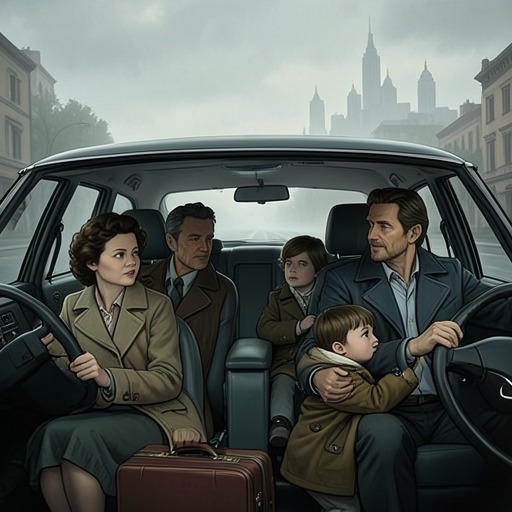
Wartime shortage eventually converts the hotel from a viable enterprise into a memory, and the family’s next home places them on the opposite side of the rural-urban divide. Sidney Wheeler secures a lease on a top-floor mansion flat about half a mile from Birmingham city centre, despite the increasing bombing. The family leaves behind the countryside’s relative safety and its access to catering supplies, entering a city where bombed buildings are already visible and food is no longer available through the hotel’s privileged system. The move is therefore not simply a change of address: it is a loss of economic protection and a transfer into direct danger.
When the new flat’s air-raid shelter cannot be reached, all the residents gather on the ground floor. Sidney Wheeler commands them to lie on the floor with their hands over their ears, drawing on his experience as an officer. The instruction saves their lives; later inspection shows shrapnel holes mostly at waist or head height, where anyone standing would have been struck. Here, scarcity extends beyond commodities to protective infrastructure. The unavailable shelter forces improvised collective action, while military knowledge supplies what the building cannot.
Domestic Improvisation and the Logic of Necessity
Shortage also produces acts that are comic, illicit, and frightening at once. A new pram intended for the baby is commandeered by Marie Wheeler to transport food for the family. Rationing has removed many familiar foods, including Marsh’s hams, advertised in December 1939 as unavailable for that Christmas and for many Christmases afterward. After leaving the hotel, the family loses its catering coupons and joins the general population on basic rations, with a Friday serving of fish and chips becoming one of the few dependable culinary pleasures.
The ham brought home in the pram creates a crisis because its smell is impossible to conceal. The family hangs it in the cellerette, closes the door, and fears that neighbours will report the offence, but the powerful odour spreads through the house and out toward the street. The ham cannot safely be given away, so the only solution is to consume the evidence. The family eats it morning, noon, and night for a month until everyone is sick of it, and Marie Wheeler is never tempted to acquire another.
This episode captures the peculiar moral atmosphere of wartime shortages. A coveted food becomes a liability once obtained outside the expected system; abundance, when concentrated in one household, can look like criminality. The family’s response is neither profiteering nor public distribution but forced consumption, a domestic punishment produced by the very scarcity that made the ham precious. Across the wider account, the same pattern recurs: a missing garment is replaced by cosmetics, exhausted lipstick is melted into a new mixture, scarce whisky is reserved for trusted customers, and a scarce meal is stretched through ingenuity and labour.
Wartime shortages therefore govern both material survival and social behaviour. They restrict mobility until a prosperous rural hotel loses its customers, remove staff until a family business collapses, ration food while allowing money and black-market knowledge to purchase exceptions, and compel households to turn gardens, kitchens, bars, prams, and clothing into instruments of adaptation. Yet the shortages also reveal forms of solidarity: Marie Wheeler feeds friends, cooks for soldiers, shelters city refugees, and sends customers home with provisions. The resulting portrait is neither simple deprivation nor uncomplicated wartime heroism. It is a world in which scarcity narrows choices, unequal access persists, and ordinary people preserve dignity through repair, hospitality, vigilance, and humour.