Any Port in a Storm
Pamela's War“Any Port in a Storm” names the wartime logic by which an imperfect refuge becomes acceptable when the alternative is exposure to a greater danger. In the memoir, the expression is applied to the family’s move from the countryside to Birmingham during the bombing campaign, where a top-floor mansion flat is chosen not because it is secure, but because, amid worsening raids, almost any shelter can serve as a haven.
Meaning and Wartime Context
The expression presents refuge as relative rather than absolute. A port is valuable to a ship caught in a storm because it offers protection, even if it is not the vessel’s intended destination or an especially good harbour. Applied to wartime domestic life, the proverb makes necessity the measure of suitability: safety is judged against the danger outside, not against the comforts or expectations of peacetime.
That contrast is already implicit in the family’s life at The Woodman Hotel. The hotel stands in a rural setting, opposite a police station and near the Clent Hills, and its rooms and surrounding spaces are repeatedly adapted to wartime purposes. The family observes activity from the bar, hears Home Guard drills on the field behind the police station, and receives soldiers whose searchlight post lies about half a mile away. Yet even this comparatively sheltered environment cannot remain secure indefinitely as bombing increases nightly and ordinary customers become less able to travel.
The Move from The Woodman Hotel
The expression occurs at the decisive moment when The Woodman Hotel is left behind. Suitcases are piled into the car, and the family sets out for a top-floor mansion flat about half a mile from Birmingham city centre. The choice is presented with dry irony: there is assumed to have been little competition for the property, particularly because bombing has been increasing. The flat is therefore not a coveted home selected under normal conditions, but an available refuge made attractive by the deteriorating circumstances around it.
The move reverses the family’s geographical relation to danger. The Woodman Hotel represents the relative safety of the countryside, while the new flat places the family in what is explicitly recognized as dangerous territory. The proverb acknowledges that reversal without disguising it. The family is not moving toward security in any complete sense; it is moving toward the best shelter that circumstances permit.
The flat initially appears to justify the decision in domestic terms. It is elegant and spacious, with high ceilings and cornicing, and its top-floor position provides views over Islington Row and much of the city. The furniture and fittings from the former life have been left behind, sold to the new tenant of the hotel, but the new home has been furnished despite wartime shortages according to the taste of the narrator’s stylish Mother. Its beauty creates a temporary impression of continuity, even as the bombed-out buildings encountered on the journey make clear that the family may itself be next.
Refuge Tested by the Air Raid
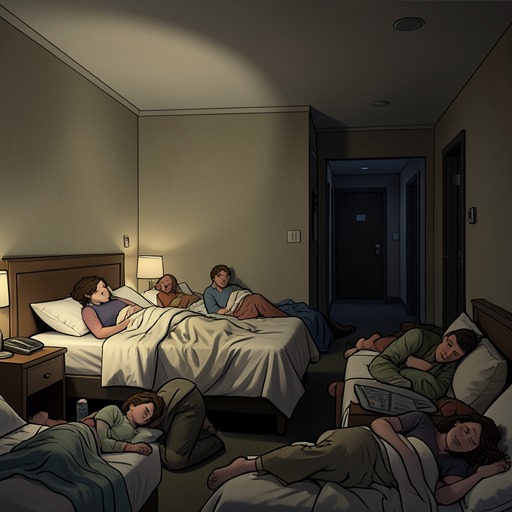
The expression’s promise is tested almost immediately. The narrator’s first air-raid experience in the new home is nearly the last, and the flat’s apparent advantages become secondary to the practical question of whether it can protect its residents. When the bombing starts, the air-raid shelter is inaccessible, so the residents of the flats gather on the ground floor of the block instead.
The ground floor becomes an improvised harbour within the threatened building. The narrator’s Father, drawing on the authority and discipline associated with his years as an Officer, orders everyone onto the floor with their hands over their ears. The residents comply without question. The action proves decisive: after the raid, shrapnel holes are found mostly at waist or head height, so anyone who had remained standing would probably have been struck.
This episode gives the expression a concrete, bodily meaning. The flat is not a guaranteed sanctuary, and the designated shelter cannot be reached, but the building still offers spaces and procedures through which survival becomes possible. Protection is assembled from whatever is available: a ground-floor gathering place, a remembered command, and immediate obedience. The family’s chosen “port” is therefore not safe in itself; it becomes safer through adaptation and discipline.
A Recurring Pattern of Improvised Safety
The proverb also illuminates the wider wartime geography of the memoir. Spaces change function according to immediate need. The Woodman Hotel is a family home and business, but its elevated bar also provides a view over the police station’s sash window, allowing the staff to see when the Sergeant puts on his helmet and to prepare for the licensing inspection. The field behind the police station becomes the training ground for the local Home Guard, whose young members drill seriously despite having only LDV armbands at first and broom handles in place of rifles.
The surrounding landscape likewise acquires military uses. The hills are patrolled at night by the Home Guard in case the enemy attempts to parachute into the area. A field near the hotel houses a battalion responsible for a searchlight aimed at German bombers, while the hotel kitchen becomes a place where the soldiers’ otherwise inedible rations are transformed into a proper meal. The Mother’s cooking is described as her contribution to the war effort, and the soldiers’ march to the hotel creates a temporary social refuge as well as a meal.
Across these episodes, safety and service are improvised rather than supplied in finished form. A hotel, a police station, a field, a kitchen, and a city flat are all redefined by wartime pressure. “Any Port in a Storm” captures that spatial transformation: the value of a place lies less in its original purpose than in what protection, cooperation, or practical help it can provide at a moment of crisis.
Narrative and Thematic Significance
As an expression, “Any Port in a Storm” condenses the memoir’s movement from ordinary domestic life into a world governed by emergency. It carries both reassurance and unease. The phrase offers a compact justification for choosing the Birmingham flat, yet the surrounding circumstances prevent it from sounding comfortably optimistic. The family leaves safety for danger, and the first raid demonstrates that the new refuge is precarious almost at once.
Its understated irony is characteristic of the wartime perspective presented here. A grand mansion flat can be less reassuring than a rural hotel; an inaccessible shelter can force residents onto a bare floor; a military unit can depend on a civilian kitchen for an edible meal. The proverb does not erase these contradictions. Instead, it gives them a common shape: in a storm, survival depends on recognizing usable shelter quickly, accepting its deficiencies, and making it function through collective action.
The expression therefore signifies more than the family’s relocation. It describes a whole wartime ethic of compromise, vigilance, and adaptation. The family’s chosen refuge is imperfect, but the danger makes imperfection tolerable; the air raid then proves that even an imperfect refuge may become the difference between life and death.