British Broadcasting Corporation
Pamela's WarThe British Broadcasting Corporation is a central communications institution in the wartime world of the narrative. Its broadcasts announce crisis, sustain morale, distribute practical advice, entertain exhausted listeners, and eventually expose the realities of Nazi persecution. Heard in the hotel’s public rooms and in private homes, the BBC becomes both a source of information and a daily mechanism through which a frightened population learns how to feel, endure, and belong.
News and the Coming of War
The BBC’s political authority is established at the moment when Neville Chamberlain announces that Germany has invaded Poland and that Britain is now at war with Germany. The declaration reaches the hotel on a Sunday morning, interrupting its ordinary routines: farm workers, businessmen, the chef, chambermaids, and the Wheeler family gather to listen in stunned silence. The broadcast turns an international crisis into an immediate communal experience. The hotel’s occupants do not merely receive news; they collectively absorb the knowledge that their lives have entered an entirely new historical condition.
The announcement also exposes the distance between political reassurance and lived reality. Earlier efforts to secure “peace in our time” have failed, and the optimistic response that the war will be over by Christmas is soon revealed as tragically mistaken. The narrative measures the failure of that hope against six Christmases of fear, deprivation, and shortages. In this setting, broadcasting does not simply report events: it gives public language to uncertainty, expectation, and the national demand for calmness and courage.
Churchill and National Morale
After Winston Churchill succeeds Chamberlain as Prime Minister, the BBC becomes the principal channel through which his leadership reaches the narrator and the wider population. Churchill is presented as the leader who recognized Hitler’s intentions before the outbreak of war and was vindicated when the conflict came. His speeches acquire unusual force because they arrive during a period when battles are being lost, London is enduring months of nightly bombing, and provincial cities are increasingly attacked.
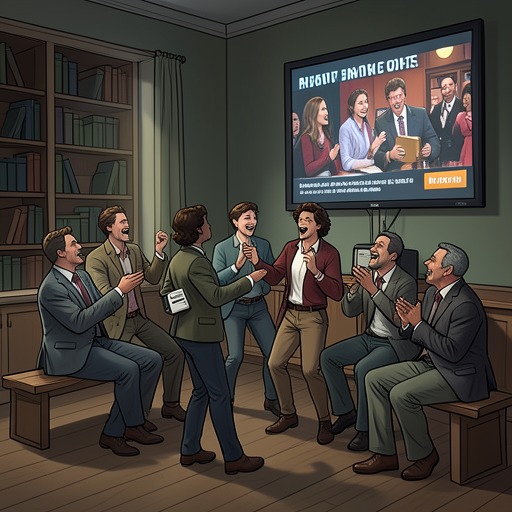
The effect of these broadcasts is shown through the hotel’s listening ritual. Whenever a speech is announced, the radiogram is turned to full volume and every room falls into a hushed silence. The audience listens with rapt attention, treating Churchill’s oratory as reassurance and inspiration when ordinary evidence offers little comfort. His cigar and two-finger Victory sign become recognizable public symbols, but the decisive instrument is his voice: through it, sacrifice is made intelligible as “blood, toil, tears and sweat,” and continued resistance becomes a collective obligation.
The BBC therefore helps create a wartime emotional community. Churchill’s words do not remove danger, explain away bereavement, or promise an easy victory. Instead, they prepare listeners to endure a war whose scale they can scarcely control. The commitment to fight on the beaches and in the hills, and never surrender, becomes part of the moral vocabulary by which the narrator understands both national courage and personal endurance.
Advice, Entertainment, and Everyday Survival
The BBC’s role extends beyond formal announcements and political speeches. Because local medium-wave broadcasts are abandoned for fear that transmitters could assist enemy direction-finding, listeners turn to the Home and Forces Service. This change demonstrates the practical constraints of wartime broadcasting, while the continued presence of radio shows how essential the medium has become despite those restrictions.
The Radio Doctor, Charles Hill, advises listeners how to remain healthy during difficult conditions. Such guidance gives the BBC a domestic and bodily function: the organization addresses not only citizens as members of a nation but also individuals trying to preserve health amid shortages, stress, and demanding work. Radio enters the intimate routines of wartime life, where survival depends on repeated small acts of knowledge and discipline.
Comedy and music are equally important. ITMA, starring Tommy Handley, supplies catchphrases that listeners repeat with gusto, while Hi Gang, presented by Ben Lyon and Bebe Daniels, offers laughter from performers who choose to remain in Britain rather than return to the safety of America. Music While You Work reaches factory floors over the noise of machinery, and Workers Playtime carries a touring variety show from factory to factory. The programs do not cancel hardship; they make hardship bearable by creating rhythm, companionship, and occasions for shared amusement.
The contrast with the radiogram’s unruly private use is revealing. One customer repeatedly selects “The Umbrella Man,” using the machine’s repeat button until the refrain becomes intolerable and the customer is expelled after its fifth playing. The same apparatus that carries national speeches and morale-building programs can also become a source of irritation within the hotel. Broadcasting thus exists between public service and everyday domestic friction, its power shaped by the habits and choices of listeners as much as by the institution’s official purpose.
War Reporting and the Limits of Knowledge
The BBC also brings the consequences of the war into public consciousness through journalism. Richard Dimbleby broadcasts live from Bergen Belsen after its liberation, reporting the inhumane conditions endured by thousands of prisoners, many of them Jewish. His account describes stolen possessions, systematic murder, gassing, starvation, unburied bodies, and survivors reduced to walking skeletons. For listeners, the report marks the collapse of any remaining veneer of civilization and reveals the murderous reality of the Nazi racial ideology and the Final Solution.
The narrative places this report beside the silences imposed elsewhere by war. Families hear only the briefest details about young men who vanish from the hotel’s circle, officially because information must not assist the enemy, though morale is also suspected to be at stake. In that context, the BBC’s report from Bergen Belsen carries an unusual moral weight. It breaks through distance and euphemism, making atrocity visible through testimony even when many other wartime losses remain unexplained.
Yet the broadcast does not make suffering fully knowable. Someone known to the family has seen the camp after liberation but cannot speak much about it because the memory is too terrible to share. Later film footage gives audiences another form of evidence, though it is shown only to those able to endure it. The BBC’s reporting therefore occupies a difficult space between revelation and incomprehension: it tells the public what happened, but the scale of the crime exceeds what words, images, or witnesses can completely contain.
Institutional and Narrative Significance
Within the book, the BBC links national history to personal memory. Its announcement of war begins the long emergency; its presentation of Churchill helps sustain confidence during bombing and military reversals; its health advice and entertainment accompany labor and scarcity; and its reporting from Bergen Belsen forces a confrontation with crimes committed in the name of a supposedly civilized state. The institution’s broadcasts repeatedly enter the narrator’s life through a concrete object, the radiogram, which turns public speech into a presence inside the hotel.
The BBC also helps explain the wartime spirit described in the narrative. Radio gives strangers a common set of voices, phrases, fears, and hopes. In a society where ordinary reserve is lowered and people offer one another lifts and assistance, shared listening contributes to the sense that the war is being endured together. The organization does not create solidarity by itself, but it supplies recurring occasions on which a dispersed population can hear the same news, laugh at the same programs, and respond to the same appeals.
Its significance is consequently double. The BBC is an instrument of national morale, operating within the pressures of wartime censorship and security, but it is also a vehicle through which concealed or distant realities eventually become public knowledge. The narrative remembers it not as an abstract broadcaster but as a voice-filled presence in rooms where people fall silent, laugh, worry, and attempt to imagine what will happen next.