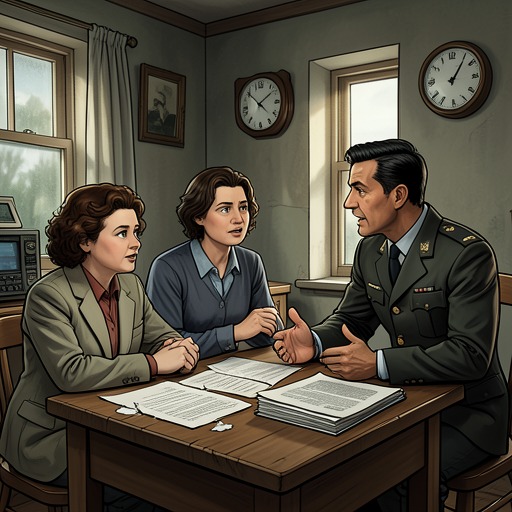
British wartime vehicle immobilisation rule
Pamela's WarThe British wartime vehicle immobilisation rule required vehicle owners to disarm their engines overnight by removing the rotor arm, preventing a potential invading army from starting and using civilian cars. Its appearance at The Woodman Hotel shows how wartime security entered an otherwise ordinary social space: a customer’s unlocked car and intact rotor arm became the basis for a police investigation, a court case, and a substantial financial threat to an unwitting motorist.
Purpose and Wartime Logic
The rule formed part of the wider British wartime effort to deny useful resources to an invader. The reasoning was practical and severe: if almost any key could start almost any engine, a car left ready for use could become transport for enemy forces. Removing the rotor arm transformed the vehicle from a convenient possession into a temporarily immobilised object, placing a small mechanical action between civilian property and military appropriation.
The measure also reveals the atmosphere of the period. The policeman’s duty at The Woodman Hotel was described as a nuisance to customers, but the narrative acknowledges that, with a war on, he had a job to do. The regulation therefore operated through an everyday tension rather than through spectacular combat. Ordinary drivers had to remember an unfamiliar technical precaution, while police officers were expected to inspect compliance late at night.
Enforcement at The Woodman Hotel
The hotel’s position directly opposite the police station made enforcement unusually visible. From the elevated bar, staff could see over the top sash window of the station and watch the Sergeant rise from his desk and put on his helmet. That visual signal normally warned the hotel that closing time was approaching, allowing the staff to cover the beer pulls with towels, lower the shutters, and persuade remaining customers to finish their drinks.
The same proximity that enabled the hotel to anticipate licensing inspections also made its car park readily available for scrutiny. One night, shortly after 11 o’clock, the policeman examined the vehicles outside the hotel. He found that a car belonging to Mr Hood had an unlocked near-side door and, more importantly, still had its engine rotor arm in place. The physical details mattered: the unlocked door suggested inadequate security, while the intact rotor arm meant that the vehicle remained capable of immediate use.
The Case of Mr Hood
The intact rotor arm was treated as a serious offence, carrying a possible fine of £100. Mr Hood was taken to court, where the wartime rule became a question not only of security but also of public knowledge. The magistrates accepted that, at this early stage of the war, the requirement to disarm car engines was not generally known. Their sympathy reduced the penalty to £10.
The reduced fine did not erase the rule’s coercive force. Mr Hood had not been presented as a saboteur or collaborator; he was a customer whose failure involved an unlocked door and a mechanical part that had been left where it normally belonged. The episode shows the law converting ignorance into liability, while the court’s leniency provides a limited correction to the harshness of the regulation. The threat of the maximum penalty remained part of the lesson even though the final punishment was smaller.
Security, Suspicion, and Everyday Space
The incident belongs to a broader pattern in which war recoded familiar places as instruments of observation and control. The bar was a workplace and family space, but it was also a lookout over the police station. The car park was a place for customers’ vehicles, yet after dark it became an inspection point. Nearby fields were used for Home Guard drills and night patrols, while a searchlight team’s rations were carried across the countryside to The Woodman Hotel kitchen. Civilian hospitality and military preparedness repeatedly occupied the same spaces.
This setting helps explain why the rule could feel both intrusive and reasonable. The policeman disrupted customers and threatened the hotel’s relaxed routine, but his inspection was connected to a genuine fear of invasion. Elsewhere, suspicion led to the detention of German residents after fears about curtains, a painted roof, and possible radio equipment at a nursing home. Against that background, the rotor-arm inspection appears as a smaller and more procedural expression of the same wartime logic: security depended on treating ordinary objects, movements, and omissions as potentially consequential.
Significance
The British wartime vehicle immobilisation rule made national defence depend on repeated private acts. No battlefield was required; a car outside a rural hotel, an unlocked door, and one unremoved rotor arm were enough to bring the machinery of enforcement into daily life. The rule’s significance lies in that scale. It demonstrates how the British wartime security system sought to prevent invasion by regulating the material habits of civilians, while the case of Mr Hood exposes the friction between emergency law and the uneven circulation of official knowledge.