Luftwaffe
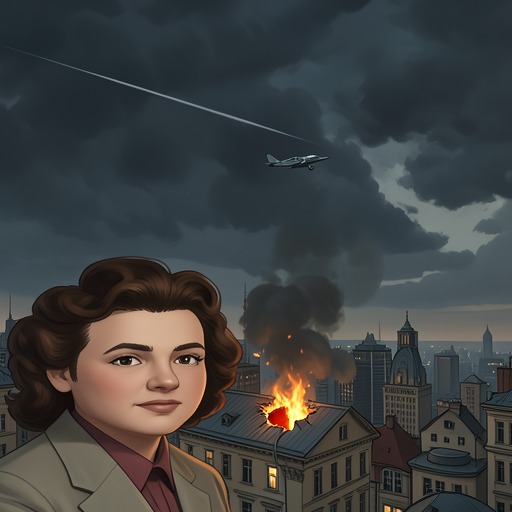
Pamela's WarThe Luftwaffe represents the aerial reach of Nazi Germany into civilian Britain. Its bombers transform distant military conflict into an everyday condition of uncertainty: aircraft pass over the countryside, Birmingham becomes a target, families seek inadequate shelter, and ordinary buildings acquire the defensive logic of wartime. The organization’s decisive significance lies in this conversion of the sky from open space into a source of surveillance, danger, and recurring fear.
A Force Heard and Inferred
The Luftwaffe first appears through the consequences of Germany’s wider aggression. After Neville Chamberlain announces that Germany has invaded Poland and that Britain is at war with Germany, the narrative looks ahead to six Christmases marked by fear, deprivation, and shortages. The Luftwaffe is part of the enemy power behind that prolonged ordeal, but it is not introduced through a formal account of its command structure or equipment. Instead, its identity is inferred from what civilians see, hear, and do: bombers overflying the area, nightly raids, shrapnel, disrupted movement, and the urgent search for protection.
This indirect presentation gives the Luftwaffe a particularly unsettling form. It is often absent from view even when its effects dominate the scene. The local authorities restrict broadcasts about bombing, referring only vaguely to an air raid in a Midlands town, both to conceal information from the public and to prevent the enemy from learning what has happened. Against this official reticence, broadcasts from Germany by William Joyce provide more detail than the British government is willing to share. The Luftwaffe therefore belongs not only to the physical theatre of bombing but also to a contested information environment in which civilians must measure danger through fragments, omissions, and enemy claims.
Dunkirk and the Threat from the Air
At Dunkirk, the Luftwaffe becomes the force that makes evacuation appear almost impossible. British troops and their Allies are trapped on the beaches of northern France, with the sea blocking their path ahead and German forces closing in behind. The narrative describes the men as sitting ducks for Luftwaffe pilots, exposed while waiting for rescue and threatened with destruction from above. The danger is not presented as an abstract strategic calculation: it is concentrated in the vulnerability of soldiers stranded on open beaches, where the aircraft can attack them at leisure.
The rescue of Tom and thousands of others does not erase the Luftwaffe’s role in the crisis. Rather, it throws that role into contrast with the courage of the small civilian flotilla that crosses the Channel. Fishing boats, leisure craft, and almost anything capable of floating carry troops away from the beaches despite the danger. Later remembered as the Dunkirk spirit, the rescue demonstrates how the Luftwaffe’s aerial threat helps produce a scene of improvised collective action. The enemy air force creates the emergency; ordinary people answer it with boats, risk, and persistence.
Bombers over the Home Front
The Luftwaffe’s overflights also determine the work of a battalion stationed in a field about half a mile from The Woodman Hotel. These young soldiers operate a searchlight, an important task because German bombers are passing over the area. Their military function is therefore connected to visibility: they attempt to locate or illuminate aircraft moving through the night sky, while the surrounding community remains exposed to the consequences of those flights.
The searchlight unit is poorly prepared for some of the less dramatic necessities of service. Its members struggle to cook their rations with basic equipment and little culinary experience, having only recently left homes where their mothers had handled the cooking. Marie Wheeler responds by offering the hotel kitchen. The soldiers bring a joint of meat to the hotel, where she prepares it; they then march across the field in single file, eat together at a large table, and consume drinks as well as food. The contrast is central to the Luftwaffe’s narrative presence: the aerial war produces a chain of practical civilian responses, and the hotel becomes a place where the consequences of enemy action are met through cooking, hospitality, and shared morale rather than through combat alone.
The same pressures bring the local Home Guard into being. The group, composed largely of young village men not yet old enough to join the armed forces, drills on the field behind the police station. Sidney Wheeler imposes military discipline through repeated commands, while the youths practise with Government-issue armbands before uniforms become available. Their weapons are scarce: broom handles substitute for rifles, and plans for a genuine emergency include shotguns, pistols left from the previous war, and pitchforks. They nevertheless patrol the Clent Hills at night in case the enemy attempts to parachute into the area. The Luftwaffe is not stated to be responsible for every imagined form of invasion, but its bombers make the possibility of attack from the air concrete enough to organize local life around vigilance.
Birmingham, Shelters, and Civilian Exposure
The Luftwaffe’s most extensive effect is felt in the bombing of Birmingham and its suburbs. The city’s factories produce aeroplanes, bombs, and guns, making Birmingham the third most bombed city in Britain, behind London and Hull. The public is not given the full measure of this danger by domestic broadcasts, which conceal the city’s identity, but the nightly bombings become terrifyingly regular. Those who can no longer endure the raids leave the city in cars, carrying blankets and thermos flasks, and sleep along country lanes when fuel and transport permit.
For those without that option, the Anderson shelter offers protection at a severe cost in comfort. Supplied in kit form by the Government, the corrugated-iron structure is covered with soil and intended to guard against nearby shrapnel, though it cannot withstand a direct hit. It is damp, noisy, and cold; despite drainage sumps, it may fill partly with water. Where there is no cellar, it can be the only alternative to the cupboard under the stairs. Later, the Morrison shelter provides an indoor option for households without gardens: a metal cage with a solid steel top, just large enough for an adult couple to lie side by side. These shelters reveal the Luftwaffe’s power not through a single battlefield scene but through the degradation and reorganization of domestic space. Gardens, rooms, stair cupboards, and country lanes are all recoded according to their distance from falling bombs.
That danger follows the family when The Woodman Hotel is abandoned. Suitcases are loaded into a car as the family moves from the relative safety of the countryside to a top-floor mansion flat roughly half a mile from Birmingham city centre. The new home is elegant and spacious, with high ceilings, cornicing, and views over Islington Row, but bombed-out buildings passed on the journey make its apparent security doubtful. The move is described through the bitter logic of taking any port in a storm: the flat is refuge only in comparison with worse alternatives, and its height and exposed urban position make the family newly vulnerable.
The Air Raid and Its Consequences
The first air raid at the new flat nearly becomes the narrator’s last experience. The designated shelter is inaccessible, so residents gather on the ground floor of the block when the bombing begins. Sidney Wheeler’s previous service as an officer returns as practical command: he orders everyone onto the floor with their hands over their ears. The residents obey without question, and the action saves their lives. When the raid ends, they inspect the shrapnel holes; most are at waist or head height, showing that anyone who had remained standing would probably have been struck.
This episode gives the Luftwaffe its clearest human scale. The attack is never turned into a spectacle of aircraft or explosions; its reality is measured by the holes left in a building and by the difference between standing and lying down. The force’s power is therefore both immense and impersonal. It can make an urban home lethal, yet survival may depend on a command issued in seconds, collective obedience, and knowledge acquired from previous military experience.
The organization’s broader consequence is the militarization of ordinary attention. The police station opposite the hotel is watched through the bar’s elevated position; Home Guard drills take place behind it; searchlights scan the skies; radio broadcasts are turned up for Churchill’s speeches and wartime programmes; families calculate whether a shelter, a car, or a country lane offers the better chance of survival. Although the narrative is filled with shortages and fear, it also records a communal response: cooking for soldiers, patrolling hills, sharing lifts, and maintaining morale through music and humour. The Luftwaffe thus functions as a persistent pressure on the Home Front, an unseen enemy whose attacks reorganize geography, law, work, family movement, and the meaning of shelter.