Quinton
Pamela's WarQuinton is presented as a place of wartime refuge rather than as a destination in its own right. After the Wheeler family is bombed out of a top-floor flat near Birmingham city centre, friends of Pamela Wheeler Fellows’s parents, Jim and Renee Parkes, take them into the cramped accommodation above their café, allowing the family to camp there for several weeks. Quinton therefore marks the point at which a threatened family’s movement away from danger becomes homelessness, then temporary shelter through friendship.
Setting and Wartime Geography
Quinton belongs to the network of rural and suburban spaces through which the wartime story moves. The Woodman Hotel lies in a countryside setting opposite a lane leading towards the hills, while the Birmingham flat represents a move into increasingly dangerous urban territory. Quinton appears after that movement has failed: the family had left the relative safety of the countryside for an elegant top-floor mansion flat about half a mile from Birmingham city centre, only to find the air-raid shelter inaccessible when bombing began.
The contrast gives Quinton a precise narrative function. The countryside hotel had served simultaneously as home, business, observation point, and local military setting. From its elevated bar, the family could watch the police station opposite; its grounds and surrounding hills were patrolled by the local Home Guard; and its kitchen fed soldiers assigned to a nearby searchlight. Quinton, by contrast, is not a controlled household or a secure military position. It is a compressed refuge above a café, made available because ordinary domestic arrangements have been shattered.
The Café as Refuge
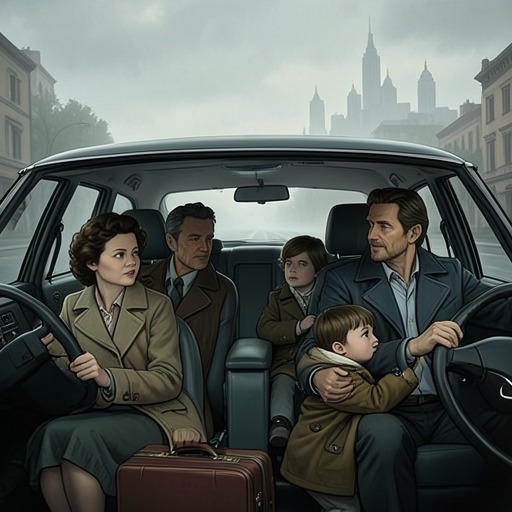
The family reaches Quinton after the bombing has destroyed the flat in which they had spent barely a night. Their possessions are reduced to what can be loaded into Mother’s little car, which remarkably survives despite being parked close to the damaged building. With the family homeless, Jim and Renee Parkes receive them into the tiny accommodation above their café.
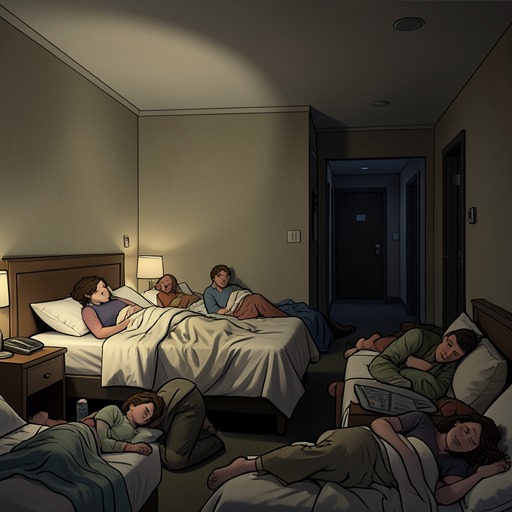
The arrangement is materially uncomfortable but socially generous. The Parkeses manage to accommodate the displaced family for a few weeks, turning a commercial premises into a provisional home. Quinton thus embodies the wartime conversion of public and private spaces: the café is a place of business during ordinary conditions, but in crisis its upper rooms become sleeping quarters and a protective household. The narrowness of the accommodation emphasizes both the family’s loss and the practical value of being taken in.
People and Practical Survival
Jim and Renee Parkes are identified as friends of Pamela Wheeler Fellows’s parents, and their action gives Quinton its human significance. The family’s survival does not depend solely on formal air-raid precautions or official protection; it also depends on a local network capable of receiving people made homeless by bombing. Their hospitality supplies what the damaged flat and inaccessible shelter could not: immediate physical cover and a place to remain while the family’s next step is uncertain.
Jim’s response to wartime shortages reinforces the setting’s atmosphere of improvised adaptation. An inventor and entrepreneur, he cannot obtain petrol for business and leisure, so he acquires a pony and trap to carry himself and Renee to the pub and the shops. The vehicle is more than an eccentric detail. It shows how civilian life in Quinton is reorganized around scarcity, with mobility maintained through whatever substitute remains available. The pony and trap belongs to the same practical world as the café accommodation: both are makeshift solutions that keep ordinary life functioning after war has made ordinary resources unavailable.
Narrative Significance
Quinton is the story’s clearest location of aftermath. The air raid has already occurred; the immediate danger has passed, but its consequences remain in the family’s homelessness, lost possessions, and dependence on friends. The move exposes the fragility of the new home that had seemed elegant and secure, while the modest café above which the family shelters proves more dependable than the spacious flat.
The place also broadens the book’s picture of the wartime home front. Elsewhere, domestic and commercial spaces are mobilized for surveillance, military training, feeding troops, or protection from bombing. In Quinton, a café becomes a refuge for civilians, and a pony and trap replaces petrol-driven transport. These changes show war not only as destruction but as a force that continually reassigns the meaning of places. Quinton matters because it turns displacement into a temporary community: after the family loses a home almost as soon as it acquires one, friendship creates the shelter that official arrangements failed to provide.