Short Stirling
Pamela's WarThe Short Stirling is presented as both an object of wonder and an instrument of attritional war. Its low passage above the hotel allows Pamela Wheeler Fellows to see the aircrew as individual young men, but the bomber’s later loss, carrying Max to his death, converts that vivid encounter into part of the generation of airmen who vanish from ordinary life.
Appearance and Immediate Effect
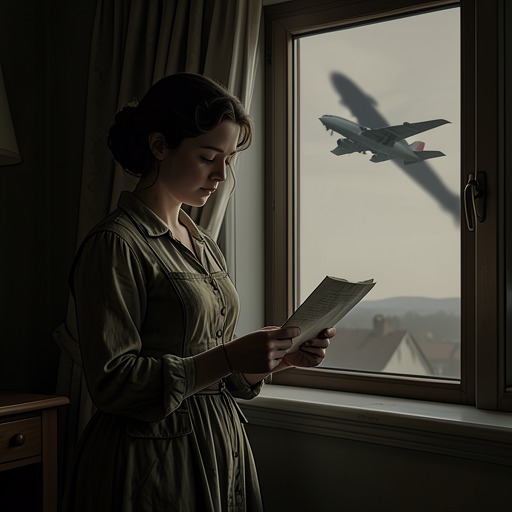
One Sunday morning, the hotel building begins to vibrate as a Short Stirling approaches almost level with the chimneys. The noise is phenomenal, and the aircraft flies so low that Pamela Wheeler Fellows can clearly see the faces of the pilot and crew. The machine is therefore not described at a distant scale as an anonymous aircraft crossing the sky; it becomes an overwhelming physical presence that enters the hotel’s immediate social world.
Pamela Wheeler Fellows runs out onto the car park, where the crew wave to her and she waves back. The exchange gives the bomber an unexpectedly personal charge. Its engines, height, and danger produce spectacle, while the wave creates a fleeting reciprocity between the people inside the aircraft and the young woman watching from below. The scene’s excitement depends on that tension: the aircraft is a military weapon, but for a moment it behaves in the narrative like a visitor acknowledging someone at the hotel.
The Low-Flying Incident
The flight is not harmlessly admired by everyone. Pamela Wheeler Fellows’s Father can also see who has carried out the foolhardy action and identifies the main culprit as the pilot, Max. He demands an apology and later obtains one, making the incident a small but definite confrontation between military daring and domestic authority. The bomber’s presence thus triggers consequences on the ground: the crew’s gesture toward Pamela Wheeler Fellows becomes an act for which its pilot must answer.
Pamela Wheeler Fellows says that she gets the blame. Later, an explanation is offered that the low-flying exercise may have been preparation for a raid intended to destroy a German dam, although she does not think her Father is convinced. The proposed military rationale remains uncertain within the account. What is clear is the contrast between the official-sounding explanation and the immediate appearance of the flight as reckless display: the bomber may have been involved in serious preparation, but its proximity to the hotel also makes the personal and the strategic impossible to separate.
From Spectacle to Loss
The Short Stirling’s meaning changes sharply when Max later loses his life in his Stirling bomber during a raid over Germany. The same type of aircraft associated with the thrilling low pass is now bound to death, and the earlier wave acquires a grim afterimage. Max is no longer simply the pilot identified by Pamela Wheeler Fellows’s Father and compelled to apologize; he becomes one of the young men whom the war removes from the hotel’s orbit.
This change is intensified by the wider fate of the servicemen who visit the hotel. The group begins with twenty young men who come for a drink, but its number diminishes week by week as members disappear, reported only as missing or dead. The Short Stirling therefore stands at the point where visible presence gives way to enforced absence. Its flight can be watched, its crew’s faces recognized, and its pilot named; its destruction leaves behind only the knowledge that Max is among those never seen again.
Narrative Significance
The bomber embodies the book’s movement between wartime exhilaration and bereavement. Its low flight is rendered as a scene of vibration, phenomenal noise, visible faces, and exchanged waves, while its later fate belongs to the compressed, indistinct language of military loss. The contrast shows how quickly a machine that seems to promise adventure can reveal the narrow margin separating youthful romance from death.
The Short Stirling also gives physical form to the precariousness of the airmen’s lives. Only a quarter of bomber crews survive, and the bomber’s destruction makes that statistic emotionally legible through Max rather than leaving it as an impersonal figure. The aircraft is consequently more than a background detail of the air war: it is the vehicle of an encounter, the source of a disciplinary dispute, and the means by which one of the hotel’s young visitors is carried away permanently.