World War II
Pamela's WarWorld War II is the decisive historical force in Pamela Wheeler Fellows’s story: it takes a fifteen-year-old living at The Woodman Hotel and, in little more than five years, turns her into a married woman with a baby and an absent husband posted overseas. The war is experienced not only as invasion, bombing, military loss, and eventual victory, but as a pressure that reorganizes family life, work, love, space, morality, and emotion. Its ending brings celebration, yet leaves survivors changed and peace itself strangely difficult to inhabit.
Declaration and Immediate Stakes
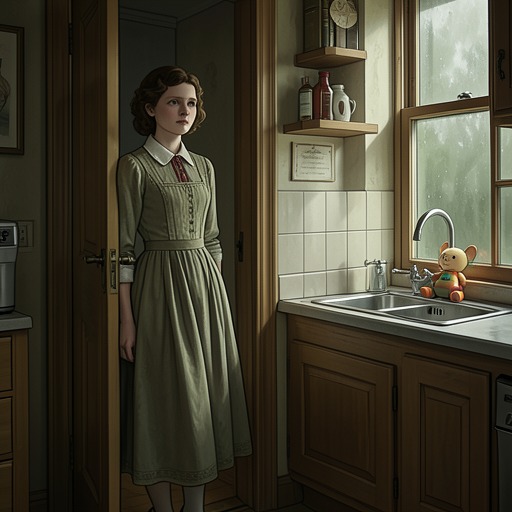
World War II enters Pamela’s life at The Woodman Hotel when she is just over fifteen. On the day war is declared, her father loads a gun with three bullets—one for Pamela, one for his wife, and one for himself—and is prepared to kill his family if German forces invade. Pamela accepts without protest that her father knows best. The episode establishes the war’s first moral atmosphere: protection is inseparable from lethal readiness, and domestic safety depends upon decisions made under an imagined national catastrophe.
The declaration becomes a public event inside the hotel. Farm workers, businessmen, the chef, chambermaids, and the Wheeler family gather to hear Neville Chamberlain announce that Germany has invaded Poland and that Britain is at war with Germany. The room receives the news in stunned silence, followed by an attempted joke that the conflict will be over by Christmas. Instead, six Christmases of fear, deprivation, and shortages lie ahead. The contrast between the casual prediction and the long reality gives the war its first major reversal: optimism is not destroyed at once, but is forced to endure against accumulating evidence.
The Home Front as a Reorganized World
The war changes the meaning of ordinary places. The lane opposite The Woodman Hotel leads toward properties, a nursing home, vegetable gardens, fields, and the wooded Clent Hills; the rural setting seems remote, yet it becomes part of the national security landscape. A group of men repeatedly arrives at the hotel, orders drinks in English, and then speaks quietly in a language that Pamela’s father recognizes as German rather than French. Suspicion enters the bar through sound, proximity, and uncertainty, showing how the fear of the enemy within could turn familiar civilian spaces into places of observation.
The police station opposite the hotel also becomes part of its daily wartime economy. Because the licensing laws prohibit selling alcohol outside permitted hours, the hotel’s livelihood depends on avoiding detection. Pamela can see over the top sash window of the station from the elevated bar, and the Sergeant’s act of putting on his helmet signals that an inspection is coming. The staff then call time, cover the beer pulls with towels, pull down the shutters, and hurry customers toward compliance. The arrangement works for months, blurring the boundary between lawful regulation and practical evasion while making surveillance an ordinary feature of hospitality.
The hotel’s field behind the police station is likewise transformed. It was once the place where Pamela played cricket; during the war it becomes the drill ground for a local Home Guard made up largely of young men from the village. At first they wear armbands marked LDV, mocked as “Look, Duck & Vanish,” before the force is renamed the Home Guard. Pamela hears her father’s commands through the hotel’s open windows as he imposes discipline on youths who initially lack uniforms, weapons, and military experience. Broom handles substitute for rifles, while shotguns, pistols, pitchforks, and eventually rifles supplied by the public and America supplement their inadequate equipment. Despite these deficiencies, the men patrol the hills at night against the possibility of enemy parachutists, converting improvised defense into a serious communal duty.
The same pattern of civilian contribution appears when young soldiers operating a searchlight half a mile from the hotel cannot cook their rations. Pamela’s mother offers to prepare their joints of meat in the hotel kitchen if they deliver the food and return at mealtime. The soldiers march across the field in single file, eat around a large table, and drink at the licensed premises. Her mother calls this her contribution to the war effort: domestic skill becomes national service, and the hotel functions simultaneously as business, family workplace, social center, and informal support institution.
Violence, Love, and Personal Loss
The wider war becomes terrifyingly visible when Coventry is bombed on 14 November 1940. From forty miles away, the family sees the glow of the fires lighting the night sky. The attack lasts for hours as waves of bombers strike the medieval city, and the destruction is described as an attempt to break the population’s spirit by attacking both people and architectural heritage. Similar devastation alters Bath, Canterbury, York, Norwich, and Exeter. Evacuation separates families, and those separations can damage relationships long after the immediate danger has passed.
For Pamela, wartime danger is intertwined with the discovery of love. Her father’s rules become stricter as young servicemen frequent the hotel: she may not walk onto the car park with them and must never be alone with a young man. David, a twenty-four-year-old Royal Air Force man, becomes a regular visitor to her cocktail bar and then her admirer. Pamela, seventeen at the time, arranges to attend a dance with him while concealing the plan from her father by claiming that she is going out with Gloria. After she serves David and his friends a meal upstairs, the tables are pushed back and the room becomes a dance floor. At the end of the evening, she is allowed onto the car park to say goodbye; she and David kiss, and she believes that he is the man she will marry.
That certainty is overturned without warning. On 5 September 1941, while attending friends’ wedding in Dudley with Gloria, Pamela is seized by an overwhelming sense of doom during the service. The feeling makes her physically ill, and she tells Gloria that David has just died, although she cannot explain how she knows. Her foreboding proves correct. The emotional movement is from romantic futurity to deathly knowledge: the imagined lifelong marriage collapses into an absence that cannot be argued away. Pamela believes her heart will break, while David’s laughing smile and carefree manner remain fixed in memory.
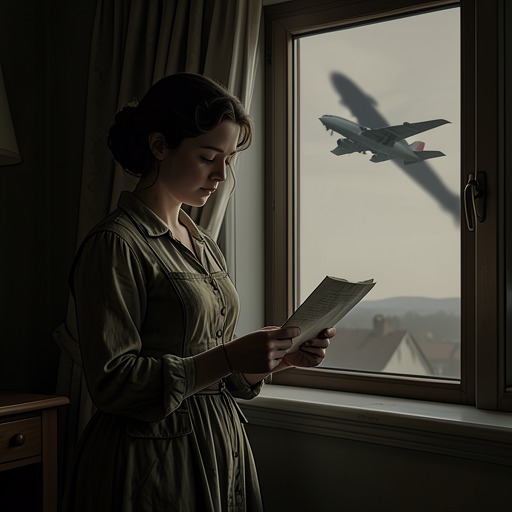
The losses accumulate around the hotel. Shortly after David’s death, Max, the pilot whose low-flying Stirling bomber had once prompted Pamela’s father to demand an apology, is killed on a raid over Germany. Of the original group of twenty young men who come to the hotel for drinks, the number diminishes week by week. Brief official information identifies them as missing or dead, while restrictions on discussing the circumstances make the uncertainty worse. War therefore reaches Pamela through repeated disappearance rather than one isolated bereavement; the social world is emptied one young man at a time.
Survival Under Bombing and Strain
The family eventually leaves The Woodman Hotel for a top-floor mansion flat about half a mile from Birmingham city centre. The move abandons the relative safety of the countryside for a city experiencing increasingly frequent bombing. Their new apartment is elegant, spacious, and newly furnished, with views over Islington Row, but the journey past bombed-out buildings makes the apparent comfort precarious. The relocation is not simply a change of address: the family carries its domestic life into a more exposed urban battlefield.
Pamela’s first air raid in the new home nearly becomes her last. When the shelter is inaccessible, residents gather on the ground floor. Her father, drawing on his experience as an officer, orders everyone onto the floor with hands over their ears. They obey, and the position saves their lives. Afterward, shrapnel holes are found mostly at waist or head height, confirming that anyone standing would probably have been struck. The scene gives physical proof of how survival can depend on a command, a posture, and a few seconds of disciplined obedience.
Yet the war also produces forms of collective emotional resistance. Radio broadcasts, including Churchill’s speeches and the health advice of Charles Hill, help maintain morale after local medium-wave transmissions are abandoned for fear that their signals could assist enemy direction finding. Comedy programmes and music keep workers singing and laughing amid factory noise, while touring variety shows bring entertainment into places of production. The war’s “wartime spirit” is represented through strangers speaking like old friends, offering lifts, and helping people they have never met. Shared danger lowers customary reserve and turns emotional solidarity into a practical survival mechanism.
Victory and the Unfinished Aftermath
Victory in Europe produces street parties, bunting, Union Jacks, trestle tables, sandwiches, trifles, jelly, cake, fireworks, and bonfires. Hoarded food is released to stretch rationed supplies into a communal feast. But celebration is uneven: at John Fellows’s parents’ home, anxiety over Rex Fellows, missing after fighting in Europe, overwhelms the general rejoicing. A telegram arrives, the form of communication feared by wartime families because it commonly announces that a loved one is missing or dead. The suspense is reversed the next day when Rex returns safely, yet the years of fear have already damaged his mother’s health.
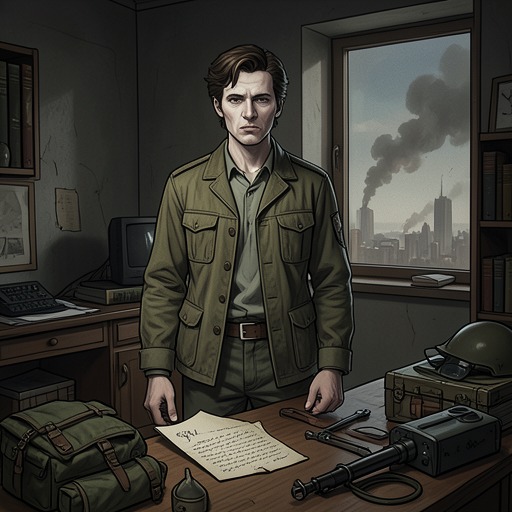
The war does not end in Europe at the same moment as it ends everywhere. Fighting continues in the East until the United States drops two atomic bombs in August 1945 and Japan surrenders. Victory over Japan is declared on 15 August, three days before Pamela’s twenty-first birthday. The end of the conflict also frees Geoff from three and a half years of captivity. He returns alive but stick-thin and hollow-eyed, with health broken by ill treatment; quarantine in America prolongs his journey, and years of treatment are needed before he approaches normal health.
The final value shift is therefore deliberately complex. Freedom and survival replace wartime terror, but victory cannot restore what has been lost. Pamela recognizes that those who survive are lucky, while their lives have nevertheless been changed forever. Peace feels odd after so long under threat, and the euphoria fades into practical difficulties: houses are scarce and jobs are hard to find. World War II ends as a military struggle, but its consequences continue in bodies, marriages, families, memories, and the uneasy transition from organized emergency to an uncertain peace.