the 1930s
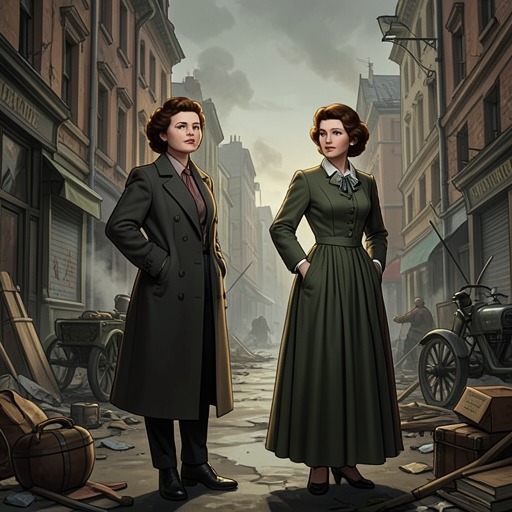
Pamela's Warthe 1930s occupy the book’s remembered threshold between an apparently settled social world and the wartime Britain that follows. They are evoked through The Woodman Hotel at Clent in its prime: freshly decorated, newly carpeted, crowded with customers drinking, smoking, laughing, and living, while dance music plays on the Radiogram. Yet this abundance is already shadowed by retrospective knowledge. The hotel will become a family home, a workplace, an observation point, a refuge, and finally a place left behind; the period’s apparent permanence survives only as memory.
A World at Its Prime
the 1930s are represented less as an abstract decade than as a lived environment. The Woodman Hotel is full of movement and sociability, and Pamela Wheeler Fellows can still remember its heyday decades later. Her recollection gives the decade a material texture: decoration, carpets, drink, tobacco, music, laughter, and customers whose lives seem to remain in the room as a ghostly presence. The later visit to the renamed French Hen exposes the distance between the remembered building and its altered present, while the hotel’s transformation makes the 1930s feel like a vanished social order rather than merely an earlier date.
The decade also contains the emotional beginning of Pamela Wheeler Fellows’s wartime story. Behind the hotel, in the car park, she saw David for the last time; it was also where they first and last kissed. David was the boy she loved and hoped to marry, one of the young airmen whose lives would be cut short by war. The memory therefore gives the period a double significance: it preserves a world before loss, but it is narrated by someone who knows exactly what that world could not protect. The personal love story becomes inseparable from the fate of a generation.
Places Before Their Wartime Reassignment
The geography surrounding The Woodman Hotel still belongs to ordinary rural life. A lane opposite the hotel leads towards the hills, passing properties that include a large house understood to be operating as a nursing home. Its extensive grounds produce vegetables for local sale; fields lie in front, while the rear of the grounds meets the wooded Clent Hills. This landscape establishes the decade’s mixture of hospitality, domestic care, agriculture, and local commerce before military necessity gives familiar spaces new meanings.
The same physical arrangement later becomes part of wartime observation and defence. From the elevated bar, Pamela Wheeler Fellows can see over the top sash window of the police station opposite. The window turns the hotel into a place of surveillance: when the Sergeant rises and puts on his helmet, the bar receives warning that enforcement is approaching, allowing the staff to call time, cover the beer pulls with towels, pull down the shutters, and hurry customers to finish drinking. The episode shows how a pre-war social space retains its old function while acquiring a new, improvised relationship to authority.
The field behind the police station, remembered as the place where Pamela Wheeler Fellows once played cricket, later becomes the drill ground for the local Home Guard. The continuity is revealing. The same landscape that had held youthful recreation now carries shouted commands, discipline, and the possibility of invasion. Likewise, the nearby fields accommodate a searchlight battalion, whose young soldiers bring their rations to the hotel kitchen so Pamela’s Mother can cook them a proper meal. These changes do not erase the older world; they layer military labour and domestic care over it.
From Consumption to Constraint
The remembered freedom of the 1930s is sharply contrasted with wartime restrictions. Clothing purchases made before the full effect of rationing is understood become a wardrobe that must last for the duration of the war and beyond. Once coupons are introduced, shopping has to become cautious; a winter coat will eventually cost an entire year’s clothing coupons. The contrast makes the decade’s consumer habits significant not because they are luxurious in themselves, but because they mark the last moment before everyday choice is governed by shortage.
This alteration reaches beyond clothing. Travel and access to places are also transformed. As fewer customers can drive and fewer live within walking distance, the hotel’s diminished clientele receives unusually close attention. The old pattern of movement—customers arriving, drinking, and returning home—has been narrowed by wartime conditions. The hotel survives by adapting its attention to scarcity, while the decade before the war remains associated with a fuller circulation of people, goods, and leisure.
Memory Against Historical Ruin
Retrospective narration makes the 1930s a standard against which wartime destruction is measured. When Coventry is bombed on 14 November 1940, the fires can be seen from forty miles away; the medieval city burns for hours beneath successive waves of bombers. The attack, like the destruction of Bath, Canterbury, York, Norwich, and Exeter, targets both people and cherished architectural heritage. The remembered hotel’s lively rooms therefore stand in implicit contrast to cities whose buildings and communities are violently altered.
The decade’s emotional afterlife is equally important. David’s death is not immediately witnessed or fully explained; Pamela feels an overwhelming foreboding during a wedding in Dudley on 5 September 1941 and becomes certain that he has died. Her grief later reaches the conviction that her heart may break, while the young men who once arrived for drinks disappear one by one. The original group of twenty is reduced week by week, and official silence about whether the missing are dead makes the losses more terrible. The 1930s thus return not as uncomplicated nostalgia but as the last visible shape of lives that war will progressively remove.
A Vanished Decade, A Continuing Social Feeling
the 1930s also supply the background against which wartime solidarity becomes legible. During the war, music, humour, radio broadcasts, and shared hardship help people endure shortages and deprivation. Strangers speak like old friends, offer lifts, and lower the reserve that ordinarily separates them. The later wartime spirit is not presented as a replacement for the earlier community so much as a transformed version of its social energy: the hotel’s drinking, conversation, and music survive in altered forms as mutual assistance, improvised meals, public broadcasts, and collective endurance.
The contrast reaches its widest scale on VE-Day, when street parties fill the country with trestle tables, bunting, Union Jacks, sandwiches, trifles, jelly, cake, fireworks, and bonfires. Hoarded food is brought out to make a communal feast. Yet even this public joy carries the decade’s defining undertow of absence: at John Fellows’s parents’ home, the family cannot celebrate freely because Rex Fellows remains missing. The festive nation and the anxious household occupy the same historical moment. In this structure of recollection, the 1930s signify not simply peace before the Second World War, but the remembered world whose objects, places, habits, and affections make both wartime loss and postwar celebration intelligible.