Andrew Glasson
Panic RoomAndrew Glasson is the father of Jane Glasson, who vanished in June 1996, and a widower whose family home preserves the traces of a life abruptly interrupted. His frailty and lasting uncertainty give the search for Jane its human cost: Blake wants to find out what happened partly because Andrew should not be left without an answer, yet the eventual discovery that Jane may be alive complicates the assumption that an answer is something her father is entitled to receive.
Identity and Background
Andrew Glasson lives in a sizeable art deco villa on the main road into Helston. When Don Challenor visits, the house is still arranged around the domestic help Blake has provided since her departure from Wortalleth West. Don wonders whether Andrew is content with that arrangement, and recognizes that Fran Revell may have hoped for a more direct solution to the problem of Blake’s living situation. For Don, finding Blake another place to live would also remove her from the reach of Amos French and Zlenko.
That threat is not abstract. Don has searched the house for signs of intrusion and found almost none, but notices that a filing cabinet in Andrew’s study, previously locked, is now unlocked. French and Zlenko seem able to enter and leave without leaving a clear trace. Don’s protective response is to seek safer housing for Blake, while concealing from her that she may already be within their orbit. Andrew is therefore encountered within a private domestic space that has become vulnerable to forces he may not know are operating around it.
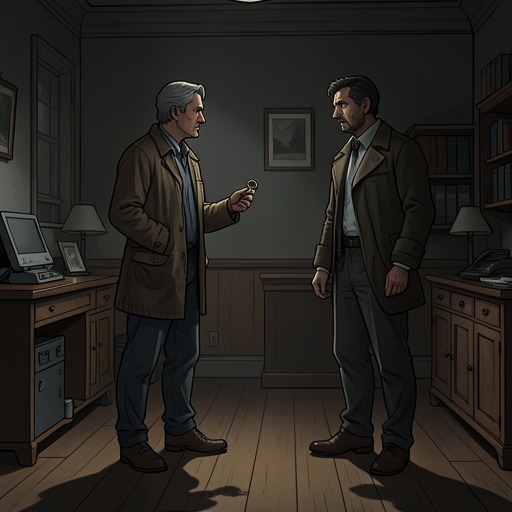
Andrew himself appears physically exhausted. He invites Don into the conservatory, where large potted plants crowd the hot, heavy air. The effort of moving leaves him needing several inhalations from his nebulizer before he can continue the conversation. His weary nods and the faltering pace of his speech establish a man with limited physical reserves; the evidence identifies his reliance on the nebulizer but does not specify a diagnosis.
Jane’s Disappearance and the Family’s Loss
A small photograph on the glass-topped wicker table gives Don a more intimate view of the family. In its silver frame, two fair-haired girls in their early teens smile at the camera. Andrew identifies Muriel on the left and Jane on the right. The image makes the absence at the centre of his life visible: Jane is not merely a name in an old mystery but one of two children preserved together in a sun-faded photograph.
Andrew tells Don that no one he knows has seen Jane for twenty-two years. She disappeared in June 1996, and he insists on the plainness of what happened: she vanished without a trace. The distinction is important to the investigation. At this stage, there is no explanation to offer, only a long interval without reliable news. Don responds with sympathy, while Andrew’s account makes clear that the uncertainty has persisted for decades.
The loss is intensified by the death of Andrew’s wife. Holly Walsh, who stayed with the Glasson family during school holidays and university vacations, later says Jane’s disappearance must eat away at her father, particularly since his wife died. Holly remembers the family as lovely people, while Anna Marchant remarks that Muriel does not sound lovely. Holly answers by placing that judgment against the difficult comparison of having a younger sister as beautiful and intelligent as Jane. The recollection supplies a complicated glimpse of the family’s history without explaining Jane’s decision to leave.
The Lead Andrew Gives Blake
Before Don can leave, Andrew asks him to remain and carry a message to Blake. The request concerns Jane: Blake should look up Holly Walsh on Facebook, using Holly’s full name, Holly M. C. Walsh. Andrew does not explain the significance of this lead in the available account. Its importance lies in the action itself: a father whose daughter has been absent for years directs the investigation toward someone with a personal connection to her.
Holly later says she has been thinking about Jane’s father since Don contacted her. She believes they should do everything possible for him, although she worries Anna would see further disclosure as risking Holly’s supply of Ditrimantelline. Holly downplays what she knows and says it may have no connection to Jane, but suggests that Don and Blake investigate. The lead thus moves through a chain of care and hesitation: Andrew points Blake toward Holly; Holly chooses to share a possible clue despite the risk she perceives; and the search continues without any guarantee that the information will resolve the disappearance.
Blake, Don, and the Search for an Answer
Blake’s reason for helping Andrew is explicit. When questioned by Keith Perkins, she says that her mother died without knowing what happened to Jane, and she does not want Andrew to die without knowing either. She distinguishes that concern from paid work: not everybody has to be paid to do something. Her commitment makes Andrew’s unresolved loss one of the moral grounds for her investigation, even though Andrew is not the person conducting it.
Don’s connection to the case begins more practically. He went to Cornwall to value a house near Mullion for a quick sale; the property technically belongs to Mona Harkness, and its disposal is part of her divorce settlement. During that work he met Blake. The house valuation brings Don into Blake’s world, but his visit to Andrew and subsequent efforts to find Blake a safe home show how the professional assignment becomes entangled with personal responsibility and danger.
The search eventually produces a claim Andrew cannot yet use as proof. Gareth Lawler is certain he saw Jane alive, but has no evidence to give Blake. She refuses to tell Andrew that Jane is alive without proof. This restraint preserves the difference between hope and knowledge: after decades of absence, an unsupported assurance could not settle the question for him.
The Unresolved Claim on Jane’s Life
As Blake prepares to pursue Jane, Don challenges her stated purpose. He argues that if Jane is living in Switzerland under a false name and working for Harkness Pharmaceuticals, that choice may be hers. Blake answers that the matter is about more than Jane, but does not reduce her determination to Andrew’s need for an explanation. Their exchange exposes the tension at the heart of his place in the story: the desire to relieve a father’s uncertainty meets the possibility that his daughter deliberately withdrew from her former life.
When Blake finally confronts Jane, she is using the name Astrid Townsend. Blake says Jane walked away from her old life twenty-two years earlier and asks why, hoping to explain the decision to her father. Jane replies that people are free to lead their lives as they choose. Blake recognizes the force of that objection even as she continues to ask for the truth. Andrew’s importance therefore rests not on a confirmed reunion or a resolved account of Jane’s motives, but on the enduring human question that drives the search: whether finding out what happened can bring comfort without overriding the missing person’s choice.