Anna Marchant
Panic RoomAnna Marchant is Holly Walsh’s partner and carer, and her role in the investigation turns on a difficult balance: protecting Holly from risks she believes the inquiry could create while deciding how much of the truth to disclose. First encountered at Holly’s home in Furzelands, Anna appears brisk, welcoming, and watchful. Her guardedness initially makes her an obstacle to Don Challenor and Blake, but she ultimately helps distinguish Jane Glasson from the anonymous woman whose money supports Holly’s treatment.
Identity and First Impression
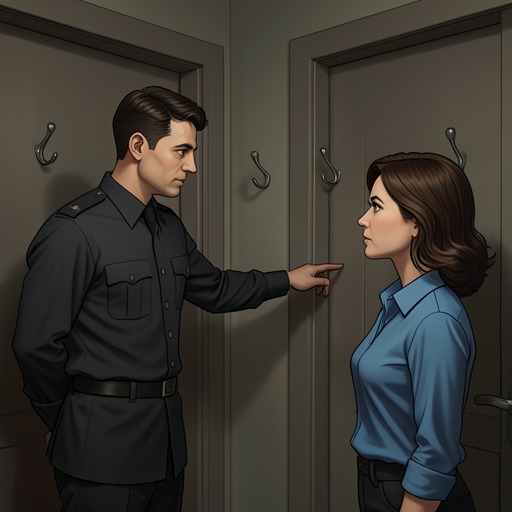
Anna meets Don and Blake when they arrive at Holly’s home in Furzelands, a modern bungalow on the outskirts of Brockenhurst. The visitors are expected. Anna comes out to greet them and is introduced as Holly’s partner and carer. Blake notices her slim build, bobbed fair hair, neat clothes, brisk manner, and tight-mouthed expression. The description of Anna moving with striking ease is Blake’s immediate observation, made against the expectation that Holly’s multiple sclerosis would shape the household; it does not establish anything about Anna’s own health or about the daily realities of Holly’s condition.
Anna’s welcome is friendly, but Blake senses brittleness beneath it and suspects she fears that the visitors may upset Holly or stir up trouble. That suspicion belongs to Blake’s limited first-person view of the meeting, not to an independent account of Anna’s thoughts. Blake recognizes that she does not share Anna’s experience of living with someone with multiple sclerosis and chooses to give her the benefit of the doubt. The scene therefore introduces Anna through both her practical role in Holly’s care and a narrator who is alert to, but not certain of, her motives.
Protecting Holly and Controlling the Inquiry
Anna’s caution becomes explicit when she explains why she had not already told Don and Blake what she knew. She says she would have denied the information in Holly’s best interests, arguing that a positive outlook matters almost as much to Holly’s welfare as the Ditrimantelline regime. For Anna, the investigation is not a detached search for Jane’s whereabouts: its consequences might reach Holly through the treatment on which she depends. Her resistance is presented as a protective judgment, even as it restricts what the investigators can learn.
After hearing Holly’s certainty that the anonymous donor has nothing to do with Jane, Blake refuses to treat that certainty as proof. Anna studies Blake before offering a little more information, saying it will remove all doubt. She asks Don and Blake to meet her an hour later. The pause before this offer gives her disclosure a deliberative quality: she has weighed whether to speak, rather than simply yielding to the investigators’ questions. Her decision does not erase her concern for Holly; it is made within that concern.
The Benefactor and Her Account
At the later meeting, Anna identifies the donor as Luscinia and recounts meeting her in a coffee shop at O’Hare Airport. According to Anna, Luscinia is an Asian American woman in her mid-thirties, not Jane Glasson. She inherited a fortune from her father and uses some of it for altruistic purposes. She did not want to discuss her present circumstances in detail, but Anna gathered that Luscinia’s husband might disapprove if he learned what she was doing, despite his own wealth.
Anna explains that Luscinia agreed to meet because she feared Anna would otherwise keep investigating and inadvertently draw her activities to her husband’s attention. The conversation also gave Anna a reason for the woman’s generosity: one of Luscinia’s brothers died as a child because he lacked proper medical treatment. By then her parents were divorced, and her mother was virtually penniless and unable to afford the drugs he needed. Anna says Luscinia now tries, when she can, to help people facing similar circumstances. Holly is therefore not her only beneficiary, and the support is presented as part of a wider charitable response to a family experience of unaffordable treatment.
Privacy, Trust, and the Later Call
Anna has learned more than she is willing to pass on. She glimpsed Luscinia’s name on a credit card and later searched online for her husband and father, finding information she describes as illuminating. Yet she refuses to give Blake the name, insisting that Luscinia deserves privacy because of her generosity to Holly and others. The boundary is precise: Anna discloses enough to establish that the benefactor is not Jane and to explain her motive for giving, but withholds the identifying details that could let the investigators pursue her further. She also directly warns that continued probing could put Holly’s health at risk.
Later, after Anna has gone out, Holly phones Don herself. Holly says she is glad he called back and explains that Anna probably would not think it wise to tell him what she wants to share, because Anna would see it as putting Holly’s Ditrimantelline supply at unnecessary risk. Holly acknowledges that this choice may be unwise, but says that, since Don contacted her, she has been thinking about Jane’s father and believes they should do what they can for him. The exchange shows that Anna’s protective position does not simply represent Holly’s own decision: Holly acts separately, contacting Don when Anna is absent and weighing the treatment risk against concern for Jane’s father. Anna remains a consequential, but not all-powerful, guardian of information. Her actions make the investigation’s ethical tension concrete: the search for one missing woman intersects with another woman’s need for treatment, a donor’s wish for anonymity, and the different judgments those involved make about how much risk is acceptable.