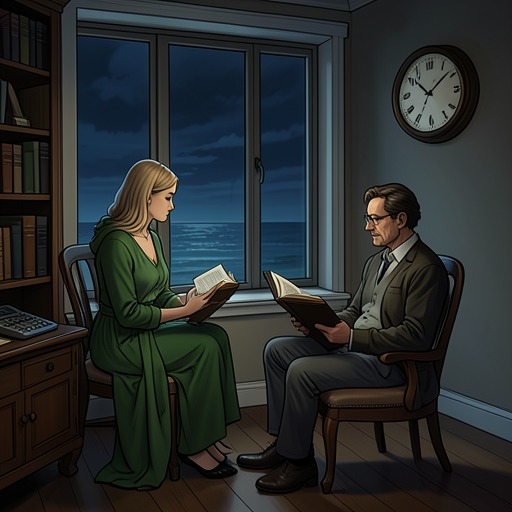
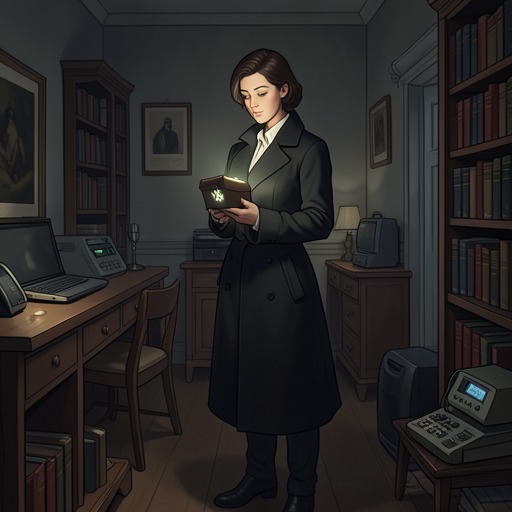
Blake
Panic RoomBlake, also known as Primrose, is both a fugitive from her own past and an increasingly determined investigator of Jane Glasson’s disappearance. At Wortalleth West she finds a rare feeling of safety and solitude, but the discovery of secrets there draws her into a case that takes her from Cornwall to London and Switzerland. Her pursuit is not simply a search for Jane: it becomes a refusal to repeat the flight and helplessness that have shaped her own life.
Identity and Background
Blake has spent seven years away from the home and family life she associates with rows, drinking, and chaos. She remembers trying to reason with her mother and concludes that logical proof could not make her mother accept that she was wrong. The recollection helps explain Blake’s guardedness: she expects some people not to be persuaded by evidence, yet values Don Challenor precisely because she believes he can understand her reasoning.
Her past also includes Lee and Daisy. Blake later describes herself as having let Lee destroy Daisy and then having run away. She does not present this history as resolved; instead, it remains a source of responsibility and regret that informs her determination not to retreat from another difficult truth. She acknowledges that recovering the Glassons’ family cannot repair her own, and that her investigation cannot undo what happened to Daisy.
Before the main investigation takes her away, Blake works for Andrew Glasson at his house in Helston. She has never met Jane, but she lived with Jane’s photograph and heard Andrew speak about his daughter’s energy, passion, and fears for the environment. Through these stories and the image, Jane becomes present to Blake as an absence she cannot dismiss. Blake later makes her connection to Andrew explicit when she approaches Jane and identifies herself as someone who used to work for her father.
Wortalleth West: Refuge and Unease
At Wortalleth West, Blake experiences a kind of safety she has not known before. The sea is central to that refuge: she watches surf strike the rocks, hears skylarks on the path to the beach, walks through wild mustard and cow parsley, and sees sunsets beyond Wolf Rock. Unlike the place she originally came from, this landscape does not make her want to leave. She imagines staying, perhaps forever, even while recognizing that her situation cannot last indefinitely.
The quiet is partly made possible by Jack Harkness’s absence. He is in serious trouble and, Blake believes, unlikely to visit soon. She swims, walks, runs, cleans, and sells driftwood art; the considerable space and luxury supplied by Harkness matter to her, but solitude matters more. Glenys Probert tends the garden three days a week, and a pool man comes when needed. Blake is relieved that few people visit and hopes the press will remain unaware of Harkness’s Cornish bolthole.
That sanctuary is never entirely secure. Once the panic room has become a concern, Blake can tell herself that nobody is inside while still knowing that somebody might be there and might emerge at any moment. Her fear coexists with the routines that make the house feel like her own. When Don stares at a wall, she notices him doing so; later, she tells him that Holly Walsh is willing to meet them, while privately noting that she has already arranged the meeting. She reads Glenys’s concern and sly encouragement as signs that the gardener knows the visit will take Blake away from the house for a while.
Blake’s response to a breach of solitude is direct. After swimming because she is angry about Wynsum Fry and the calling card that has stayed on her mind, she senses someone nearby and finds a man at the pool. She is not shown scrambling for a towel or retreating; she puts her hands on her hips and demands to know who he is. The moment contrasts her usual isolation with the readiness to confront an unexpected presence. Her naked swimming, which she regards as natural and comfortable, is part of the same insistence on inhabiting the space on her own terms.
Jane Glasson and the Choice to Pursue the Truth
Holly Walsh’s name immediately changes the conversation between Blake and Don. Blake recognizes that it means something to her: Holly travelled with Jane from Cambridge to London on the day Jane disappeared and was among the last people to see her. Blake explains what she knows of Holly’s friendship with Jane at boarding school and Cambridge, and of Holly’s later attempts to help Andrew and his wife. To Holly, Jane’s disappearance had been a complete surprise. Blake arranges for the two investigators to meet her, making a remembered connection into a practical lead.
The investigation also gives Blake a reason to leave a refuge that has become untenable. Walking through London, she feels out of place among strangers and tourists in St James’s Park. She understands that her life at Wortalleth West ended when Don entered the house, though she also recognizes that it was always going to end. She had no next destination planned. Her uncertainty is not merely geographical: she wonders why Jane should matter to her when she never knew her, then answers through the daily photograph, Andrew’s memories, and the sense of Jane’s absence in her father’s face.
Blake’s resolve sharpens when she decides that she must retrieve her passport and pursue Jane, despite not wanting to return to the place she fled. Don asks whom she is really doing it for and doubts that the answer is simply Andrew or Jane. Blake cannot yet give a complete explanation. She does know that Harkness wants her to take money from Ingrid Denner and travel around the world, and she wants to understand what he fears she will discover if she refuses. She frames continuing as a decision not to run away again, even though the investigation cannot mend her family history.
Partnership with Don Challenor
Blake’s trust in Don rests on a contrast with her mother: Don, she believes, does understand reason. The folded Financial Times bearing the name Perkins and a phone number becomes a small but consequential sign of their shared work. Don supplies the investigator’s contact details without texting them, and Blake notices the name written on the paper. Their partnership is practical, but it also gives Blake someone with whom she can reason without expecting the conversation to collapse into refusal or chaos.
The trust becomes visible in their separation at Heathrow Airport. Blake is about to fly for the first time in her life. Don has bought her a phone, surprised that she had managed to remain off the grid without one, and gives her a credit card as well. They must keep in contact as they go separate ways, though Blake admits that the idea of being a team is still unfamiliar to her. Neither knows what awaits at the end of the journey. The new phone and the credit card mark a departure from her carefully maintained inaccessibility: to continue the investigation, she accepts connection and practical dependence on Don.
Their connection is tested later, when Blake cannot reach him by mobile and suspects he may be at Wortalleth West. Filippo Crosetti puts a landline at her disposal and gives her the instructions for placing the call. Don answers, apparently without being able to explain why he picked up, and Blake recognizes how glad he is to hear her. She moves quickly to the urgent question of whether the panic room has been opened. In this moment, their partnership is not just an agreement to investigate together; it is the channel through which Blake tries to act across distance in a crisis.
Confrontation and Narrative Role
Blake’s pursuit brings her to 53 Belgrave Square, where she stands outside Harkness’s closed-off house and wonders what kind of life he leads behind its windows. Harkness appears at an upstairs window, recognizes her, and calls down to her by name. The encounter turns a distant target into a person Blake can confront. Later, when she approaches Jane, Blake introduces herself through her work for Andrew in Helston. The approach is personal as well as investigative: Jane is no longer only the subject of a disappearance that Blake has imagined from a photograph.
In the confrontation involving Ingrid, Blake hears the company’s case against taking her claims seriously. Ingrid argues that a consultant’s possible identity change twenty-two years earlier and the money that may have passed through the Nightingale account pose no meaningful reputational threat to Harkness Pharmaceuticals; she also says Blake has offered no proof that Anna Marchant was placed in Holly Walsh’s life by Harkness. Blake turns that dismissal toward Jane and presses her to acknowledge the identity question. Jane refuses to do so. The exchange leaves Blake without the admission she seeks, but it makes plain that she has brought the question into the open before the company and the person at its center.
Blake’s narrative is shaped by the tension between wanting to remain beyond reach and choosing to make herself reachable when the work demands it. At Wortalleth West, safety means privacy, space, and the possibility of staying; in the investigation, action requires travel, exposure, and reliance on other people. Her first-person reflections register uncertainty rather than mastery: she does not know exactly what she will find or, at first, whom she is doing this for. What changes is her willingness to proceed without a complete answer. The former fugitive who once escaped a chaotic life now insists on following the questions about Jane and Harkness to their consequences.