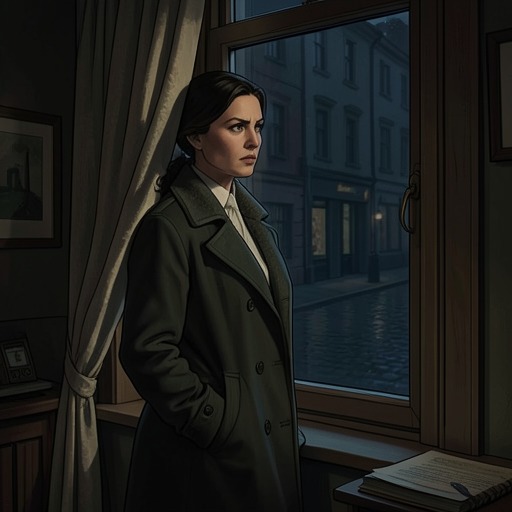
Blake and her mother Bren’s mother-daughter relationship
Panic RoomBlake and her mother Bren’s relationship is defined by a painful contrast: Blake remains deeply marked by the family she left, yet has kept herself apart from Bren for seven years. Bren’s drinking and passivity left Blake feeling that she had to protect herself and Daisy alone; when Blake returns to Birmingham, the old bond resurfaces not as reconciliation but as a source of danger, anger, and guarded resolve.
Family Damage and Daisy’s Death
Blake remembers Bren’s household as a place where her mother’s boyfriends were usually cruel, but Lee was worse: he drew Daisy into his orbit and supplied her with drugs. Blake tried to save her sister, but felt that Daisy dismissed her as a younger child who could not understand what was happening. Blake insists that she did understand, and that she saw what Lee and the drugs were doing to Daisy before she witnessed the fatal outcome.
Bren may also have understood where events were leading, but Blake remembers her doing nothing to stop them. Instead, Bren drank more, as though drinking could make her care less. That perceived failure remains central to Blake’s account of their relationship: Daisy’s death was not only a loss but a moment when Blake believed her mother had abandoned the responsibility to act. Blake tries to hold on to memories of Daisy alive, laughing, and full of energy, but the image of her dead at twenty-two continues to return.
After Daisy’s death, Blake’s grandmother died about a month later. Blake says that Daisy’s death had already nearly broken her, while her grandmother’s belief that Blake was the strong one in the family became a grim confirmation of the role she had been left to occupy. Lee feared Blake might tell the police about his drug dealing. Blake read his look as a sign that he understood she was a problem he could not control now that Daisy was gone; Bren, by contrast, did what Lee wanted. Blake refused to be controlled in the same way. Although she considered going to the police, she feared that Lee’s criminal associates would retaliate, and knew that reporting him could not bring Daisy back.
Leaving Birmingham
Blake had been planning to get away for some time, particularly since Lee entered the household. In her view, Bren had already been an unreliable mother, but Lee made the situation worse. The decisive moment came when Blake saw the look in Lee’s eyes and realized that her time to leave might be running out. Her escape was therefore not a sudden break from an otherwise secure family life; it was a decision formed over time and made urgent by the danger she perceived.
A year before leaving, Blake had obtained a passport using her grandmother’s address. She concealed it under the floorboards in her bedroom, keeping the document and her plans from Bren. On a Saturday, after spending the day in the city centre with college friends, Blake made an excuse not to return with them. She felt that going home could be a fatal mistake, bought a ticket to London, and took the next train to Euston as evening fell in the rain. She later explains that she did not need the passport to make that journey, and had not needed it since. Its sudden importance years later signals that the separation she had maintained is about to be tested.
The Return for the Passport
When Blake needs the passport to travel to Zürich, she tells Don Challenor only that she left in a hurry after falling out with her mother and forgot to take it. She withholds the history of Daisy’s death and the kind of men Bren became involved with, even as she recognizes that Don would be more reluctant to help if he knew. She insists that she does not need protecting, while conceding to herself that the claim may not be entirely true; Don is more convinced than she is that she does. Their exchange shows how much of Blake’s relationship with her mother remains unspoken even to someone who has come to care for her.
Blake is confident that the passport will still be under the floorboards because no one else knows its hiding place. She has had no contact with Bren since leaving. The trip consequently requires more than recovering a document: it takes Blake back to the home and family from which she had deliberately severed contact, while leaving her determined not to tell Don the full reason for her flight.
The Highwayman and the Limits of Reconciliation
As they approach Birmingham, Blake asks Don to check whether Bren is drinking at The Highwayman before Blake goes to the house. Describing her mother is visibly difficult. Her account focuses on Bren’s appearance and drinking habits, and ends with a shuddering rejection of the woman who had claimed her as a daughter. The strained description conveys not an abstract estrangement but Blake’s distaste at having to identify and return to her mother at all.
Don finds Bren in the crowded pub among four women of similar age and appearance. He recognizes her by the dyed blonde hair, clothes, gum-chewing, and the drink he guesses is Bacardi and Coke. His attention lingers long enough for Bren to notice and smile; before he can leave, she approaches him. The encounter turns Blake’s carefully controlled plan into an unwanted contact between her mother and the person accompanying her. When Don returns to the car, Blake says he was not supposed to speak to Bren and makes clear that she does not want to know what her mother said. Her reaction establishes the boundary she has carried through seven years of silence: returning to retrieve the passport does not mean that she is ready to hear Bren out or repair their relationship.
The relationship thus remains suspended between enforced proximity and deliberate distance. Blake goes back because a hidden object from her former life is necessary to pursue answers about Jack Harkness, but she does not return in search of family restoration. Her account of Bren is inseparable from the loss of Daisy and from the decision to survive by leaving; the journey makes that history present again without resolving it.