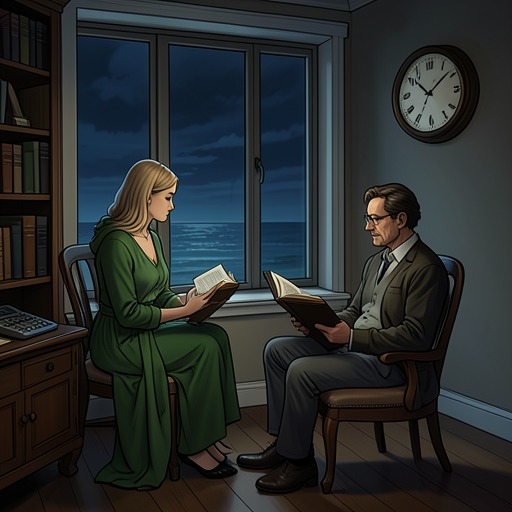
Blake’s seven years away
Panic RoomBlake’s seven years away are defined by a departure she had prepared in secret and a return she chooses despite the family danger she has kept hidden. She left home after Daisy’s death and the collapse of her family life; years later, the passport concealed beneath her bedroom floorboards draws her back to Birmingham, while her investigation of Jack Harkness gives that return a purpose beyond retrieving it.
Preparing to Leave
Blake had been considering escape since Lee entered the household. A year before she left, she obtained a passport using her grandmother’s address. Her mother did not know about it, and Blake hid it beneath the floorboards in her bedroom, preserving a means of departure outside the family’s awareness.
Daisy’s death and her grandmother’s death about a month later deepened the circumstances around Blake’s decision. Lee was involved in drug dealing, and Blake believed that reporting him to the police could expose her to danger from the people around him; she also knew that doing so could not bring Daisy back. She understood that Lee regarded her as a threat, especially because Daisy was gone and he could no longer control Blake as he controlled her mother.
The immediate decision came when Blake saw the look in Lee’s eyes and realized that her opportunity to leave might be running out. On a Saturday, after going into the city centre with friends from college, she made an excuse not to return with them. She bought a ticket to London and boarded the next train to Euston. Though she had never felt more certain that leaving was right, the departure also meant abandoning the passport she had arranged to secure.
The Years Away
The account gives little detail about Blake’s life during the seven-year interval, but it establishes that she remained away from the home she had fled. She did not need her passport to travel to London and had not needed it in the years since. Her separation was therefore not simply a postponed journey: the document she had hidden before leaving became necessary only when circumstances changed.
Blake describes herself as having been a fugitive for seven years. That duration shapes the prospect of returning: she knows the house and still has a key, but the place she is going back to is the one she escaped when she feared that staying could be fatal. Her confidence that her mother remains in the council house rests on the fact that it is a council property, not on any renewed closeness between them.
The Return to Birmingham
The passport becomes urgent when Blake decides to go to Zürich in pursuit of the truth about Harkness. She suspects that his effort to send her away with money from Ingrid is meant to prevent her from discovering something, and she refuses to abandon the investigation. She also insists that she will not run away from this matter as she once ran from home.
Don is reluctant to drive her to Birmingham, but understands that she will go whether he accompanies her or not. Blake does not tell him about Daisy or the danger connected to her mother’s associates. Instead, she offers the narrower explanation that she left in a hurry after falling out with her mother and forgot her passport. She says she does not need protecting; Don disagrees, and the narrative makes clear that his concern has become personal.
They travel after the rush hour, with Don agreeing to establish whether Blake’s mother is drinking at the Highwayman before Blake goes to the house. He does not press her with the many questions he has about her family. Blake’s jaw is tense, and although she is grateful for his presence, she does not say so. Her return is thus both practical and emotionally charged: she comes back for a document, but must approach the home and history from which she has spent seven years away.
What the Seven Years Mark
The interval separates two acts of resolve. Blake’s first departure protects her from a home she believed had become unsafe; her return is not a reconciliation with that home, but a refusal to let fear dictate another retreat. The passport hidden before she fled becomes a concrete link between those moments: once a safeguard for leaving, it is now required for the journey she intends to make in pursuit of answers.
Blake’s account also distinguishes the family crisis she has survived from the investigation she chooses to continue. Returning to Birmingham cannot undo Daisy’s death or repair her family, and Blake knows that. Her decision to go with Don instead rests on a different commitment: she has come too far in questioning Harkness to stop now. The seven years are therefore not an interval of simple absence, but the span between escape and a deliberately chosen return to danger’s edge.