Cascade panic-room trigger
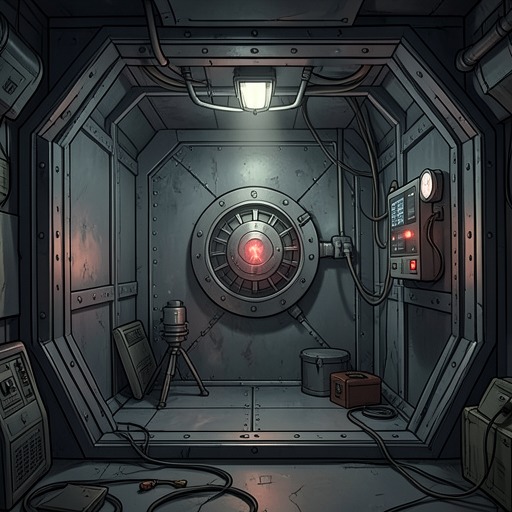
Panic RoomThe Cascade panic-room trigger is the opening or breach of the panic room at Wortalleth West: the act that initiates a nanobot chain reaction designed to become uncontrollable. The rule turns a protected room into a concealed activation mechanism. Its danger lies not merely in what the room contains, but in the fact that breaking into it can start a process whose participants may not recognize what they have set in motion.
Definition and Mechanism
Cascade is a method for remotely triggering nanobots already present in human hosts. Doctor Tau has solved the problem of controlling the devices from outside the body and activating their pre-designed function. The control signal propagates as a chain reaction: one nanobot triggers another, then another, provided they remain within ultrasonic range. The system at Wortalleth West is powerful enough to initialize that sequence.
The panic-room breach is the specific initiating condition. Filippo Crosetti states that Cascade begins once the room is breached, and later confirms the rule directly: the process will happen once the panic room is opened. These formulations describe the same decisive threshold—opening the room is not simply access to a hidden space, but an action that activates the larger system. Before that threshold, the mechanism remains latent; after it, the chain reaction is expected to continue beyond effective control.
Control and Design
The system has overrides at Wortalleth West and in Locarno, but only Jack Harkness and Crosetti know how to operate them. Crosetti describes the consequence of lacking that knowledge in absolute terms: there is no control and no way to stop Cascade once it starts. The existence of overrides therefore does not make the trigger safe. Control depends on restricted knowledge, and the account gives no indication that the people who might breach the room would know how to use those controls.
The trigger is also designed to conceal responsibility. Harkness has made the arrangement easy for Crosetti, while the anticipated breach is framed as something another person will eventually cause. That person may start Cascade without understanding the effect; Harkness and Crosetti, by contrast, would know what the breach means. The mechanism thus separates the person who performs the initiating act from those who understand its consequence. The apparent accident is part of the design, not evidence that the trigger is harmless.
Intended Effects and Stakes
The nanobots have been produced and introduced into the world over a period of years. Crosetti distinguishes their earlier presence from their later design for this particular function: enough have been deployed, he says, for the system to work. Their ubiquity makes the room’s local trigger the beginning of a process with reach beyond the building. The account describes them as a latent presence that becomes dangerous when switched on.
The technology is presented under the rationale of nerve-stimulation therapy powered by nanotransducers. Crosetti explains, however, that he redesigned the components: rather than serving that therapeutic purpose, the nanobots discharge an electrical signal modulated to interfere with the host’s bioelectronic system. The breach therefore activates a system whose intended effect has been concealed behind a medical application. Crosetti also recognizes a possible alternative to the plan: a shift to renewable energy over the coming decade might achieve the desired aim without this intervention. He concludes that Harkness and his partner will not wait, making the panic-room trigger the point where a long-term scheme becomes imminent.
Revelation and Narrative Significance
The trigger is disclosed through a sequence of confirmation rather than a single technical explanation. First, Crosetti identifies opening the panic room as the event that will make Cascade happen. He then explains the chain reaction and the room’s capacity to initialize it. When Don Challenor presses him on whether the claim is true, Crosetti confirms that Cascade will begin once the room is breached. The repetition narrows the uncertainty: the threat is not an abstract property of nanotechnology but a specific, impending consequence attached to one physical act.
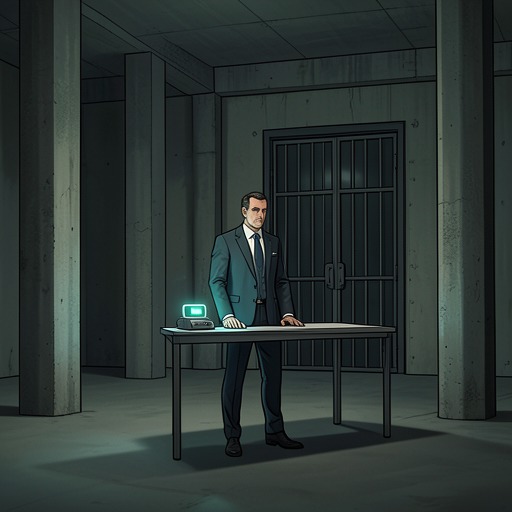
That act also structures the immediate suspense. Crosetti says the event has not yet occurred, but believes Jane has locked him out to ensure that he cannot stop it; he says she only pretended to agree with him and concludes that it will now happen for certain. Later, as French urges Don to open the room, Crosetti again insists that breaching it will start Cascade. Don has run out of diversions and delays, and expects that he will no longer be useful to French once the room is open. The rule thus converts a concealed room into a countdown: the unresolved question is whether someone will cross the threshold, while the stated consequence makes that threshold difficult to treat as an ordinary door. Its central irony is that the act may be carried out by someone unaware of its meaning, even as the people who designed the system anticipate precisely that ignorance.