Dale
Panic RoomDale is the Home Security Electronics representative who examines the apparent panic-room barrier at Wortalleth West. His visit gives the hidden room a practical, frightening dimension: the question is no longer only whether a chamber exists, but whether someone may be trapped behind a door that appears impossible to open from outside. Dale’s expertise makes that possibility credible, while the later discovery of his crashed company van leaves his own fate uncertain.
Identity and Introduction
Dale arrives at the house in a company van and identifies himself as working for Home Security Electronics, showing photo identification when he introduces himself to Blake. He is young, dressed in working trousers and a shirt bearing the company logo, with a shaven head and several tattoos. Blake notices the contrast between that appearance and his cornflower-blue eyes and unexpectedly gentle voice. Dale asks whether Mr Challenor is at home, then turns to Blake when told he is not, addressing her as though she might be the lady of the house. The exchange establishes him as a visitor with a specific professional purpose, not someone already familiar with the household.
His assignment concerns a reported problem with a panic room. Blake has not noticed the concealed feature herself until Don Challenor pointed it out, so Dale arrives to inspect a mystery that is still uncertain even to the people living at the house. His cautious manner and straightforward introduction make him an ordinary outside technician entering a situation whose significance exceeds the apparent service call.
Technical Assessment of the Room
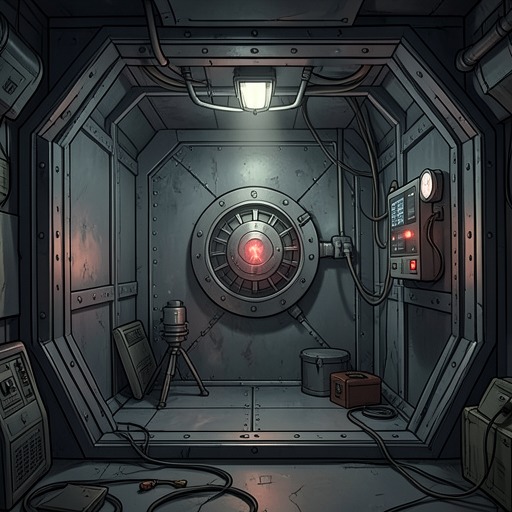
Dale explains that the steel barrier could be a sliding door, closed and locked from within, with a chamber extending over two floors behind it. But he cannot trace the expected electrical connections or air supply. A functioning panic room, he says, should have ducted cables and pipes independent of the rest of the house, as well as a separate phone line. If those systems exist, he cannot locate them; they are either absent or so well shielded that his inspection cannot detect them.
That distinction unsettles the simple explanation that the door is merely faulty. Don has suggested either a malfunction or a deliberate closure before someone jumped out. Dale counters that a panic room should have a fail-safe preventing that kind of entrapment, and that a fault should likewise leave the room accessible even if it is not functional. His technical reasoning does not prove that anyone is inside, but it removes the reassurance that an ordinary defect would explain the sealed barrier.
Dale also describes what the room would ordinarily provide: a separate telephone line for calling for help and cameras offering a view of selected rooms. These expected safeguards sharpen the contradiction. If the space is real, it seems designed to let an occupant communicate and observe; yet Dale cannot confirm the systems that would make those provisions usable. The possibility that someone has shut themselves inside crosses his mind, though he calls the idea crazy and asks whether the household would know if that had happened. Blake agrees, but her shiver registers how quickly his professional speculation has become an immediate fear.
Pressure and Disappearance from View
Dale closes his laptop with a peevish clunk and says he will report back to his boss. His bottom-line assessment remains conditional: if the structure is a panic room, his first thought would be that somebody had shut themselves inside. He does not claim to have found an occupant, nor does the inspection resolve whether the chamber exists in the form suggested by the barrier. His contribution is a disciplined account of what the building should contain and what he cannot detect.
Later, Amos French tells Blake that he and his associate have spoken with Dale. French describes him as unaccustomed to the way French questions people and says that the questioning shook him up. He then uses the information Dale supplied about the panic room to press Don Challenor to find out what is inside. The technician’s visit has therefore become part of a coercive chain: Dale’s inspection gives French a lead, and French turns that lead into a demand on Don. Dale is not present for the threat, but his earlier work is the stated basis for it.
The Van and Dale’s Narrative Role
While Blake and Glenys Probert are travelling, they come upon a van that has left the road near Bonython Plantation and ended up at an angle in a deep ditch beside an overgrown wall. A police car blocks their side of the road; the van’s front is badly damaged, with crumpled metalwork and a smashed windscreen. Blake and Glenys recognize the name and telephone number on its side as those of the van Dale had been driving. The evidence connects him to the vehicle and the crash, but does not say whether Dale was inside, what caused the vehicle to leave the road, or whether he survived. His fate remains unresolved in the available account.
Dale’s role is brief but structurally consequential. He translates the concealed steel barrier into testable expectations—air, power, communications, and surveillance—and finds that the expected systems cannot be traced. That gap sustains the central uncertainty rather than solving it. His later connection to French’s questioning and the wrecked van makes the investigation feel hazardous beyond the walls of the house, while the absence of a confirmed outcome preserves the distinction between a disturbing clue and a proven explanation.