Don’s pact with Wynsum Fry
Panic RoomDon Challenor’s pact with Wynsum Fry turns an investigation into a personal commitment: Don asks the sister of Jory Fry to bless his attempt to uncover Jack Harkness’s part in the past, and Fry makes him seal his earnestness with a handshake. The encounter joins practical motives, family grievance and a bodily change that Don cannot explain. Its promise is spoken lightly enough to be negotiated, but Fry’s warning gives it weight; its handshake is gentle and painless, yet immediately followed by nausea and, later, the disappearance of Don’s wrist pain.
Background and concealed motives
The meeting grows out of two strands of Don’s recent concerns. He had visited Andrew Glasson to see whether Blake might move back in with him after leaving Wortalleth West. During that visit, Andrew told him the sad story of his missing daughter. Alongside what Blake had told him about Wynsum Fry’s dead brother, Jory, the story led Don to wonder whether he could establish what part Harkness had played in those events. His interest in Fry, then, was not simply a question of earning money: he wanted to pursue a possible connection between Harkness and the death in her family.
When Fry challenges him to explain why he should care, Don does not disclose all that has drawn him into the matter. Instead, he borrows the self-serving rationale Mike Coleman had used for digging up dirt on Harkness. Don tells Fry that he hopes an American company pursuing Harkness will pay generously for information capable of adding to his troubles beyond bribery and embezzlement charges. The answer supplies a plausible commercial motive while keeping Don’s deeper interest out of the bargain. His cover story is not wholly fabricated, but it is deliberately arranged to conceal why the inquiry matters to him.
Asking for Fry’s blessing
Don makes the family connection explicit when he tells Fry that the matter concerns a schoolfriend of Jane Glasson’s who may know where Jane is. He stops short of claiming certainty: the friend may know, and the search may lead somewhere. Fry asks why he is telling her. Don answers that, because she is Jory’s sister, he supposes he hoped she would give him her blessing. The request brings his investigation back to its personal stakes: Harkness is not merely a potentially profitable target, but a man whose past may involve Fry’s brother.
Don reinforces the request with an offer. If he makes money from the information, he says, it would be fair for Fry, as Jory’s closest surviving relative, to receive a share. The offer frames the prospect of payment as a matter of fairness to the bereaved family, even as Don’s earlier account presented the American company’s money as his own incentive. Fry accepts his right to have reasons she need not approve of, provided he can bring Harkness down. Her assent is therefore conditional and purposeful: she gives her blessing to the pursuit, not an endorsement of every part of Don’s explanation.
The handshake and its warning
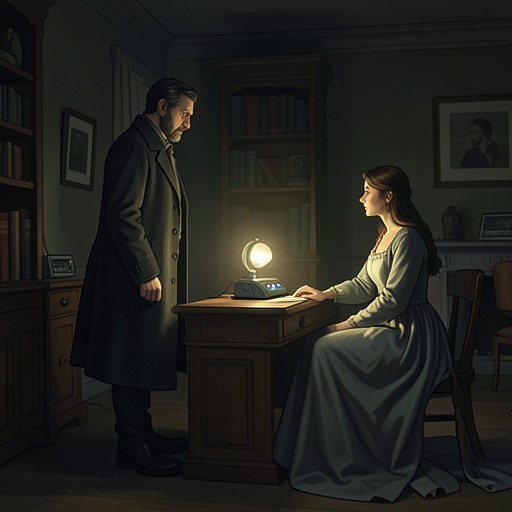
Fry asks Don to take her hand, saying that she will know he is in earnest if he does. The gesture makes the commitment immediate. Don braces himself for the pain he expects from the contact and half rises from his chair to reach her. Instead, their hands meet lightly and without pain. Fry closes her left hand over his right; Don feels an odd warmth in his wrist, but nothing more at first. The exchange is intimate in scale, yet it functions as the decisive test of the promise he has just made.
Fry’s warning gives the handshake its lasting meaning: “A promise lightly given is a ’eavy thing to break.” She speaks so quietly that Don thinks he may only have imagined hearing her. The words turn his assurance into something more binding than a convenient pledge, while their subdued delivery leaves the force of the moment uncertain. Don does not answer with a declaration. A wave of nausea comes over him; he pulls his hand away, bends forward and grips his knees. When Fry asks what is wrong, he can only say that he does not feel well. The scene thus places the bodily reaction directly after the handshake without explaining what caused it.
The vanished pain and the pact’s significance
Later, someone asks Don how his wrist is. He has forgotten about the pain. When he flexes the joint, he realizes that it no longer hurts and murmurs, “Bugger me.” Asked whether it is a miracle cure, he replies, “Apparently.” The exchange confirms the change in his condition as something he recognizes through movement, not through an explanation of how it happened. The earlier handshake had been painless despite his expectation of pain; only afterward does Don register that the pain itself has gone.
The scene leaves the relation between Fry’s words, the strange warmth, the nausea and the wrist’s recovery open rather than settling it as an ordinary cure or a proven supernatural act. What is clear is the sequence and its narrative consequence: Don seeks Fry’s sanction for continuing an inquiry into Harkness, accepts her test of sincerity, and leaves the meeting with both a promise to honor and a pain he no longer feels. The pact binds together the investigation’s public rationale and its concealed personal stakes. Fry’s warning makes the promise itself the encounter’s enduring burden, while Don’s unexplained relief gives their handshake a consequence beyond permission to proceed.