Foiling of Cascade
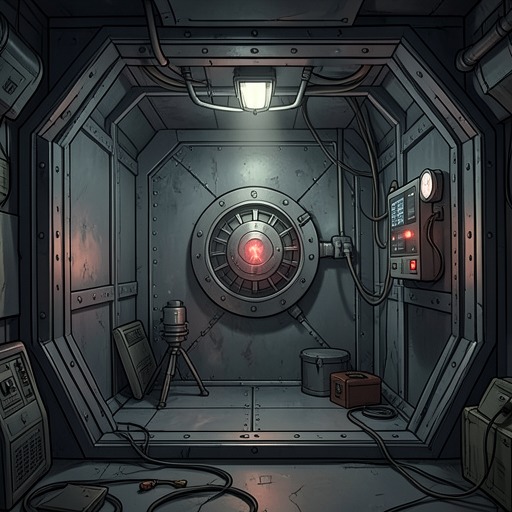
Panic RoomFoiling of Cascade prevents a concealed system at Wortalleth West from turning the worldwide distribution of Harkness Pharmaceuticals products into a mass-casualty mechanism. The plan depended on a breach of the house’s panic room to trigger Cascade, a chain reaction among nanobots already present in millions of people. Don Challenor helps keep that room sealed, while Filippo Crosetti’s redesign makes the scheme incapable of succeeding even if the room is eventually opened.
The hidden infrastructure and the plan
The danger is built into a house whose unusual infrastructure first appears as a puzzle. A steel barrier may be a sliding door to a chamber extending over two floors, but its concealed systems make the room difficult to assess: there are no traceable electrical connections, air supply, ducted cables, pipes, or separate telephone line. If these services exist, they are heavily shielded. The uncertainty matters because the room is not simply shelter. Opening it is the planned trigger for a process whose scale is far beyond the building.
Mike Coleman’s account of the property’s power supply adds another part of the puzzle. Jack Harkness had arranged for a solar array in a field about half a mile inland, photovoltaic film on the south-facing walls of the house and garage, and a large flow battery. Coleman describes the independent supply as excessive and cannot locate the battery, a rack of modules roughly as high as the room they are discussing. Don suspects an answer connected to the panic room, but withholds it from Coleman. In retrospect, the excess capacity and concealed construction form part of the same network: the house has resources suited to operating something hidden and consequential.
The intended trigger exploits the reach of Harkness Pharmaceuticals rather than a single person’s exposure. Jack Harkness, Astrid Townsend, and Filippo Crosetti developed the nanobot programme. Nanobots had been distributed through medicines, cosmetics, pesticides, and antibiotics, among other products, reaching people through ingestion, injection, and absorption through the skin. Their presence was latent: they eventually left the body, but continued production replaced them. Cascade was designed to activate them from outside a host. Doctor Tau’s method could pass the trigger from one nanobot to another within ultrasonic range, while the Wortalleth West system supplied the power to initialize the process. A control device in Locarno was also part of the arrangement, and only Harkness and Crosetti knew how to operate the overrides.
The intended outcome was not therapeutic. Crosetti explains that he had redesigned the components so the nanobots would discharge an electrical signal intended to interfere with the host’s bioelectronic system. The room’s breach would initiate a chain reaction; the effects would spread beyond the house and would not be readily controlled once underway. The plan’s scale gives the hidden door a grim reversal of its apparent purpose: a chamber built to protect its occupants becomes the concealed starting point for a threat to millions.
Don’s intervention
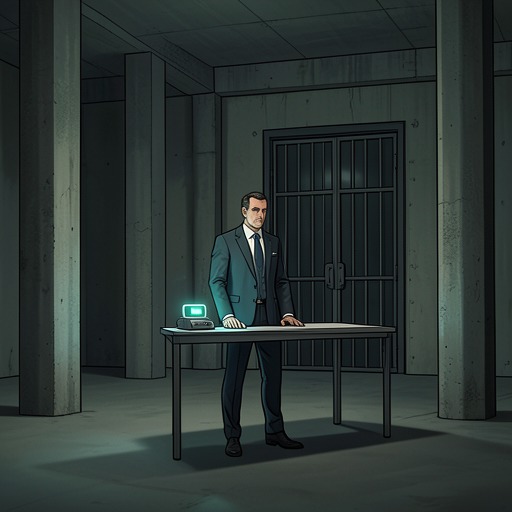
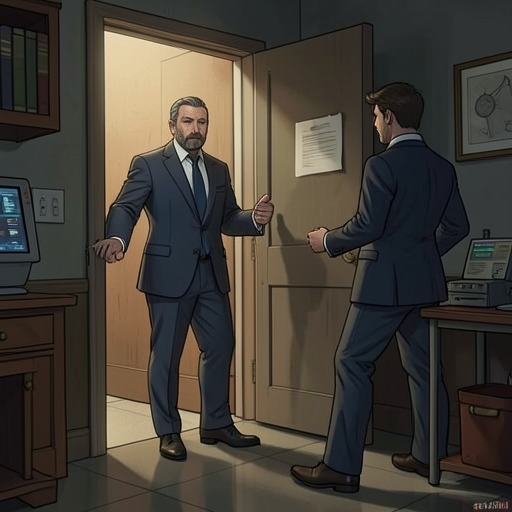
Blake reaches Don by telephone while he is at Wortalleth West and urgently warns him that the panic room must remain unopened. She tells him that Harkness rigged it to trigger something catastrophic and that the futures of millions depend on keeping the room shut. The call breaks off abruptly. Don has received the warning, but the immediate danger shifts to another device in the house: a safe whose open door reveals a switch.
Amos French is moving toward the safe and flicks the switch on. Don charges him, but French collapses before he can reach it; the effects of his earlier fall at Tredarvas have caught up with him. Don closes the safe, raises its handle, and turns the dial until the lock engages, checking the handle before leaving. Gennady Zlenko then confronts him and knocks him down. The interruption leaves the immediate crisis unresolved, but Don has secured the switch and has already acted on Blake’s warning. The sequence makes prevention depend on precise, ordinary actions—closing a door, turning a dial, securing a room—rather than on a dramatic technical counterattack.
Prevention and aftermath
The plan fails through more than one intervention. Don’s actions prevent the safe’s switch from remaining available and help preserve the panic room’s sealed state. Separately, Crosetti has ensured that Harkness’s design cannot work even if the room is opened later. This safeguard is crucial: the immediate danger may be contained, but the door remains a potential trigger in the story’s physical layout. The revised components remove the threat behind that contingency rather than relying on the room remaining untouched forever.
At Harkness Pharmaceuticals, the security team eventually finds a way to override the lock on the steel screen sealing Harkness’s office. By then, Jane Glasson has understood that Cascade will not happen. She leaves without speaking, poker-faced, while the others remain. Harkness is dead, and Jane cannot restart a scheme of this scale alone; nevertheless, she must live with the failure of a plan developed over twenty years. Her departure closes the immediate operation without resolving her future or revealing where she goes.
The consequences are both bodily and institutional, though the surviving account gives them in restrained terms. Don is taken to Treliske Hospital after police suspect a heart attack; doctors attribute his condition to a stress reaction. French and Zlenko are also hospitalized in comas with serious head injuries. Blake, speaking later from Zug, recognizes how narrowly the catastrophe might have begun, while the people around her have no idea that it nearly did. Harkness Pharmaceuticals may try to suppress the truth; with Harkness dead and the plan disabled, the company may be able to make a deal with Quintagler Industries and treat a fine as a manageable consequence. The ending therefore distinguishes technical prevention from public accountability: Cascade is stopped, but concealment and corporate damage control remain possible.
Narrative significance
The event draws its suspense from the distance between the visible scale of the action and the invisible scale of its stakes. Don’s effort centers on a safe, a switch, a locked door, and a telephone call; the mechanism those objects serve reaches through global product distribution and bodies far from Wortalleth West. The excessive renewable-energy installation, the shielded room, the nanobots, and the distant control device are not isolated curiosities but connected parts of a system built to convert private decisions into widespread consequences.
That design also makes the near-disaster a challenge to the idea that environmental catastrophe can be answered by any means whatsoever. Harkness’s stated aim was to prevent mass extinction, but his chosen intervention turns living people into instruments of a plan that would kill on a vast scale. The novel does not present the successful prevention of Cascade as a complete resolution: the population remains unaware of the danger, Jane’s next course is unknown, and the company may conceal its role. The room stays shut, the trigger is neutralized, and the wider truth remains unsettled.