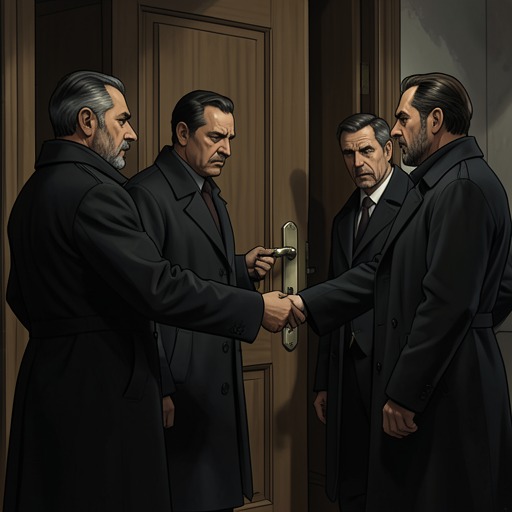
French’s interrogation of Dale
Panic RoomBackground and Setup
The encounter begins with Dale trying to reach his boss in Plymouth from the driveway of Wortalleth West. The property has no phone signal, so he gives up and drives into Mullion, parking opposite the church to try again. His practical problem—finding a place where the call will connect—takes him away from the house but does not make him less exposed. He is still in his van, occupied with the call, and has not noticed the dusty black four-wheel drive that arrives nearby. Nor, as he drove into the village, had he considered its reflection in his rear-view mirror. The vehicle’s presence is thus established before Dale registers any threat: the reader sees the approach that he has missed.
The car park is not presented as a place where a confrontation was expected. Dale is there because the signal failed at Wortalleth West, and the car’s dark, dusty appearance is something he pays no attention to. Those details give the interception its asymmetry. French and Zlenko have arrived together and can act on Dale while his attention is divided; he is alone and is trying to complete an ordinary call. The scene’s danger grows not from a prolonged pursuit but from the vulnerability built into that mundane task.
The Interception
French and Zlenko get out of the four-wheel drive and walk toward Dale’s van without haste. The controlled approach contrasts with the speed of what follows. From Dale’s point of view, events suddenly become bewildering: French presses a button on the jammer in his pocket, and the phone call is cut off. Zlenko opens the driver’s door and removes the key from the ignition while French opens the passenger door and climbs in beside Dale. In a few coordinated movements, they interrupt his attempt to communicate, prevent him from simply driving away, and occupy the vehicle with him.
French presents the intrusion as casual conversation, asking, “Got time for a little conversazione?” Dale opens his mouth, but no words come out. The silence is the only response the scene gives him; it does not disclose what he thinks or whether he can formulate an answer. French supplies an answer on his behalf: “I’ll take that as a yes.” The breezy phrasing is at odds with the control he and Zlenko have just established. French can call the encounter a conversation because his companions have disabled the phone, taken the key, and entered Dale’s van. The politeness is not evidence of consent; it makes the coercion more visible by setting the language of an invitation against the actions that have removed Dale’s choices.
What the Interrogation Reveals
The scene initially withholds the substance of the questioning. Dale’s silence is described, and the physical arrangement of the encounter is clear, but the account does not show French asking about the house or Dale answering him. That gap matters: the reader sees how French takes control, not a transcript of how he obtains information. The later phone call to Blake supplies the consequential result. French says that he and Zlenko know about the panic room and have spoken with Dale. He adds that Blake met Dale earlier, calls him a “Nice kid,” and says he is not accustomed to being questioned in French’s manner and was shaken up. This confirms the interview’s intimidating effect without filling in the omitted questions or answers.
French’s disclosure also turns Dale’s roadside vulnerability into a larger problem for Don. Having learned that the room exists, French says that he and Zlenko want to know what is in it and expect Don to find out. The demand does not establish what the room contains, how Dale’s information came to French, or whether Don will comply. It does establish the pressure French is applying: knowledge of a concealed feature of Wortalleth West becomes an assignment imposed on Don. Dale’s questioning is therefore consequential beyond the van. French uses its result to extend his reach from the property to the person he expects to investigate it.
Leverage and Narrative Function
French’s call to Blake makes the interrogation’s power structure explicit. Blake begins to respond, but French cuts across the exchange with his message to Don, delivered through Blake. He then ends the call; the line is dead because French has hung up. The abrupt cutoff echoes the earlier interruption of Dale’s phone call. In each instance, access to communication is controlled by French: a device in his pocket stops Dale’s call, and French decides when the conversation with Blake is over. Communication does not merely carry the scene’s threats; its interruption is one of the ways those threats are enacted.
The encounter also links two different kinds of information. Dale’s unsuccessful call begins as an attempt to contact his boss, while French’s later call transmits what his questioning has achieved and what he wants Don to do next. Between them, the van becomes the point at which a private attempt to communicate is forcibly converted into intelligence for French. The narration’s movement from Dale’s bewildered perspective to French’s concise report leaves the reader to connect the two moments. The interrogation is thus effective in the plot without the text needing to disclose its full procedure: the decisive evidence is French’s later knowledge of the panic room and his demand that Don uncover its contents.