Hidden room behind the master-bedroom mirror
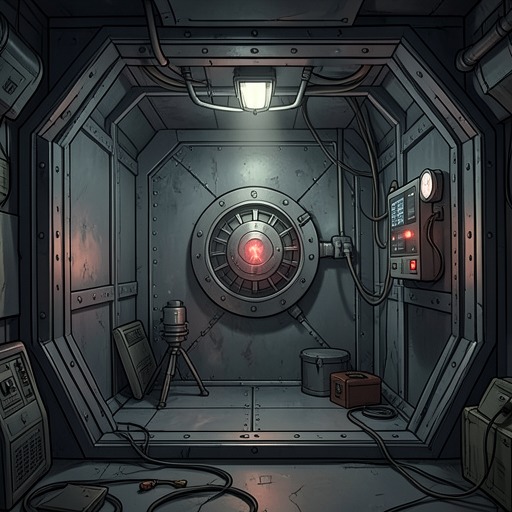
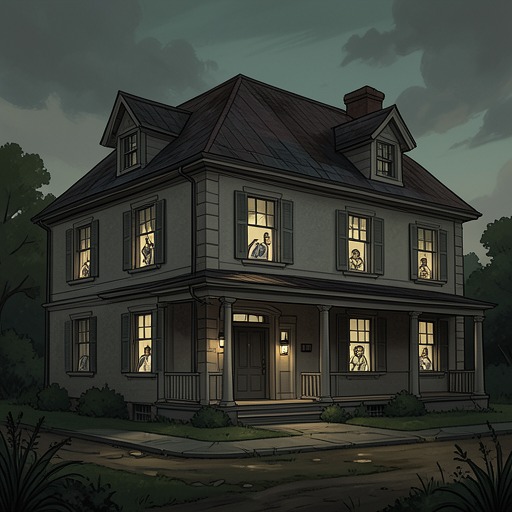
Panic RoomThe Hidden room behind the master-bedroom mirror is the secret center of Jack Harkness’s house at Wortalleth West: a concealed space from which the house is watched and recorded, yet which the surveillance cannot itself reveal. Its screens turn ordinary rooms into evidence, while its own hiddenness gives the system a blind center. Don Challenor’s encounter with the mirror and steel door makes that concealed space tangible without resolving what lies beyond; Fran Revell’s later discovery of damaged steel elsewhere in the bedroom suite extends the mystery of what the house conceals.
Setting and concealed arrangement
The room is introduced in darkness, but not in total obscurity. Amber standby lights glow on computers described as off-line, digital clocks shine red, and grey-and-white images flicker across a bank of screens. The arrangement is functional rather than domestic: the clocks register seven time zones—London, Frankfurt, Moscow, Beijing, Tokyo, Los Angeles, and New York—while the screens receive pictures from cameras concealed in light fittings, cornices, and intrusion sensors around the house. The room’s equipment makes its hidden position feel less like an ordinary bedroom annex than a private observation post.
The cameras encompass bedrooms and shared spaces as well as vacant rooms. One view catches Don approaching the master-bedroom mirror and standing close to it; another shows Blake stirring porridge at the kitchen hob; a third records Don again on the landing. Other screens show empty chairs and tables, a stretch of hallway without anyone in it, the gym, and the wine cellar. The range matters: surveillance here records both people acting and the apparently uneventful spaces through which they move. The house’s privacy has been turned into a continuous visual archive.
Surveillance and its blind center
The system does not merely show live images. It records minutes, hours, days, and weeks of the inhabitants’ comings and goings, as well as their much longer absences. Its scale is expressed through duration: the cameras preserve not only conspicuous incidents but also the ordinary passage of time and the gaps in it. The screens make Wortalleth West seem wholly legible, down to its empty rooms, and the repeated claim that everything is seen gives the surveillance an almost absolute reach.
That apparent completeness has a precise limit. The narrative marks the room itself as the exception: everything in the house is recorded except what happens inside this concealed space. It is therefore simultaneously the system’s control point and the one place outside its own field of vision. Describing it as the invisible center and secret heart of what Jack Harkness has built makes its secrecy structural, not incidental. The house can be watched from within, but the watcher’s room remains unobserved and unsuspected; its provisions wait there for their appointed moment, though their nature is not disclosed in this scene.
Don at the mirror and steel door
After sleeping, Don wakes calm and refreshed, and notices that the pain in his wrist has disappeared. He does not want to attribute the change to Wynsum Fry, but the unexplained relief remains with him. Before going downstairs to join Blake, he returns to the master bedroom and studies the mirror at the back of the closet. It reflects him with striking clarity; if anything is out of place, he thinks, it is behind the glass rather than in the reflection. The familiar mirror thus shifts from an object that returns a person’s image to a boundary that may conceal another space.
Don presses the mirror’s frame where he had pressed it before, and it swings open to reveal a steel door behind it. He touches the smooth surface and thinks he can feel a faint vibration, like contained energy, but hears nothing when he puts his ear to the metal. His reaction stops short of certainty: he reassures himself that there is nothing to hear, yet the thought trails into doubt. He clicks his tongue at his own uncertainty, closes the mirror, and walks away. The scene reveals the door but not what it protects, letting the solid barrier—and Don’s inability to confirm what lies beyond it—carry the suspense.
Damage to the house’s hidden architecture
A later discovery in the bedroom suite offers a different view of concealed steel. Fran moves through the quiet bedroom and dressing room into the bathroom, where nothing else moves and her reflection meets her in a full-length mirror. From a low plinth beside the freestanding tubs, she looks out at the sea and clifftops; when she turns back, the room’s stillness gives way to evidence of a forced attempt to penetrate the wall behind the dressing-room closet. A jagged patch of plaster has been knocked away, fragments lie scattered on the floor, and a sledgehammer rests against the wall. The exposed steel bears several dents that catch the window light.
Fran immediately guesses that the steel is the wall of the panic room and that Coleman has made a clumsy attempt to break through it. The damaged surface is not the mirror-hidden room Don inspected: it is a separate exposed wall that Fran associates with the panic room. Her inference makes the hidden architecture more dangerous without establishing that Coleman has entered either concealed space. She wants to leave the house, away from him and whatever he is trying to accomplish, but two men enter from the dressing room before she can do so. The concealed spaces are consequently not just puzzles built into the house: their barriers attract force, their attempted breach exposes people to danger, and the information they might contain remains inaccessible.