Holly Walsh
Panic RoomHolly Walsh is both a crucial witness to Jane Glasson’s disappearance and an unwitting point of connection between Jane’s past and Harkness Pharmaceuticals’ present. A friend who travelled with Jane on the day she vanished, Holly later becomes the recipient of anonymous funding for an experimental drug. The treatment brings her relief, but its source leads Don Challenor and Blake into a chain of disclosures linking Jane, company money, and the nanobot programme.
Identity, health, and home
Holly is a woman in her forties living in Hampshire with multiple sclerosis. In the blogs Don finds, she describes her illness and the improvement she has experienced through Ditrimantelline, an experimental drug she calls the Wonderpill. The treatment is extraordinarily expensive, and Holly says that an anonymous benefactor has made it possible. Her online gratitude is directed toward a secret supporter whose reasons she does not know; she reports that her symptoms are under control and that she has regained her life.
When Don and Blake visit, they find Holly at Furzelands, a modern bungalow in a cul-de-sac on the outskirts of Brockenhurst. Anna Marchant, Holly’s partner and carer, greets them and joins the conversation. The house is orderly and carefully maintained. In the bathroom, Blake notices wall-mounted grab handles, alongside ordinary domestic details such as a knitted toilet-seat cover and a yellow rubber duck. The same cabinet holds Elixtris face cream and body scrub, as well as several cartons of Ditrimantelline. The medicine’s packaging identifies Harkness Pharmaceuticals as its manufacturer and warns against driving, operating machinery, or drinking alcohol while taking it. These details place Holly’s day-to-day treatment within the reach of a company that has already become central to the investigation.
Friendship with Jane Glasson
Holly had known Jane since boarding school and remained her best friend at Cambridge. She stayed with the Glasson family during school holidays and university vacations, and recalls Jane’s parents as welcoming. After Jane disappeared, Holly met with Andrew Glasson and Muriel several times and tried to help the family, though she felt there was little she could do. She says Jane’s disappearance had taken everyone by surprise.
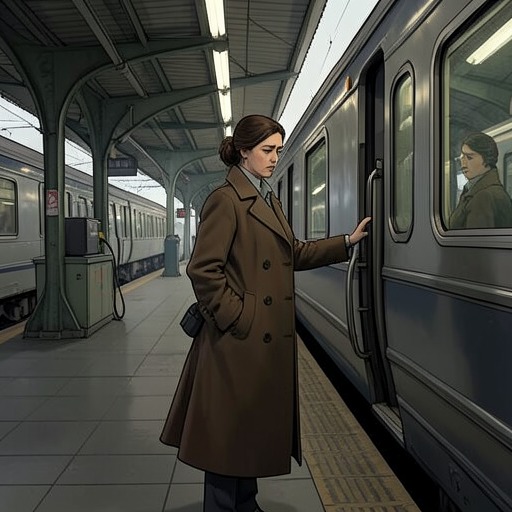
The importance of this friendship becomes clear when Andrew directs Don to Holly’s Facebook posts. Don initially sees no obvious reason for the referral. When he tells Blake the woman’s name, Blake immediately recognizes it: Holly travelled from Cambridge to London with Jane on the day Jane vanished. She is effectively the last person known to have seen Jane before she disappeared. Blake believes that Jane may have been picked up between King’s Cross station and Paddington by a dangerous man, but this is her inference, not a fact Holly has established. Holly’s presence in Jane’s final known journey gives the old disappearance a living witness, even though more than two decades have passed.
Holly responds promptly when Blake and Don contact her. In an email addressed to both, she says she has always been willing to do what she can to help Jane’s family learn the truth, while acknowledging that she may have little to contribute so many years later. Her openness contrasts with the long absence of a clear explanation for Jane’s disappearance. To Blake, Holly’s willingness also reinforces the sense that Andrew should not have been left to pursue the mystery alone.
The anonymous treatment and its source
During the visit, Holly explains that her benefactor first contacted her by email under the name Luscinia, Latin for nightingale. The writer claimed to work in pharmaceuticals and to be appalled by the high cost of effective medicines. She offered to supply Ditrimantelline anonymously, saying that disclosure could get her into trouble. Holly had heard of the drug’s success in the United States and accepted the offer. Eighteen months into treatment, she and Anna both describe its effect as transformative.
The arrangement is more complicated than a private act of generosity. Holly tells Don that a man visited a couple of weeks earlier after somehow learning that she was receiving money from the Nightingale account at Credit Suisse. He wanted to know why she was receiving it. Holly says he was a private investigator working for creditors of Jack Harkness, although he would not confirm that connection. She worries that Luscinia may be a Harkness Pharmaceuticals employee diverting company funds to pay for her medication. The investigator, she says, assured her that the payments were unlikely to stop before Harkness’s American court case had run its course, assuming he was extradited. Holly asks Don to keep her account private from Anna, explaining that Anna’s concern for her can sometimes distort her judgement. She also gives Don the investigator’s contact details in a way that avoids sending them by text.
The investigation later brings the funding back to Jane. Blake tells company representatives that money was diverted through the Nightingale account to pay for Holly’s Ditrimantelline, and Hertha demands an account of what she calls the unapproved use of company funds. The company’s representative argues that the sum is insignificant to its budget and that Blake has not proved Anna was placed in Holly’s life by Harkness Pharmaceuticals. That denial leaves the question of Anna’s role unresolved; it does not undo the connection between Holly’s treatment and the disputed account. A later disclosure identifies Jane, now known as Astrid, as the person who paid for Holly’s medication.
Personal relief within a larger danger
Holly’s treatment is not merely a clue in a financial inquiry. Ditrimantelline has given her a substantial improvement in her condition, and the novel sets that real benefit against the concealed interests surrounding its supply. Jane’s payment appears to be an act directed toward the comfort and well-being of her old friend. Yet the medicine is made by Harkness Pharmaceuticals, and the company’s products are part of a much wider scheme: the novel reveals that people who have used its drugs or cosmetics in recent years may have nanobots in their bodies. Blake later warns that Holly’s Ditrimantelline treatment will kill her, making the apparently benevolent gift inseparable from the danger of the programme.
Holly herself does not know the full meaning of the funding when she accepts the drug. Her story therefore holds together two scales that the investigation might otherwise separate: an individual’s practical dependence on an effective but costly treatment, and the corporate system that controls its production and distribution. The anonymous benefactor’s intervention gives Holly relief while withholding the identity and purpose behind the money. When that identity is traced to Jane, an old friendship becomes part of the present conspiracy. Holly’s importance lies not in solving Jane’s disappearance herself, but in showing how the private bonds left behind by that disappearance have been drawn into the machinery of Harkness Pharmaceuticals.