Jack Harkness
Panic RoomJack Harkness, born John William Harkness, is a Cornish-born pharmaceutical entrepreneur whose public career and private designs are bound together by secrecy. He builds Harkness Pharmaceuticals into an international power through beauty products and acquisitions, then faces allegations of massive financial misconduct and bribery. At Wortalleth West, a secluded house whose legal ownership is obscured, he has also prepared for a concealed purpose: a nanobot programme intended to intervene in climate change by reducing the human population. The contrast between the scale of his corporate influence and the secrecy of his private plans defines his role in the novel.
Identity and background
Harkness was born on February 29, 1956, and educated at Truro School and St John’s College, Cambridge, where he received scholarships and earned a first-class degree in Archaeology and Anthropology. Rather than pursue an academic career, he travelled. From 1978 to 1981, his whereabouts and activities are largely unknown; he then appeared in Switzerland as personal assistant to Lenore Furgler, who had inherited control of Furgler Gesellschaft, a medium-sized pharmaceutical company based in Basel.
During the 1980s, Harkness joined Furgler Gesellschaft’s board and took responsibility for company strategy. Lenore trusted him, though her three sons did not, and the family expected eventually to take control of the business themselves. Harkness married Mona Jackson, daughter of the millionaire builder Fred Jackson. They had no children; a later magazine interview with Mona referred to the tragedy of miscarriage. The couple divided their time among Basel, London, Monte Carlo, and Cornwall.
Building a pharmaceutical empire
In 1995, as Lenore’s health declined, she sold the company to Harkness. The price was substantial but not regarded as especially high, and the source of his purchase money remained uncertain. One circulating rumour linked it to a loan from Vladimir Drishkov, a Russian oligarch whose mining corporation was said to have been acquired corruptly. Drishkov was shot dead by unidentified assassins a few months later; the rumour is not established as fact, and the financing remains unexplained. What was clear was the result: Harkness took control, and the company became Harkness Pharmaceuticals.
The company expanded rapidly. Harkness established a research laboratory in Locarno, where Filippo Crosetti developed beauty products that helped make the business internationally prominent. The most successful was Elixtris, an anti-ageing cream launched in 2009. Its release helped the company withstand an economic downturn. Harkness also partnered with Quintagler Industries, a United States conglomerate, to finance acquisitions that eliminated or absorbed competitors in North America, Europe, and Asia. The company’s commercial success rested principally on Elixtris, but the later accusations against Harkness concerned a much broader structure of joint ventures, subsidiaries, and hidden financing.
Legal and financial crisis
By the time the investigation reaches him, Harkness is fighting extradition to the United States. A judge allows him to remain free on bail pending a full hearing, subject to electronic ankle monitoring. US prosecutors seek to try him on multiple counts of fraud, bribery, and embezzlement. Separately, Quintagler alleges that he diverted vast sums from their joint ventures over several years into subsidiaries of shell companies he ultimately owned. Those companies are also alleged to have supplied money for bribes to doctors prescribing Harkness Pharmaceuticals products. These remain allegations, not established convictions; Harkness faces the prospect of years awaiting trial and potentially decades in prison.
The investigators can account for only a fraction of the alleged money. According to the account presented to Blake and Don Challenor, the shell companies are based in tax havens with limited disclosure requirements, and the whereabouts or use of the remaining funds are unknown. One comparatively small exception is the Nightingale account, opened in London. It funds Holly Walsh’s Ditrimantelline treatment, an experimental drug she says has substantially improved her multiple-sclerosis symptoms. Her anonymous benefactor, using the name Luscinia, claimed to work in pharmaceuticals and to object to the high cost of effective medicines. Holly worries that the donor may be a Harkness employee diverting company money, but neither the source nor the suspected connection is confirmed. The treatment links Harkness’s pharmaceutical reach to an individual’s regained health, even as the opaque account intensifies questions about how his business operates.
Harkness’s manner in a confrontation with Blake offers a glimpse of how he frames the accusations. Asked whether he had taken money from his partners, he answers in effect that money cannot be stolen from its rightful owner. The response asserts entitlement rather than resolving the factual dispute. He also knows that he had lived at Andrew Glasson’s house in Helston before moving to Wortalleth West. When Blake raises the claim that he had a hand in Jane Glasson’s disappearance, he calls it a witch’s belief and answers her challenge with another challenge of his own. His words neither prove nor settle his involvement.
Cornwall, Wortalleth West, and old accusations
Harkness’s Cornish past is entangled with the Fry family’s longstanding feud with the Harknesses. Wynsum Fry has never accepted her brother Jory Fry’s drowning as accidental. Jory was twelve when he drowned in a rock pool at Poldhu Cove, and Calensa Fry later accused Harkness of holding him under the water. Maris Hemsley recounts that Calensa wanted the accusation printed, but that request did not make it independently verified. Calensa connected the family feud to opposing sides in the Cornish rising of 1648 and repeatedly emphasized that Jory drowned on August 1, 1970, Lammas. The novel preserves the accusation as a serious part of Harkness’s local history without establishing that he killed Jory.
Wortalleth West is another expression of Harkness’s secrecy. Amos French’s informants identify Harkness as the owner, although the legal title is not in his name. A resident housekeeper describes the estate as the refuge that saved her after Muriel expelled her; she believes it is one of Harkness’s greatest secrets and says that he knows little about her and does not give her much thought. His absence allows her to live there privately, but she also recognizes that this arrangement cannot last indefinitely. The house therefore functions both as Harkness’s concealed property and as shelter for someone whose safety depends on remaining unnoticed.
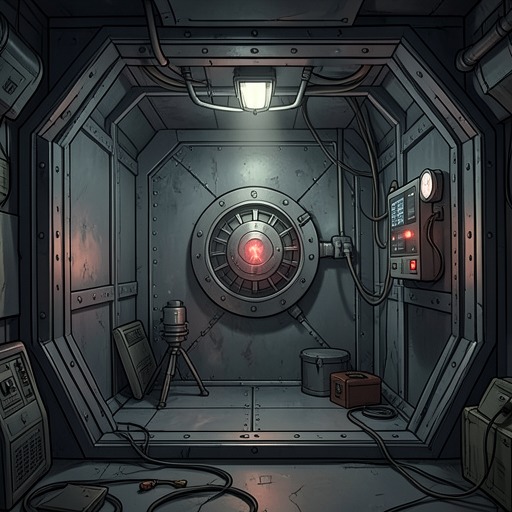
The house’s unusual security becomes an explicit subject when Harkness is asked whether it contains a panic room. Later, as Don faces danger inside Wortalleth West, Harkness tells him how to open the concealed room: behind Peter Lanyon’s painting Far West in the drawing room is a safe; a switch inside releases the panic-room door. He specifies that the safe has a three-number combination. The practical precision of this instruction confirms that the room is not merely a rumour or a defensive curiosity. Its access mechanism is part of a prepared system, and Harkness’s design gives the hidden room a role in the events that expose his larger plan.
The nanobot programme
The concealed project begins to emerge through financial and research anomalies. Investigators identify company-funded work in nanotechnology and bioelectronics with no obvious connection to ordinary pharmaceutical development. They also suspect that Filippo Crosetti has channelled a large additional package of funding without a recorded source, apparently arranged by Harkness. Crosetti insists the research is relevant, but the accounts and research areas point beyond the company’s conventional product business.
Harkness’s explanation, relayed at Wortalleth West, is that he wants to prevent catastrophic ecological loss and curb global temperature rise. He entered pharmaceuticals because he believed the industry could provide the means, recruited colleagues to develop the programme, and made nanobots the mechanism. For five years, he says, nanobots have been present in Harkness Pharmaceuticals drugs and cosmetics, including Elixtris and Fenextris. He also describes their distribution through food grown using the company’s pesticides and meat from animals treated with its antibiotics. Their presence is intended to be widespread: as nanobots leave people’s systems, production replaces them, extending exposure through the company’s products and manufacturing network.
The purpose turns the programme’s reach into a moral and political horror. Harkness argues that humanity is driving a sixth mass extinction and that sharply reducing the human population would lessen the danger to other species and restrain warming. He expects the number of deaths to be beyond anyone’s ability to count, while claiming that the result would keep temperature rise below two degrees. His stated end is environmental intervention; his means are mass killing on an immense scale. The ambition does not make the violence incidental: it is built into the plan itself.
Character and narrative significance
Harkness’s public crisis initially appears to concern the familiar machinery of corporate power: acquisitions, disputed accounts, shell companies, and alleged bribes. The later disclosure changes the meaning of the missing money and the obscure research budget. His apparent indifference to prosecution or imprisonment is presented not as proof of innocence or simple carelessness, but as evidence that he is pursuing an objective he considers larger than his own legal fate. Wortalleth West, the concealed panic room, the protected power supply, and the company’s global distribution system become parts of one preparation.
The novel does not resolve every question around him. His claim that money belonged to him does not settle the allegations against him; the suspicions surrounding Holly Walsh’s treatment do not identify Luscinia; and the charges involving Jane Glasson and Jory Fry remain accusations rather than proven facts in the evidence presented here. What the nanobot revelation does establish is the scale of Harkness’s capacity to convert commercial infrastructure into an instrument of social intervention. He is at once benefactor, accused executive, secretive property owner, and architect of a plan whose promised climate outcome depends on a catastrophic human cost.