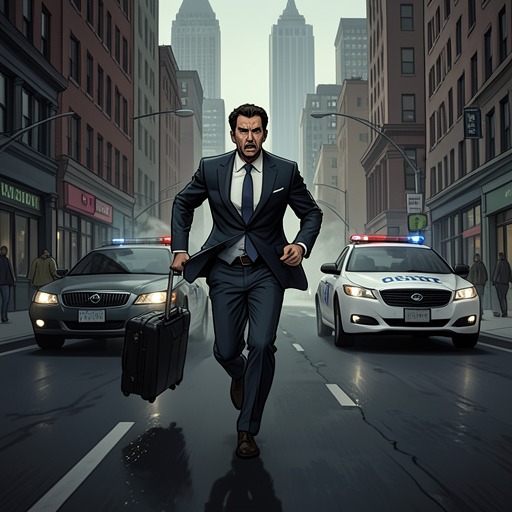
Jack Harkness’s escape from electronic monitoring
Panic RoomJack Harkness’s escape from electronic monitoring turns on a small but telling reversal: outside his London home, the ankle tag is visible on someone else, while Harkness later shows Don Challenor that his own ankles are free. Blake identifies the switch before Don understands what has happened. Harkness’s subsequent account reveals that the escape was not a single disappearance but a managed deception, designed to mislead the authorities while leaving him free to pursue his own plans.
Discovery outside 53 Belgrave Square
Don and Blake approach 53 Belgrave Square expecting the quiet frontage of a substantial London house. Instead, police cars are outside, radios are crackling, officers are at the entrance, and onlookers have gathered. A further police car arrives with its blue light flashing, and two detectives hurry inside. The sudden activity makes clear that something has happened, but the first visible clue to Harkness’s escape comes only when a young man is brought out of the house under police escort.
Blake tells Don to look at the young man’s left ankle. The electronic tag is there. She identifies him as the housekeeper’s nephew and concludes that the device belongs to Harkness: the two have somehow been switched. Don and a Spanish-speaking companion are astonished, both by the apparent exchange and by Blake’s ability to read the clue so quickly. Her inference transforms the arrest into evidence of an absence. The person being taken away is not Harkness; the monitoring device has been left on someone else.
The scene supplies a visual answer without explaining the mechanics. The tag is present, but its placement no longer confirms that Harkness is at home or in police custody. Blake believes he has given the authorities the slip, probably according to a plan made well in advance. At this stage, however, the precise means of escape remain unknown to Don and to the observers outside the house.
Harkness confirms the escape
The explanation comes later, when Don encounters Harkness despite believing that he is supposed to be confined to London. Don challenges him about the restriction. Harkness responds by hitching up his trouser legs and showing that neither ankle bears the tag. The gesture settles the immediate question: Blake’s reading of the switch was correct, and Harkness is no longer wearing the device.
Harkness does not present his freedom as accidental. He says that an expert helped him, but does not identify that person. The sparse explanation leaves the technical details undisclosed, while making clear that the removal was assisted rather than a matter of simply slipping out of the monitored arrangement. The earlier sighting outside 53 Belgrave Square and this later display of untagged ankles therefore form two halves of the same revelation: first the misplaced tag, then Harkness’s confirmation that it is no longer on him.
Don’s wariness is also part of the encounter. He has wanted to speak to Harkness, yet recognizes that Harkness serves his own agenda. Harkness appears relaxed and confident, and Don understands him as someone who knows what he is trying to achieve. The escape thus does more than restore Harkness’s ability to move around: it underscores the difficulty of treating his presence, explanations, or apparent circumstances as straightforward.
A staged departure and an improvised route
Harkness describes a second layer of the deception. He left his car in the long-stay parking area at Heathrow Airport and deliberately made himself visible to CCTV inside Terminal Five. The performance was meant to persuade the authorities that he had left the country. Rather than actually relying on that apparent departure, he travelled by accepting lifts. He describes this arrangement as a return to his student days, presenting the journey as enjoyable even as its practical purpose is to keep his movements difficult to track.
His account distinguishes the appearance of a route from the route he actually took. The parked car and airport cameras supplied the impression of an international departure; the lifts carried him onward. The authorities could be directed toward what the cameras seemed to show while Harkness continued elsewhere. The book does not specify who gave him each lift or how long the journey took, and his mention of expert assistance does not establish that the expert arranged the travel as well as the tag removal.
Harkness says he recognized Don’s MGB and approached him because Fran Revell had apparently mentioned which car Don drove. He describes their encounter as chance rather than a pursuit, and says that he had been relying on lifts since Heathrow. The explanation makes the meeting contingent on a recognizable car and a detail passed on by Fran, not on Don having deliberately sought him out. Harkness immediately presses to get moving: he and Don are heading to Cornwall for the same reason, he says, and the matter cannot wait. The escape therefore enables his onward journey at a moment when he regards delay as unacceptable.
Significance and limits of the episode
The escape is revealed through a sequence of contrasts: the apparently monitored young man is not Harkness; the apparent airport departure is not a departure from the country; and the confident man Don meets has no tag on either ankle. Each reversal depends on an ordinary sign being made misleading. The device remains visible, the cameras record what they are meant to record, and Harkness uses the gap between those appearances and his actual movements to remain free.
The episode also sharpens the distinction between Harkness’s immediate cooperation and Don’s mistrust. Harkness offers a shared destination and an urgent purpose, but Don has already judged that Harkness acts for himself. His escape has restored his mobility without making him more transparent: he withholds the expert’s identity and controls the account of how he travelled. The scene supplies enough information to establish the deception and its practical result, but not enough to explain every arrangement behind it.
In the wider plot, this freedom lets Harkness appear where Don does not expect him and press ahead toward Cornwall. The event is consequently both a practical evasion of electronic monitoring and a demonstration of how Harkness shapes what others believe they have seen. Blake first exposes the switch by interpreting the tag; Harkness later confirms it through the conspicuous absence of the device. Between those two moments, surveillance records an apparent departure while the actual journey proceeds by less visible means.