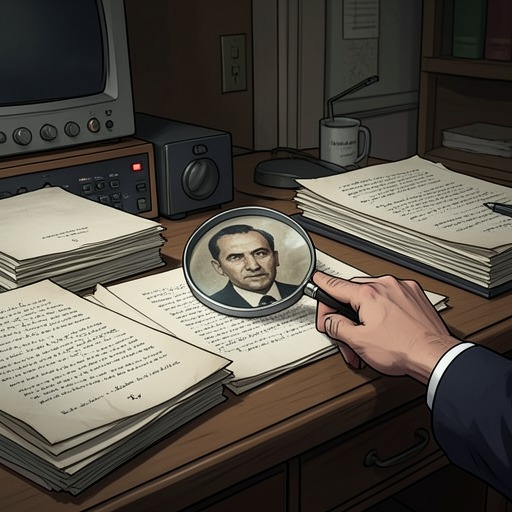
Keith Perkins
Panic RoomKeith Perkins is an investigator pursuing the Nightingale account and a wider web of suspected dealings connected to Jack Harkness. His importance lies in the questions he refuses to let the inquiry evade: who controls the account, how it fits into the allegations against Harkness, and what became of the much larger sums that remain untraced. He gives Don Challenor and Blake a point of contact with an investigation already confronting a gap between the money allegedly taken and the purpose for which it may have been used.
Introduction and First Meeting
Don calls Perkins using a number supplied by Holly Walsh, proposing an exchange of information because he and Blake are investigating something that may connect with Perkins’s work. Perkins sounds gruff and guarded, but sufficiently curious to arrange a meeting. Rather than discuss the matter over the telephone, he suggests a face-to-face conversation and chooses Fleet Services on the M3, a convenient rendezvous while he is travelling towards London.
Traffic delays Don and Blake beyond the agreed hour, but Perkins waits. They find him in the far corner of the car park, sitting on the raised tailgate of a dark green Volvo estate and watching as they approach. He is lean, heavy-browed, close-cropped and grey-haired, dressed in ordinary superstore casuals; his lined, weary face gives little away. He does not acknowledge them until they reach the car. When he confirms their identities, Blake objects to being addressed as Miss, and Perkins accepts the correction without fuss. His flat, faintly estuarine accent and neutral, non-committal manner reinforce the guarded first impression. The meeting begins not with warmth but with a cautious assessment of whether the two parties have enough to trade.
The Nightingale Inquiry
Perkins describes the operator of the Nightingale account as a person of interest because that person may connect a web of suspect dealings. He makes the proposed exchange conditional: if Don and Blake can identify Luscinia, the name associated with the account, he will share what his side has uncovered. The arrangement is carefully bounded. Neither side is asked to disclose everything over the telephone; both are invited to bring useful information to a meeting and judge its value in person.
That caution coexists with a clear willingness to cooperate. Don has introduced himself as working with Blake and frames their approach as mutually beneficial, and Perkins responds by setting a meeting rather than dismissing an unsolicited call. His role therefore opens a channel between separate lines of inquiry. The evidence does not establish the full scope of his position or the organization behind his investigation, but it shows that he is pursuing the account as part of a broader case, not treating it as an isolated curiosity.
Harkness, the Allegations, and the Missing Money
At the meeting, Perkins guides the discussion towards the mechanics of the accusations against Harkness, inviting Clarice Dow to explain the financial structure. The distinction between allegation and established fact remains important: Quintagler Industries alleges that funds were diverted over several years through subsidiaries of shell companies ultimately owned by Harkness. Those companies are also alleged to have been the source of bribes paid to doctors. The account of the case does not resolve either allegation into a proven finding.
The suspected bribes, Perkins and Clarice explain, account for only a fraction of the money supposedly diverted. The rest is the problem that drives his questioning. The shell companies are based in tax havens with limited accounting and disclosure requirements, making it difficult to discover what their records conceal. The Nightingale account, by comparison, was opened in London and contains only a relatively small amount. It offers a lead, but not an explanation of the billions Quintagler says may be missing. Perkins keeps the uncertainty visible rather than presenting the account as a complete solution.
His repeated focus is on what Harkness might have done with the money if the allegations are true: what he bought or what he used it for. He raises the possibility that the funds financed something on a very large scale, unknown to the people investigating him. This remains a question, not a conclusion. Perkins’s inquiry is shaped by the imbalance between the enormous sum alleged and the investigators’ inability to identify its destination. He also entertains a possible Russian connection in the surrounding suspicions: Zlenko, believed to have been employed by Vladimir Drishkov, survived Drishkov’s killing, prompting speculation that he may have betrayed his employer and that Amos French could be acting for a Russian blackmailer. Perkins presents this as an uncertain possibility, not a settled account of events.
Method and Narrative Role
Perkins is both an information-holder and a questioner. He does not simply deliver the results of an investigation; he identifies what those results cannot yet explain. During the briefing, he signals that the most consequential issue is the fate of the unaccounted-for funds, then turns to Clarice for the financial mechanics. His brief show of satisfaction with the explanation’s orderly presentation gives the exchange a self-conscious, almost staged quality, but the underlying problem remains stubbornly unresolved.
For Don and Blake, the encounter widens the frame of their investigation: the Nightingale account may connect their discoveries to the much larger allegations surrounding Harkness and Quintagler Industries. For the reader, Perkins makes the limits of the available evidence part of the mystery. The account is identifiable, its operator matters, and suspected routes through shell companies can be described; nevertheless, the largest question—what the missing money funded—remains open. Perkins’s contribution is to keep that gap at the center of the inquiry without mistaking a plausible hypothesis for an answer.