Mike Coleman
Panic RoomMike Coleman is the head of Sympergy, a renewables business whose work at Wortalleth West gives him a reason to investigate the house—and a dangerous temptation to profit from what he finds. His technical knowledge makes him an important source of information about Jack Harkness’s unusually extensive power system; his self-interest, however, turns that curiosity into an attempted trespass and a plan to sell secrets. Later, Coleman’s frozen body makes the cost of that venture brutally concrete.
Identity and First Impressions
Coleman is introduced as a businessman with affluent connections and a substantial sense of his own importance. He tells Don Challenor that he runs Sympergy, a company supplying wind turbines and solar panels, and describes himself as able to introduce potential buyers for Wortalleth West. He knows the local area: Sympergy’s offices are at Water-ma-Trout Industrial Estate in Helston, and he lives on the Lizard. His professional role and connections make him useful to Don, but Coleman’s offer of referrals is also the opening move in a negotiation about what he wants in return.
Blake recognizes him before Don can introduce the two men. Coleman arrives at Wortalleth West in a large red Mercedes convertible, roof down and music blaring. Blake recalls an earlier encounter from the previous October, when Coleman argued with Harkness in the study. Coleman shouted; Harkness stayed composed; something smashed shortly before Coleman stormed out. Blake did not then know Coleman’s name or what the argument concerned, but remembers his demand for a straight answer. Even in his anger, Coleman looked Blake over in a way she found lecherous, then offered what seemed to him a seductive smile. Her recollection frames his later confidence not as simple charm but as a combination of temper, entitlement, and intrusive attention.
The Power System and Coleman’s Suspicions
Coleman’s most consequential knowledge concerns Sympergy’s installation at Wortalleth West. A few years earlier, when he believed Harkness still legally owned the property, Harkness had hired the company to establish a large solar array in a rented field about half a mile inland. It supplied the house with independent power, supplemented by photovoltaic film on the south-facing walls of the house and garage. The film was transparent, less than a millimetre thick, and based on oligomer cells rather than silicon, making it deliberately difficult to notice.
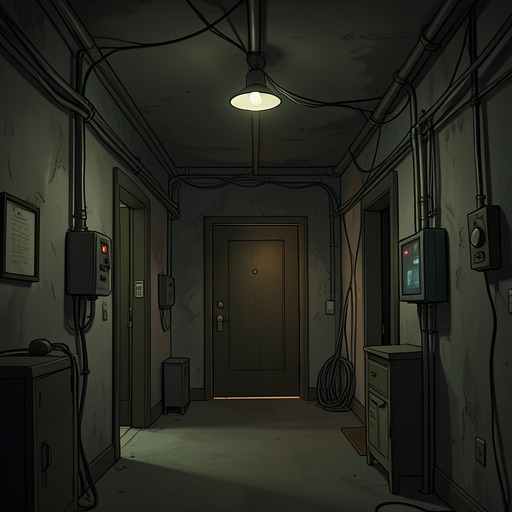
Sympergy had also supplied Harkness with a large flow battery: a rack of modules about as high as a room. Coleman stresses that the property’s independent supply is excessive and cannot understand where the battery went or what required so much electricity. His detailed account establishes the scale and concealment of the system, but also the limits of what he knows. Don has already thought of an explanation involving the panic room and deliberately keeps it from Coleman. The difference between Coleman’s technical expertise and Don’s guarded knowledge gives their conversation its tension: Coleman can identify the anomaly, but he cannot see the hidden purpose behind it.
Coleman’s suspicions extend from the equipment to the way the contract was handled. He says the arrangements were made through a contact called Schmitz at Harkness’s Swiss headquarters, not directly with Harkness. Schmitz then became unreachable, and Harkness’s human-resources staff claimed not to know him. Coleman says the bills were not paid by Harkness Pharmaceuticals, but through a Swiss shell company, although maintenance money continued to arrive. After Harkness’s arrest on allegations including bribery and embezzlement, Coleman begins to wonder whether Schmitz and an off-the-books operation were part of something larger. He also suspects Harkness arranged for the original house plans to go missing. These are Coleman’s theories, not established explanations, but they show how the hidden power infrastructure draws him toward the house’s wider secrets.
From Inquiry to Trespass
Coleman proposes that he and Don search Wortalleth West, find the battery, and work out what it powers. He wants to sell the resulting information to Quintagler Industries in the United States, believing it could earn both men a great deal of money. The plan exposes the gap between his stated interest in renewables publicity and his actual aim: although he had hoped Harkness would publicize Sympergy’s work, Coleman now treats the installation’s secrecy as a tradable asset. Don refuses to participate, citing the likely objections of Mrs Harkness or her lawyer.
Rather than accept the refusal, Coleman announces that he will look around on his own and heads for the basement. When Don tries to stop him, Coleman warns him off, claiming that whatever Harkness’s system is doing could be a valuable discovery. The confrontation is interrupted by Glenys Probert, who blocks Coleman’s way in her gardening clothes, carrying a hoe. She makes clear that, though she is staff, she can intervene in the house’s comings and goings if necessary. Coleman’s bluster diminishes, and he pretends he had only been talking with Don. Glenys’s presence prevents his attempted search from proceeding at that moment, but does not resolve his fixation on the property.
Coleman also turns up when Fran Revell is at Wortalleth West. He introduces himself as being from Sympergy Renewables and says Robin Pawley had suggested they might meet, though Fran has not been told of the arrangement. During their exchange, a heavy, fragmentary sound comes from upstairs. Coleman does not react, and Fran notices that he appears to be making a particular effort not to. The episode adds another note of unease to his visits without clarifying what he knows about the sound or why he suppresses his response.
Murder and Narrative Significance
Coleman’s story ends in the discovery of his body. Don and Harkness open a freezer and find a blond-haired man in a pale suit dusted with ice: Harkness identifies him as Coleman. His head falls against the door, preventing it from closing, and Don has to push it clear before seeing Coleman’s grey-white face and staring eyes. The scene transforms the earlier references to a red Mercedes and a missing battery into part of a much darker chain of events: Coleman is no longer merely an intrusive visitor but a murder victim whose presence in the freezer demands explanation.
Harkness speculates that Coleman’s irritating manner and habit of manipulating situations to his own advantage may have brought him into conflict with Zlenko, who can react violently when provoked. This is presented as Harkness’s guess, not a complete account of Coleman’s death. The uncertainty matters: Coleman’s greed and aggressiveness help explain why he repeatedly pushes into dangerous situations, but they do not establish who killed him or exactly what happened. His Mercedes is later identified by Harkness in the garage, and Fran recognizes it as Coleman’s when she is led into the yard during the events surrounding her release. The car’s recurrence after his death gives the missing man a continuing material presence even as the investigation turns toward the living conspirators.
As a character, Coleman connects renewable-energy technology to the concealed design of Wortalleth West and links the house’s hidden systems to the financial suspicions surrounding Harkness. He is both a source of concrete technical detail and a compromised investigator: he sees that the power supply is disproportionate, but his proposed response is to monetize the discovery rather than clarify its purpose. His death marks the danger of approaching the house’s secrets as a private business opportunity, while the unresolved circumstances keep his murder within the larger mystery.