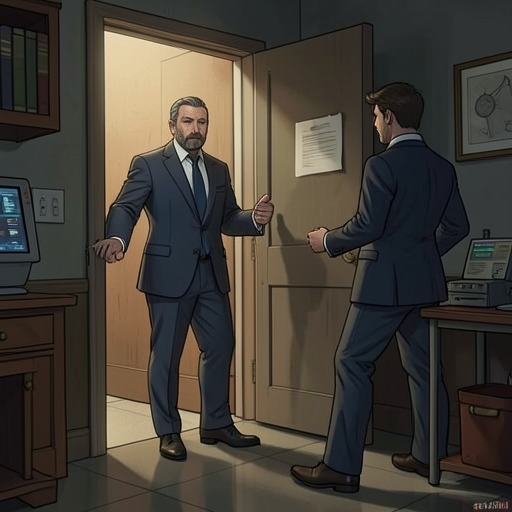
Rex Challenor
Panic RoomRex Challenor is Don Challenor’s father, a once handsome, debonair man-about-town whose later life was marked by failed business ventures and heavy drinking. The novel presents him chiefly through Don’s retrospective account: first as the source of a family resemblance Don would rather minimize, and then as the dead man Don found after several days alone. That gap between the polished man of the past and the ruined body of the present makes Rex’s fate one of the most disturbing memories in Don’s history.
Identity and Background
Don sees Rex’s fecklessness as part of his own inheritance. After losing his position at Mendez Chinnery, Don explains his departure by blaming the narrow-mindedness of the firm rather than his own corner-cutting. The narration links that self-protective explanation to a family pattern: Don has inherited more of his father’s irresponsibility than he cares to admit, and, like Rex, he avoids acknowledging his part in the consequences. This resemblance is not a complete account of either man, but it gives Don’s account of Rex an uncomfortable personal edge: the father is not only someone Don mourns, but a precedent Don recognizes in himself.
The few details of Rex’s decline are bleakly concrete. His business ventures had failed; cheap supermarket vodka and the growing certainty that his luck would not turn again left him with no way out. In Don’s recollection, this is the situation that preceded Rex’s death. The account does not describe a recovery or a change of course. Instead, these accumulating failures form the background against which the discovery of his body becomes possible.
Death and Discovery
In the summer of 1995, a neighbour summoned Don to Rex’s flat in Honor Oak, complaining about flies and a bad smell. Don had a spare key. Before entering, he already feared that he knew what he would find: his father had been going downhill for some time. Yet that expectation did not prepare him for the physical reality. Rex had been dead for several days, undiscovered, and his body was decomposing, rotting and crawling with maggots. The flies and the stench turned an anticipated loss into an immediate, bodily horror.
The contrast between expectation and encounter is central to Don’s memory. He had prayed that his suspicion was wrong, but the knowledge he had formed in advance could not lessen what he saw. The sight of Rex’s ruined body clashed with the image of the handsome, debonair man-about-town Don remembered. Death had not merely confirmed the end of Rex’s decline; it had made the distance between that earlier image and the neglected body impossible to ignore.
When Don later speaks with Maris Hemsley about his gloomy thoughts, he identifies his father and how he died. He specifies that Rex died of alcohol poisoning and was not found for several days. The brief disclosure makes explicit what the earlier recollection shows in visceral detail: Rex’s death was both alcohol-related and lonely, and the delay in finding him remained part of what Don carried forward.
Memory and Don’s Self-Image
Rex also returns in a dream. After a poor night’s sleep, Don dreams that he is a child walking in the countryside with his father and Patch, the dog who had arrived when Don was five. Although Patch is fully grown in the dream, he runs into a wood; Don follows, searches for him, and cannot find him. The scene is not an account of an event in Rex’s life, but a remembered image in which the father appears alongside Don’s childhood and the loss of the dog. Its unresolved search echoes the story’s other, harsher absence: Rex’s death, which Don could not truly anticipate despite knowing that something was wrong.
The dream fades, but the recollection of Rex’s death does not remain safely in the past. Don is usually a phlegmatic manager of his memories and is not often caught out by them. Here, however, the memory breaks through while he is already strained by the complications surrounding Jack Harkness. Its return shows that Don’s composure has limits: he can explain away responsibility in his working life, but he cannot reduce the discovery of his father’s body to an account that leaves him untouched.
Narrative Significance
Rex’s role is therefore brief but consequential. The book supplies no extended portrait of his independent life; instead, it lets Don’s memories assemble a character from inherited fecklessness, failed ventures, vodka, childhood companionship, and a death discovered too late. These details connect family history to Don’s present habits without making the two men interchangeable. Don recognizes a likeness in their evasions, while the horror of Rex’s end marks the cost that lies behind that resemblance.
The recurring contrast between Rex as a living, debonair man and Rex as a body left undiscovered gives Don’s recollection its force. The memory is not simply a piece of background explaining Don’s character: it becomes an interruption in his present, surfacing in a dream and then in conversation. Rex’s significance rests in that persistence. Though absent from the action, he remains a measure against which Don’s conduct and self-understanding are unsettled.