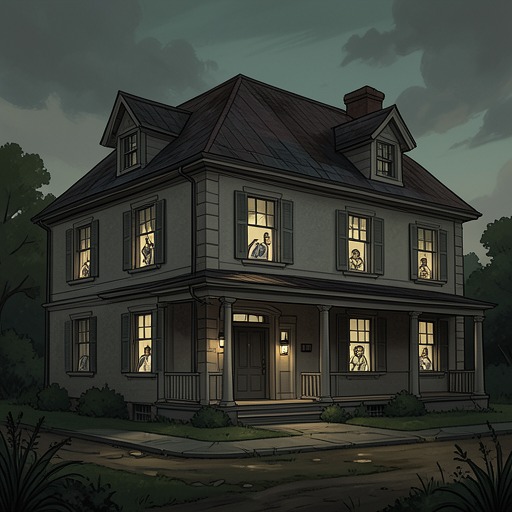
Surveillance and Privacy
Panic RoomSurveillance and privacy form a recurring tension between what can be watched and what remains concealed. At Wortalleth West, Jack Harkness’s hidden system turns the house into a record of its occupants’ movements, yet its most secret space escapes that record. Elsewhere, a warning about the traces people leave online extends the same problem beyond the house: privacy depends not only on what people disclose, but also on who can observe them and how carefully they try to evade observation.
The Architecture of Watching
The surveillance system is revealed in the room behind a mirror, where the lights are off but standby indicators and screens continue to glow. Off-line computers sit in darkness beside red digital clocks displaying seven time zones: London, Frankfurt, Moscow, Beijing, Tokyo, Los Angeles, and New York. The carefully arranged clocks suggest an operation oriented across distance and time, while the flickering screens make the house itself its immediate field of vision.
The cameras are concealed in ordinary features of the building: light fittings, cornices, and intrusion sensors. Their placement makes surveillance difficult to distinguish from the fabric of the home. A screen shows Don Challenor approaching the mirror and standing close to it for a minute or more; another picks him up in the bedroom, and a third shows Blake stirring porridge at the kitchen hob. A further image catches Don on the landing. Private routines become a succession of views available to an unseen observer.
The system records not just people in motion but also rooms in which nothing happens: empty chairs and tables, stretches of hallway, a gym full of equipment, and a wine cellar lined with bottles. Its scope includes the comings and goings of Wortalleth West and its much longer periods of absence. The declaration “Everything is seen. Nothing is missed.” makes the system’s ambition sound absolute. The claim is chilling precisely because the screens show mundane domestic activity as well as the emptiness between visits: surveillance gathers both events and their apparent lack.
The Hidden Center and Its Limits
The room that houses the computers and screens is itself outside the system’s gaze. The narration identifies it as the “invisible centre of the house,” where what Jack Harkness has prepared remains “unobserved and unsuspected.” This is not simply a technical gap in coverage. The surveillance apparatus can display the surrounding rooms while leaving its own center secret, dividing the house into spaces that are watched and a space from which watching is organized.
That contradiction limits the system’s claim to total knowledge. Its records may encompass rooms, occupants, routines, and absences, but the hidden room preserves an interior beyond the visible network. The scene therefore makes privacy uneven rather than simply absent: those moving through the house are exposed to cameras they cannot see, while the concealed observer retains a protected position. The more comprehensive the monitoring appears, the more consequential its undisclosed blind spot becomes.
From the House to the Network
The concern widens beyond Wortalleth West when a conversation turns to the Web and a person’s work in the “funky furniture business.” Asked how he learned about it, the speaker replies, “The Web.” The answer is followed by the assertion that everyone is online whether they know it or not, and that people leave traces as they move through the world. The warning is not limited to deliberate publication: a person can be discoverable without considering themselves present on the network.
The exchange gives this broad claim a personal edge. The speaker says the other person has not been quite careful enough, then asks whether he has any savings. The shift from knowledge of someone’s livelihood to a question about money makes information feel like leverage. Surveillance here is not a camera in a room but an ability to assemble knowledge about another person and use that knowledge in a conversation. The text does not specify how the Web information was obtained; its force lies in the unsettling fact that the speaker knows it, while the person addressed believed they were not online.
Insecurity, Knowledge, and Power
A separate exchange makes the same uncertainty explicit in relation to communication. Don is about to answer when he wonders whether the phone line is secure and whether anything is secure. He cuts off the topic and tells the other person that they have put him in the middle of a serious mess, while insisting that Blake is an innocent bystander. The abrupt retreat registers how suspicion of interception changes what can safely be said: the conversation itself becomes a possible exposure.
Across these scenes, privacy is less a stable possession than a contest over visibility and knowledge. Don questions the security of a phone call; the Web conversation suggests that people leave traces without knowing it; and the hidden system at Wortalleth West records ordinary life while keeping its operators’ room out of sight. The contrast between screens that appear to miss nothing and a secret center that remains unseen prevents surveillance from becoming omniscience. It instead presents monitoring as an exercise of unequal access: one party is watched, another watches, and the person being watched may not even know that the distinction exists.