Sympergy Ltd
Panic RoomSympergy Ltd is a renewable-energy company that supplies wind turbines and solar panels. Its work at Wortalleth West gave Jack Harkness a dedicated, independent power supply on a scale that appeared excessive even to the supplier. That arrangement makes the company relevant to the novel’s investigation of the house’s concealed spaces and systems, although the evidence does not establish that Sympergy Ltd knew what Harkness intended to power or was involved in his secret plans.
Corporate profile and commercial reach
Mike Coleman describes Sympergy Ltd as a renewables outfit supplying equipment such as wind turbines and solar panels. Its offices are at the Water-ma-Trout Industrial Estate in Helston. Coleman also presents the company as commercially well connected: he tells Don Challenor that he has affluent clients who might be interested in Wortalleth West and offers to introduce suitable prospective buyers. The offer is part of Coleman’s effort to draw Don into a cooperative relationship, rather than evidence that a sale is arranged.
Coleman’s account emphasizes the company’s role as both supplier and commercial intermediary. He says Sympergy Ltd had technology that put it ahead of competitors, and that Harkness appreciated its capabilities. In particular, the company supplied the unusually specialized energy equipment Harkness wanted for the property. Coleman had hoped the transaction would also provide favorable publicity by associating a pharmaceutical billionaire with renewable energy, but Harkness did not participate in that promotion.
The Wortalleth West installation
Several years before Coleman’s conversation with Don, Harkness hired Sympergy Ltd to establish a large solar array in a field he had rented about half a mile inland from Wortalleth West. The array was intended to provide the house with an exclusive power supply. The installation extended beyond the field: photovoltaic film was fitted to the south-facing walls of the house and its garage block. Coleman explains that the film was transparent, less than a millimetre thick, and based on oligomer cells rather than silicon. Its discreet appearance helps explain why Don had not noticed it during his visit.
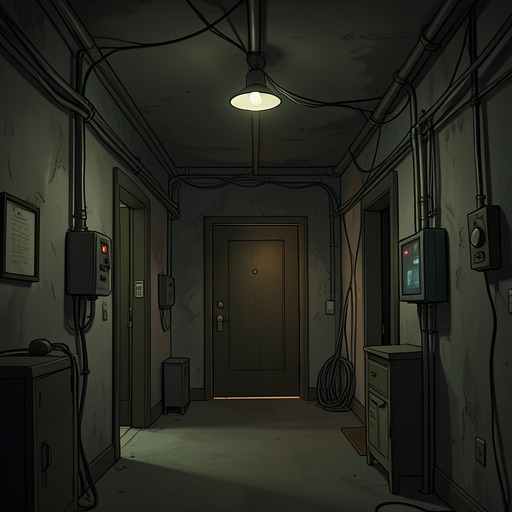
The installation also included a substantial flow battery, which Coleman says Sympergy Ltd supplied as backup for periods without sunlight. He describes it as a full rack of modules about as high as the room where he and Don are speaking, with a large capacity and a high price. Coleman contrasts it with lithium-ion batteries, but breaks off before explaining the technical comparison. The detail that matters to his account is the scale: the system combined an off-site solar array, building-mounted generation, and a sizable means of storing electricity.
An unexplained scale and a missing component
Coleman says the independent supply was excessive for what he could understand about the property’s needs. The absent flow battery sharpens his concern: despite having sold a rack of modules, he cannot find out where Harkness put it. Don recognizes that a concealed space could be an obvious explanation but does not tell Coleman about the possible panic room. The battery therefore becomes a clue in two investigations at once: Coleman is trying to account for an expensive piece of equipment, while Don is withholding a possible connection to the house’s hidden architecture.
The uncertainty extends to the suspected panic room’s utilities. A steel barrier might be a door to a chamber spanning two floors, but the inspection described in the novel cannot trace the expected electrical cables, air supply, or separate phone line. The possibility that those services are well shielded remains open. This does not prove that Sympergy Ltd installed or concealed the room’s systems; it does, however, place the company’s independent-power contract alongside the unresolved question of how a hidden chamber could operate.
Contractual opacity and narrative significance
Coleman says he did not deal directly with Harkness on the contractual side. Instead, the arrangements were made through a person called Schmitz at Harkness Pharmaceuticals headquarters in Switzerland. Schmitz later became unreachable, and Harkness Pharmaceuticals’ human-resources staff told Coleman they had never heard of him. When Coleman checked the paperwork, he found that the bills had not been paid by Harkness Pharmaceuticals but through a Swiss shell company. Payments for maintenance continued, leaving Sympergy Ltd with money coming in even as the original transaction became difficult to trace.
That payment trail leads Coleman to suspect that the project may have belonged to a larger off-the-books operation, particularly after Harkness was arrested and accused of bribery and embezzlement. His suspicion is not proof of corporate complicity: the account presents Coleman as puzzled by the arrangement, and his dealings with the property are evidence of supply and maintenance, not of knowledge about Harkness’s purpose. The gap between routine servicing and opaque ownership is precisely what makes the contract useful to the investigation.
The later disclosure that Harkness’s system at Wortalleth West could initiate Cascade gives the house’s power infrastructure a far more dangerous context. Sympergy Ltd’s installation helps establish that Harkness arranged independent, unusually extensive energy provision, but the novel does not identify the company as a participant in Cascade or show that it understood the system’s function. Its narrative importance rests on that distinction: ordinary renewable-energy equipment becomes part of the trail toward a hidden operation, while the supplier’s actual knowledge remains uncertain.