The panic room at Wortalleth West
Panic RoomThe panic room at Wortalleth West is a hidden, steel-lined chamber whose security system becomes a mystery in its own right. Concealed behind a mirror-fronted door and designed to let an occupant observe the house without being seen, it seems to offer absolute protection. But when Don Challenor discovers its entrance shut and locked from the inside, the room’s reassuring purpose reverses: its sealed door raises the possibility that someone is trapped within, while the system’s failure to behave as expected makes the house feel unsafe.
Concealed Entrance and Construction
The room first becomes legible through a small physical clue in a closet. Don Challenor approaches the mirror and presses its frame at about waist height. A click releases the mirror-fronted door, which swings open to reveal solid steel behind it. The concealed mechanism makes an ordinary-looking reflective surface part of the house’s security architecture; the entrance is not simply hidden from view but disguised as something else.
Don taps the steel and judges it very thick, probably impenetrable, and certainly concealing something. The discovery is therefore material before it is explanatory: the steel barrier is unmistakable, but its purpose and what lies beyond it remain unknown. Don suggests that he has seen comparable arrangements in London houses, though only on a single floor. At Wortalleth West, the possibility that the structure connects with the void below makes the arrangement unusual.
Intended Function and Security
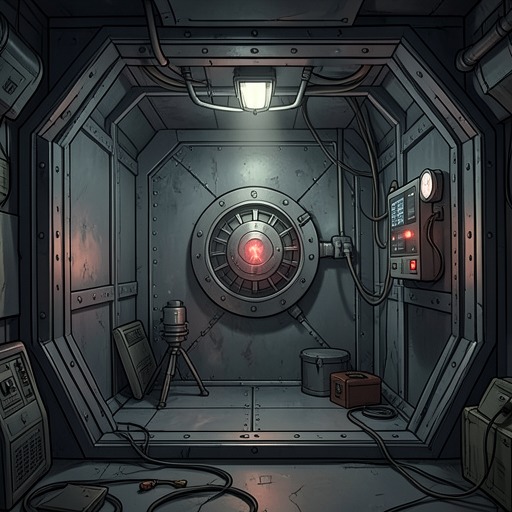
Don’s working interpretation is that the hidden chamber is a panic room: a retreat in which a householder could take shelter from an intruder. He expects it to have independent lighting and communications, allowing its occupant to remain secure while separated from the rest of the house. The later description makes the arrangement more elaborate still. The room is enclosed within the house, walled in steel, and fitted with cameras through which someone inside can observe every other room while remaining unseen themselves.
Its door defines the room’s unusual security rule. It can be opened only from the inside, and only if somebody within chooses to open it. Without that action, it remains sealed. The protection is described as absolute, but it is also conditional: the system depends on the person inside being able and willing to operate the door. Its strength and secrecy thus make the chamber both a refuge and a place from which an occupant may be inaccessible.
The Sealed Door and the Technical Puzzle
The immediate concern is that the entrance is not in the state Don expects. A panic-room door, he reasons, should be open; this one is shut and locked from inside. Blake, who had been prepared to invent a threat, is unsettled by the discovery that the locked room is real. The question of whether someone is inside follows directly from the apparent direction of the lock: the house’s hidden protective feature now suggests possible confinement.
A later inspection complicates that inference rather than resolving it. The steel barrier could be a sliding door with a two-floor chamber behind it, but the inspector cannot trace the independent electrical supply or air system that should serve such a room, nor a separate phone line. Those connections may simply be so well shielded that they cannot be detected. The absence of visible evidence therefore leaves two readings open: the expected systems may be present but concealed, or the room may not function as its design suggests.
The proposed explanations for the sealed state are likewise tested against the room’s intended safeguards. Don considers whether the door is faulty or whether someone triggered it to close and lock before jumping out. The inspector objects that a fail-safe should prevent the latter, and that a fault should leave the room accessible even if it is non-functional. Neither suggestion provides a secure explanation. The chamber’s defining rule—that it opens only from inside—makes a closed door consequential, while its apparent technical irregularities prevent the rule from yielding a definite answer about what happened.
Narrative Function
The room turns the architecture of Wortalleth West into an instrument of suspense. Its entrance is revealed by a hand pressed against a mirror frame, but that discovery exposes only another barrier: steel. The progression from familiar surface to concealed mechanism to impenetrable-looking door delays knowledge at each step. The uncertainty is not merely about what the space contains; it is also about whether the house’s elaborate protective systems can be trusted.
That tension sharpens the contrast between security and safety. The room is designed to let an occupant see without being seen and to withstand intrusion, yet its sealed state makes the characters consider the possibility of an unseen person within it. The later failure to locate the expected utilities leaves the chamber’s actual operation uncertain. At the point described, neither the presence of an occupant nor the reason for the locked door is established. The panic room’s significance lies in this unresolved reversal: the feature meant to guarantee safety becomes a hidden enclosure whose silence invites suspicion.