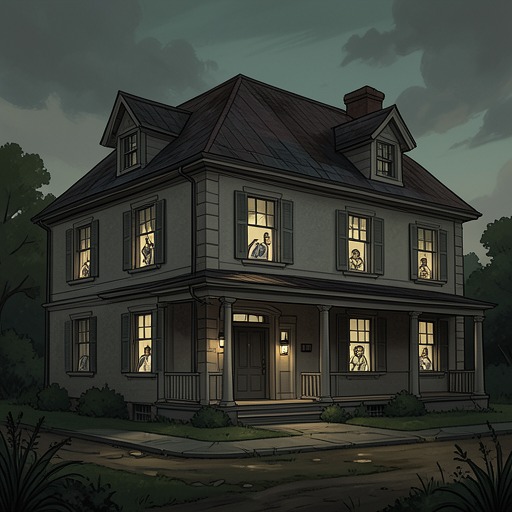
The sealed panic-room mystery
Panic RoomThe sealed panic-room mystery at Wortalleth West transforms a hidden architectural space into a threat that cannot be seen or safely dismissed. Don Challenor discovers a mirror-fronted steel door whose design suggests a room that can be secured only from within; because it is already shut, neither he nor Blake can establish whether anyone is on the other side. The uncertainty expands beyond the door itself: cameras may allow an occupant to watch the house without being watched, while the occupants of the house cannot know whether they are alone.
Discovery in the house
Don’s investigation begins with a mismatch between the house’s visible layout and its internal spaces. His measurements and a sketched plan suggest that the closet in the master-bedroom dressing room lies above a space missing from the study, but the closet does not extend far enough to account for it. There is another unexplained void. The discrepancy makes the house’s architecture a problem to be read: ordinary rooms and walls conceal a volume that the layout does not explain.
The closet’s arrangement sharpens the puzzle. Clothes in protective covers line racks along either side of a central walkway, which ends at a floor-to-ceiling mirror. Don pushes at the frame at about waist height. A click releases it, and the mirror swings open as a door, exposing solid steel. The reveal converts a familiar domestic object into a boundary, while the mirror’s reflected image of Don and Blake had offered no visible indication of what lay behind it.
Don recognizes a possible parallel with arrangements he has encountered in houses he sold in London, but notes that those occupied only one floor. Here, the unexplained space may connect vertically with the void below. He proposes a panic room: a retreat from an intruder, equipped with independent lighting and communications. This is an informed guess, not a complete explanation of the hidden structure; the unusual connection between floors is part of what makes the discovery difficult to interpret.
A door locked from within
The proposed function gives the steel barrier its disturbing significance. Don identifies it as a sliding door that can be locked only from inside. By his reasoning, the door should be open if the room is unoccupied; instead, it is shut and appears to have been locked from within. Blake’s immediate fear is that someone may be inside. The possibility is not proof of a person’s presence, but the door’s apparent operating rule makes absence difficult to verify: those outside cannot simply open it and settle the question.
The house’s later description clarifies both the security and the trap. The panic room is an enclosed steel space nested within the building, equipped with cameras that let an occupant observe every other room while remaining safe from observation. Its door cannot be opened from outside. It will remain sealed unless someone inside wants to open it. The same mechanism that offers absolute protection to whoever is within therefore prevents everyone else from confirming whether the space is occupied. The room is not merely concealed; its security conceals the nature of what it contains.
The unresolved engineering
Dale’s inspection supplies a second, technical line of inquiry without resolving the first. He says the steel barrier could be a sliding door and that the space behind it might form a two-floor chamber. But he cannot trace the independent electrics or air supply that such a room should have, nor the separate phone line. Those systems might be present but well shielded; his inability to find them does not establish that they are absent.
Dale also questions whether the room could have become sealed through a fault or through someone triggering the mechanism and then leaving. A fail-safe should prevent a person from closing and locking the door before jumping out. A fault, in turn, should leave the room accessible even if it no longer functions. These expected protections make the apparent state of the door harder, not easier, to explain: the room seems sealed in a way the design should prevent. The distinction between an unworkable system and an inaccessible one keeps the human possibility alive without confirming it.
Surveillance and domestic fear
The cameras turn the mystery outward, into the rooms beyond the steel. After Dale leaves, Blake looks again at the wall behind the wardrobe mirror and imagines the view an occupant might have of her through the hidden system. Her fear is not only of an intruder emerging from the room. It is also of being watched without knowing when, or by whom. The possibility of surveillance makes familiar spaces feel exposed, while the concealed observer remains protected from view.
Don experiences a related unease. The house seems to him at once empty and solid, hollow and somehow filled. He cannot know whether Blake imagines herself on the panic room’s camera screens; he admits to imagining it himself, and finds the thought physically unsettling. Their reactions connect the room’s two forms of concealment: the hidden volume interrupts the house’s apparent completeness, and the possible cameras interrupt the occupants’ sense of privacy. The fear depends on not knowing whether the imagined watcher is real.
Narrative role and limits
The discovery unfolds through inference rather than an immediate opening of the door. A measured gap in the house’s layout leads to a mirror, a concealed steel barrier, and a plausible function; each answer generates a more consequential question. The narrative supplies enough mechanical detail to make the danger legible, but withholds the decisive evidence that would identify an occupant or demonstrate that the room can be opened from outside. The reader is held at the same boundary as Don and Blake.
That withheld confirmation is the mystery’s governing condition, not a minor gap awaiting an easy technical solution. The room is designed to protect someone from observation and intrusion, yet its sealed state also makes protection indistinguishable from confinement. The cameras promise knowledge to whoever is inside and deny it to those outside. Until the door opens, the house’s apparent emptiness cannot be trusted, and the steel room remains both a possible refuge and a possible hiding place.