Tredarvas Farm
Panic RoomTredarvas Farm is a ruined former tenant farm near Mullion, remembered as both the setting for Maris Hemsley’s meetings with Calensa Fry and the birthplace of Wynsum Fry. The place links the Fry family’s long-held history and beliefs to later events: an accusation concerning Jory Fry’s death is recounted there, a proposed ritual is tied to Wynsum’s birthplace, and Don Challenor names the farm as a destination during a confrontation involving Jack Harkness, Amos French, and Gennady Zlenko.
Setting and history
The Frys had been tenants of Tredarvas Farm, but by the time Maris visited, the farm was a ruin. The family had abandoned the land and remained in the house for a time. Later, it is located more precisely as a ruin in a field off Ghost Hill, near Mullion. The accounts establish both its former domestic use and its later condition, without describing the surviving buildings in detail.
The farm also carries a family history that reaches beyond the immediate events. Calensa tells Maris that the Harknesses and the Frys have been in conflict for generations, and that they stood on opposing sides in the Cornish rising of 1648. The location is not presented as the cause of that feud, but as one of the places where its history and beliefs are passed on. Maris observes that the Frys experience time differently: for them, old grievances do not simply heal. Tredarvas thus anchors a family past that remains active in the present.
Maris’s visits and Calensa’s accusation
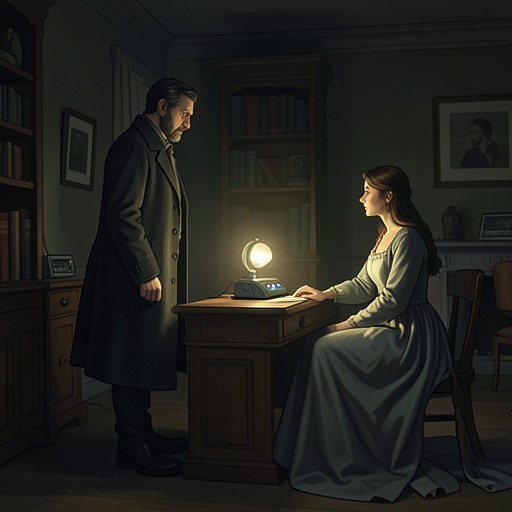
Maris went to Tredarvas whenever she met Calensa; Calensa did not visit her in return. Their meetings took place in the kitchen, and Maris never saw further into the house. That repeated, limited setting gives the conversations a particular boundary: Maris can report what Calensa said there, but her knowledge of the household itself remains narrow.
At the farm, Calensa declared her certainty that Jack Harkness had murdered her grandson, Jory Fry. She alleged that Harkness had held Jory face down in the rock pool where he was found until he drowned, on 1 August 1970, which was Lammas. The account places Calensa’s declaration at Tredarvas; it does not place Jory’s death at the farm. Calensa offered no evidence beyond Wynsum’s sighting of Harkness cycling away up the hill toward Mullion as she approached the cove while searching for Jory, who had not appeared for breakfast. The distinction matters: the farm is the remembered setting for an accusation, not the stated scene of the drowning.
Calensa also tried to enlist Maris’s writing. She wanted Maris to accuse Harkness in print, but Maris could not fit the claim into an academic study of witchcraft, and the allegation lacked evidence. Tredarvas therefore becomes a place where private conviction is pressed toward public record, while Maris’s account preserves both Calensa’s certainty and the limits of what she could substantiate.
Birthplace, ritual, and return
Tredarvas acquires another significance through Wynsum’s birth there. A dewitcher whom Maris consulted after Fry began troubling her told her that breaking a witch’s hold required burning something the witch had worn next to her skin at the place of her birth. The instruction makes the farm a site in a proposed counter-ritual. Maris had a parcel containing the item the dewitcher said she needed, but she never acted on the advice. The evidence does not identify the parcel’s contents, and the ritual remains proposed rather than performed.
Much later, the birthplace becomes a practical destination in a crisis. With Zlenko pressing a gun to Harkness’s neck, Zlenko asks where Wynsum was born. Don answers that it was Tredarvas Farm, describing it as a ruin near Mullion, and says Jack knows where it is and can take them there. Harkness confirms that he could lead them, though his answer is cut short. Don then names the farm as the place to go. French threatens Don, while Zlenko orders the car turned around. The scene establishes a decision to head for Tredarvas, not the group’s arrival there.
Narrative significance
The farm’s significance accumulates through recurrence rather than detailed description. It is a former home, the setting of Maris’s constrained meetings with Calensa, Wynsum’s birthplace, and the destination selected in a moment of danger. Each return gives the same place a different function: family history is recounted there, supernatural belief makes it a potential ritual site, and the confrontation makes it a route toward an unresolved next step.
Tredarvas also connects memory to action without settling the truth of the old accusation. Calensa’s claim about Jory remains unsupported beyond Wynsum’s sighting, and Maris never carries out the dewitcher’s instruction. Yet in the later confrontation, knowledge of the birthplace is treated as immediately useful. The ruined farm consequently stands less as a fully explored setting than as a fixed point in the characters’ accounts—a place whose remembered past repeatedly draws the present toward it.