Wortalleth West independent power system
Panic RoomThe Wortalleth West independent power system begins as a renewable-energy installation and becomes a source of suspicion: its scale exceeds the apparent needs of the house, its largest component cannot be found, and the power available at Wortalleth West ultimately matters to the activation of Cascade. The system links ordinary-looking building materials and commercial equipment to a concealed space and a threat extending far beyond the property.
Design and installation
A few years before the investigation, Jack Harkness hired Sympergy to create an exclusive supply for Wortalleth West. The installation combined a large solar array in a field roughly half a mile inland with photovoltaic film on the south-facing walls of the house and garage. The film was designed to be inconspicuous: transparent, less than a millimetre thick, and based on oligomer cells rather than silicon. Its unobtrusive appearance helps explain why Don Challenor had not noticed it during his work at the property.
The solar array and wall film were backed by a new flow-battery system purchased through Coleman’s company. Coleman described a full rack of modules, roughly the height of a room, and stressed its capacity to store substantial energy for periods when sunlight was unavailable. He also presented the arrangement as a technically advanced package, with components he considered tried and tested. For Harkness, the combination meant an independent power supply rather than reliance on the ordinary household system.
The missing battery and the hidden room
The system’s scale troubles Coleman because he cannot locate its most substantial component. He tells Don that the property has an excessive independent supply and asks where the flow battery has been installed. Don has already considered an answer but withholds it: he suspects that the battery may be in the panic room. That remains his inference at this point, not a location Coleman has established.
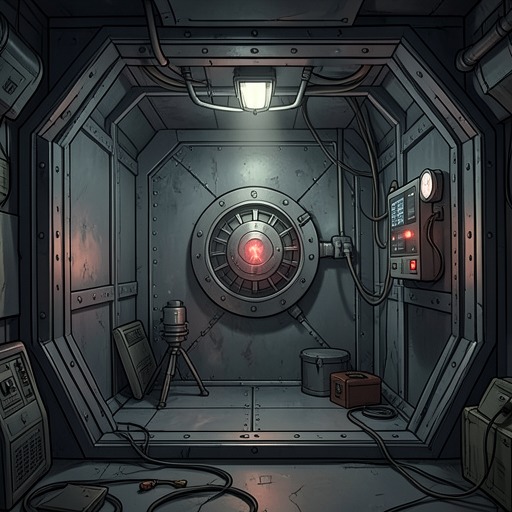
The suspicion has a physical basis in the house. A steel barrier may be a sliding door, closed and locked from inside, with a two-floor chamber beyond it. Yet an inspection reveals no visible electrical cables, air supply, or separate phone line of the kind a functioning enclosed room would require. If those services exist, they are well shielded. Don’s suggestion that the door has malfunctioned, or was triggered shut before someone escaped, does not resolve the problem: the expected fail-safe should prevent such a lock-in, while a fault should leave the room accessible. The concealed infrastructure and the missing battery therefore converge around an uncertain question: whether the room is merely hidden or whether someone could be trapped inside it.
Coleman’s own access adds another strand to the mystery. He says he has held a key for some time so that he can deal with faults in Harkness’s domestic renewables system. With the house being put on the market, he claims he has come to check the equipment, and says Don had appeared receptive to the proposal. Fran Revell finds Harkness’s decision to entrust Coleman with a key implausible, even as Coleman presents his visit as routine maintenance. The system thus has a practical service history, but the stated reason for Coleman’s presence does not explain why the house requires so much power or where its battery has gone.
Investigation and changing significance
The installation becomes newly legible when Don shows Blake the clear film on the rendered wall. Blake had not noticed it; Don identifies it as solar technology and explains that Harkness bought the system from Coleman’s company alongside a massive backup battery. Coleman’s unanswered question about the battery then acquires greater weight. Blake believes that Don suspects it is inside the panic room and considers that the electrical supply may serve something concealed there. She also recognizes that this is not certain: the hidden room might contain something requiring far more power than secret financial records, or the battery and room might not be connected as she supposes.
The later disclosure gives the installation a function beyond domestic resilience. Harkness’s programme has placed nanobots in people exposed to the company’s pharmaceuticals, cosmetics, pesticides, and antibiotics. A chain reaction called Cascade can activate them, with one nanobot triggering another within ultrasonic range. Wortalleth West’s system is powerful enough to initialize that process. The system is therefore not simply an oversized convenience or an architectural clue: its available power forms part of the mechanism capable of turning the concealed plan into a widespread crisis. The panic room’s breach is identified as the trigger, while overrides at Wortalleth West and in Locarno are known only to Harkness and his associate. In this arrangement, the house’s independent supply connects a hidden room to a remote biological network, making the apparently self-contained property a control point with consequences far beyond its walls.
Narrative significance
The system’s central tension lies in the contrast between concealment and capacity. The transparent film is designed to disappear against the building, while the battery is so large that its absence becomes conspicuous; the more carefully the energy infrastructure is integrated into the property, the more its unexplained excess invites scrutiny. The equipment also redistributes agency: Coleman can service it, Don can recognize the significance of the barrier, and only a small number of people know how the overrides work. What first appears to be a technical anomaly gradually proves to be part of the plot’s most consequential threat.