Wynsum Fry
Panic RoomWynsum Fry is a Cornish woman known for her unsettling presence, card readings, and association with witchcraft. Her importance lies not in any definitive proof that she possesses supernatural powers, but in the way belief in those powers alters what other people do: a missing woman’s father accepts a reading as hope, Don Challenor’s wrist pain vanishes after he gives his word, and Gennady Zlenko can be manipulated through fear of a curse. At the same time, Wynsum’s feud with Jack Harkness is rooted in a family history of accusation and loss, making her a living link between local memory and present violence.
Identity and Family History
Wynsum is introduced as a short, stout woman with closely cropped grey hair and a watchful manner. At the Blue Anchor, she pays for cider without looking at the barman, then meets Don’s eyes; the encounter leaves him wishing he had not attracted her attention. Later, at the edge of the cove, she appears on the cliff above Blake despite having no car and no obvious way to have walked there from the main road. When Blake looks again, Wynsum is gone. The scene offers no explanation for her arrival or disappearance, preserving the uncertainty that surrounds her reputation.
Her family’s history is bound to Tredarvas, the ruined ancestral home of the Frys. Wynsum’s grandmother, Calensa Fry, once gave readings in the farmhouse kitchen, which Jack Harkness identifies as the place where Wynsum learned much of her witchcraft. Calensa also told Maris Hemsley that the Fry and Harkness families had been on opposing sides in the Cornish rising of 1648. Maris describes the Frys as people for whom time does not simply heal a grievance but allows it to harden. The family feud is therefore presented as inherited memory, not merely a personal disagreement between Wynsum and Harkness.
The feud has a specific and grave focus: the death of Wynsum’s brother, Jory Fry. Calensa was convinced that Harkness had drowned Jory in a rock pool on 1 August 1970, a date she associated with Lammas. This remains an accusation attributed to Calensa, rather than an independently established account in Wynsum’s story. Yet the accusation shapes Wynsum’s later conduct. She tells Don that Harkness murdered her brother and names him the King of Spades, turning an old family charge into a public challenge.
Readings, Reputation, and Uncertainty
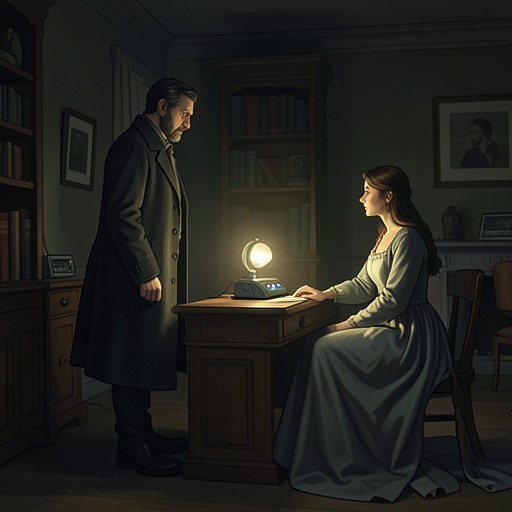
Wynsum’s methods acquire influence through people’s encounters with them, while the novel leaves their supernatural basis unresolved. When Andrew Glasson was desperate to know whether his missing daughter, Jane Glasson, was alive, Blake suggested that he consult a seer. Glasson expected to recognize a charlatan, but found that Wynsum’s manner made belief difficult to resist. She had him shuffle and cut an ordinary pack of playing cards, then deal twelve cards face down. Wynsum turned them over in a sequence Glasson could no longer recall; all but one were hearts or diamonds. She interpreted the predominance of red as a sign of life, and Glasson allowed himself to believe that Jane was alive. The reading gave him hope, but it did not establish Jane’s whereabouts or resolve her disappearance.
Maris’s account of Calensa offers a second explanation for the family’s influence. Calensa initially denied possessing supernatural powers and described psychological manipulation as a way of maintaining her reputation and business. She also suggested that people’s misfortunes were self-induced. Later, however, she implied that she possessed trade secrets and asked Maris to accuse Harkness in print of responsibility for Jory’s death. Maris refused: the allegation could not responsibly be inserted into an academic study of witchcraft. These competing accounts—deliberate manipulation, inherited practice, and possible supernatural power—remain in tension. The practical consequences of belief are clearer than its cause.
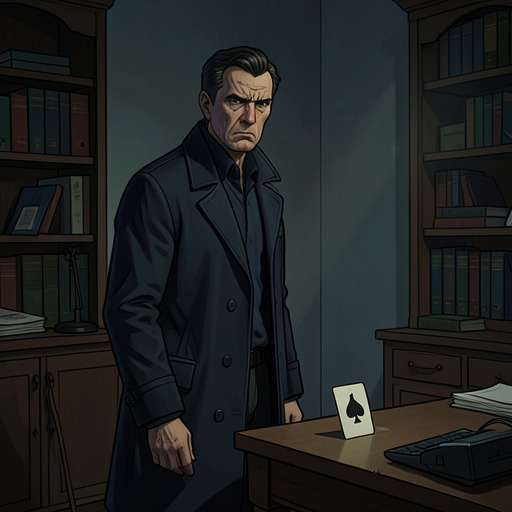
Wynsum’s recurring card symbol condenses that uncertainty into an image. Blake finds a King of Spades playing card pinned to the entrance-gate pillar with a rusty pin. She understands it as Wynsum’s mark and knows that Wynsum calls Harkness the King of Spades. The card’s reverse bears a geometrical labyrinth. Blake leaves it face down after removing the pin, and later finds it gone. The gesture functions as an unexplained sign of Wynsum’s attention: it connects her to Harkness’s title without explaining why she has left the card or what she intends.
Encounters with Don Challenor
Wynsum’s relationship with Don begins in wary confrontation. After meeting her at the Blue Anchor, Don later visits her bungalow, where she receives him at the half-glazed door in the same clothes he had seen the previous day. He says he wants to talk about Harkness. Wynsum permits the conversation but makes clear that another card reading will require payment. The exchange presents her as neither a passive embodiment of local superstition nor a simple source of information: she controls access to her practice and expects the terms of an encounter to be respected.
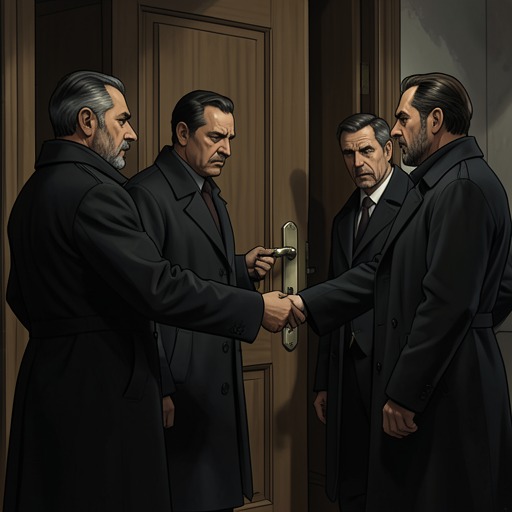
When Don tells her that he has a lead and suggests that public knowledge could cost Harkness his crown, Wynsum challenges his ability to achieve that result. She asks him to take her hand as proof that he is in earnest. Don braces for pain in his already sore wrist, but their handshake is light and painless. Wynsum closes her other hand over his, and he feels warmth in the wrist; she quietly warns that a lightly given promise can be difficult to break. A wave of nausea follows, and Don pulls away. Shortly afterward, he realizes that his wrist no longer hurts. The sequence makes the promise and the apparent cure inseparable, while leaving open whether the change is supernatural, psychological, or coincidental.
Blake interprets Don’s wrist trouble as Wynsum’s means of keeping him in Mullion, and points to Maris’s earlier experiences with Calensa. Maris recalls that she became accident-prone and anxious when she returned to Exeter after encounters with Calensa, while those effects seemed absurd when she was away. After she confessed to trying to deceive Calensa, the accidents ceased. Maris says she does not believe that change was coincidence, though she also recounts Calensa’s claim that people caused their own misfortunes. The parallel gives Don’s experience a history within the Fry family’s practice, without converting either account into objective proof of a curse.
Confrontation with Harkness and Death
Wynsum eventually confronts Harkness directly. Don sees her arrive at a yard in a police car with a young constable, while Harkness and others are present. When the constable asks Harkness to identify himself, Wynsum declares that he murdered her brother. The accusation is abrupt and public, bringing the family grievance into an immediate confrontation rather than leaving it confined to readings and private recollections.
The encounter turns lethal when Zlenko shoots the constable and then kills Wynsum as she runs towards the lane. Her death ends her direct role in the confrontation, but not the force of the beliefs attached to her. Harkness responds to the killing by warning Zlenko about its serious consequences; Don, frightened and trapped among the men, recognizes that Zlenko is susceptible to the fear that Wynsum’s power might persist beyond her death.
Legacy and Narrative Role
Don exploits that fear by telling Zlenko that a piece of clothing Wynsum wore next to her skin can neutralize her hold, and that the item must be burned at her birthplace. Blake had previously given Don a small paper bag as protection against trouble from Wynsum, repeating a remedy that Maris had learned from a dewitcher. Don’s account to Zlenko is therefore both a deliberate tactic and an echo of a ritual already circulating in the story. At Tredarvas, Harkness identifies the ruined kitchen as the place where Calensa gave readings and where Wynsum learned her craft. Zlenko accepts the location as significant and burns the garments there. The ritual’s immediate consequence is not proof that Wynsum had magical power, but evidence that fear of it can govern Zlenko’s actions.
Wynsum’s narrative role rests on this double effect. The novel repeatedly supplies concrete details—the twelve-card reading, the King of Spades, the handshake, the old accusation, and the return to the farmhouse—while withholding a final explanation of the occult claims. Her family’s practices organize grief and suspicion, but they also become tools that people use to influence one another. Even after Wynsum is dead, the story’s attention returns to the kitchen where her knowledge began, and to the ritual carried out there. Her presence thus survives less as a settled supernatural answer than as a forceful uncertainty, entangled with family history, personal vulnerability, and real violence.