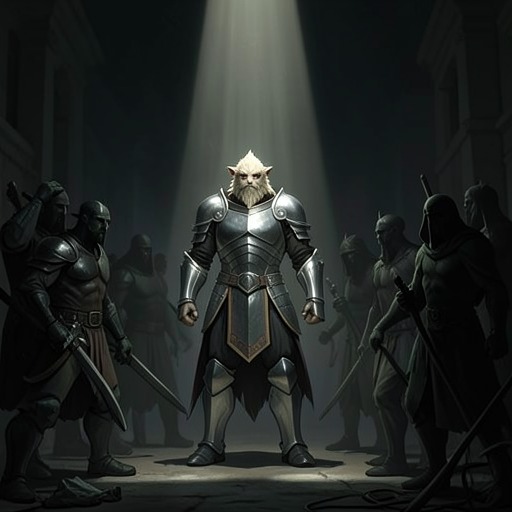
Abdiel
Paradise LostAbdiel is the Seraph who embodies steadfast obedience amid the revolt of Satan and the Rebel Angels. When Satan presents equality and liberty as reasons to reject the Son of God’s kingship, Abdiel refuses the seductive logic of collective defiance. He answers not as a hesitant dissenter but as a witness to a divinely ordered universe: the Son of God is rightful King, God’s decree is just, and true freedom is compatible with obedience to the order that created and sustains the Angels. His solitary resistance becomes one of the poem’s clearest demonstrations that moral authority is not measured by numbers.
Identity and Introduction
Abdiel appears in the Infernal Council’s political and theological crisis, when Satan has gathered the Angels who followed him in the War in Heaven and is preparing them to resist the authority of God and the Son of God. Satan argues that the Angels were created free and equal, that no monarch should rule over equals, and that the demand to bend the knee is an intolerable yoke. The appeal is directed at a vast audience of Thrones, Dominations, Princedoms, Virtues, and Powers, and it gains the sound of approval from the surrounding host. Abdiel’s entrance interrupts that apparent unanimity. He is described as the one who adores the Deity with greater zeal than any other and obeys divine commands with corresponding fervor. His defining traits are therefore not passivity or ignorance, but intellectual clarity joined to active loyalty. He understands the terms of Satan’s argument well enough to answer them directly, and he refuses to confuse independence from God with genuine liberty.
Argument Against Satan’s Rebellion
Abdiel identifies Satan’s speech as blasphemous, false, and proud. Against the claim that it is unjust to bind the free by law, he insists that God has expressly decreed that every Soul in Heaven shall bend the knee to the Son of God, whose regal scepter is held by right. The issue is not arbitrary domination but rightful kingship: God made the Angels, determined the limits of their being, and appointed the Son of God as their head. His reasoning also rejects the assumption that hierarchy necessarily diminishes freedom. The Angelic orders and degrees, he argues, do not contradict liberty; they can coexist with it. The Son of God’s reign does not obscure the glory of the Thrones, Dominations, Princedoms, Virtues, and Powers. Rather, because the Son of God is one of their number and their head, honor given to him returns to the whole order in which they participate. Abdiel thus recasts obedience as a form of shared dignity rather than servitude. Abdiel further grounds his case in the relationship between creation and authority. Satan claims that the Angels have always existed as self-begotten powers, owing their strength only to themselves. Abdiel answers that the Son of God, as the Word of the Father, made all things, including the Angels and their bright degrees. The question is therefore not whether the Angels possess power, but whether creatures may treat their created power as self-originating and use it to challenge their Creator. For Abdiel, Satan’s doctrine of self-generation is not liberation but ingratitude elevated into metaphysics.
Departure from the Rebel Host
Abdiel’s speech receives no support. The host treats his intervention as untimely, singular, and rash, while Satan welcomes the absence of opposition and presses his own argument more arrogantly. Abdiel nevertheless does not moderate his position to secure companions. He warns Satan that the rejected golden scepter will become an iron rod, that the laws of mercy will no longer be offered to those who persist in rebellion, and that punishment will follow the crime without recall. His departure is therefore a decisive action rather than a symbolic withdrawal. He leaves the wicked tents devoted to destruction even though he is surrounded by hostile Angels and knows that divine wrath may soon fall upon them. The poem emphasizes the asymmetry of his courage: he is not brave because he has a reassuring majority, but because he remains faithful while no one follows him. He passes through hostile scorn, suffers their contempt without yielding, and turns his back on the proud towers that are destined for ruin.
Confrontation and Battle with Satan
Abdiel’s loyalty carries him from debate into combat. When the loyal Angelic host advances against Satan’s army, Abdiel sees Satan approaching in adamant and gold, still displaying the outward resemblance of the Highest even though faith and reality have departed from him. This resemblance troubles Abdiel because it shows that strength may remain after virtue has failed. He resolves to test Satan’s power with the aid of the Almighty, having already tested and exposed the weakness of Satan’s reasoning. Stepping out from the loyal ranks, Abdiel meets Satan halfway and challenges the assumption that the path to the throne of God lies open and unguarded. He declares that God could defeat the rebel host with armies raised from the smallest things or with a solitary act of power, and he reveals the existence of faithful Angels whom Satan had not perceived. His own isolation becomes evidence against the rebel claim that unanimous opinion proves truth: the few may know rightly while thousands err. Satan answers with contempt, presenting Abdiel as an ambitious Angel seeking recognition and accusing him of arming those who prefer service to liberty. The exchange repeats the central conflict in a sharper form. Satan defines freedom as refusal of rule; Abdiel’s conduct defines it as the capacity to choose fidelity despite pressure, fear, and numerical isolation. Their dispute then becomes physical. Abdiel strikes Satan with such force that the rebel leader is wounded and forced back to his chariot, his pride humbled by discovering that he is not matchless. Abdiel also fights elsewhere in the battle. He helps overthrow the Atheist crew, striking Ariel and Arioch and blasting Ramiel from the field. These actions place him within the collective victory of the loyal Angels without dissolving his distinctive role. The same character who stood alone in debate becomes an effective combatant among the faithful, proving that obedience is not weakness and that moral clarity can issue in decisive force.
Change, Ending, and Narrative Role
Abdiel’s arc moves from solitary witness to vindicated participant. At the beginning of the crisis, the rebel host appears to possess the advantage of numbers, eloquence, and shared conviction. By the end of the confrontation, the rebels are disordered, wounded, and fleeing, while the loyal Angels remain firm and invulnerable because they have not sinned or disobeyed. Abdiel does not undergo a conversion; his significance lies in refusing the conversion that overtakes the others. His constancy is the change the narrative measures around him. The poem explicitly presents him as “Among the faithless, faithful only hee.” This is not merely praise for private sincerity. Abdiel demonstrates a standard by which speeches, institutions, and majorities can be judged. Satan’s rhetoric makes tyranny sound like liberty, while Abdiel restores the meanings of creation, law, rank, and freedom by placing them within divine order. His conduct also gives the narrative a compact pattern of separation, ordeal, and return: he leaves the rebel community, passes through hostile scorn, and returns to the loyal side with his allegiance confirmed rather than weakened. Abdiel’s importance is therefore both dramatic and theological. Dramatically, he supplies the necessary countervoice to Satan’s persuasive rebellion and turns an apparently settled consensus into a genuine moral contest. Theologically, he shows that obedience is an informed act of judgment, not the surrender of thought. His singularity is the point: when the multitude mistakes self-assertion for freedom, one faithful Seraph preserves the distinction between created power and divine authority, and his later success in battle gives visible form to the truth he defended in words.