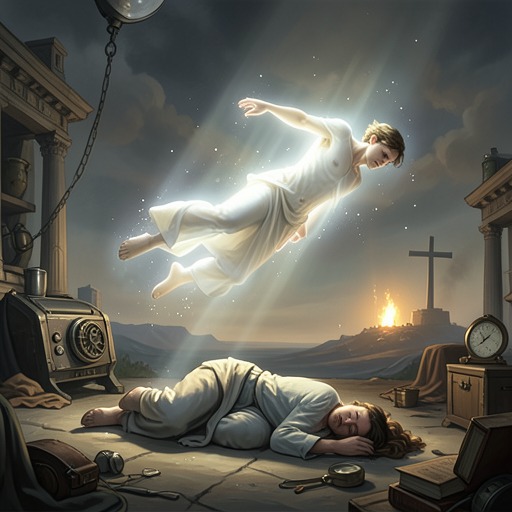
Ascension of Christ
Paradise LostAscension of Christ is the exalted return of the Son of God to Heaven after his incarnation, sacrificial death, and resurrection. It is not an isolated departure but the upward completion of a movement that begins in divine mediation: the Son offers himself as life for mortal life, assumes human nature, pays the debt of death, rises victorious, and then enters glory at God’s right hand. Through this ascent, the apparent defeat of the Cross becomes the public triumph over Satan, Sin, and Death and the foundation of universal redemption.
Causes and Redemptive Background
The necessity of the Ascension arises from the ruin of humanity after Adam’s transgression. God declares that mankind, having violated divine supremacy, must either suffer destruction or receive an adequate substitute who is both able and willing to pay the required satisfaction. The silence of Heaven makes the Son of God’s intervention unique: no other heavenly being offers to become mortal and bear the forfeiture on humanity’s behalf. The Son therefore volunteers to leave the bosom and glory of the Father, enter human existence, and die in place of the guilty.
The Son’s offer is presented in the language of exchange and obligation. He offers life for life and accepts the anger due to mankind, while also affirming that death will not retain him permanently. Because he possesses life in himself, his surrender is temporary; after the debt has been paid, he will rise, strip Death of its prey, and lead the powers of darkness captive. Ascension is thus prepared from the beginning as the necessary second movement of sacrifice: descent into flesh and death must culminate in victorious return.
Death, Resurrection, and the Upward Triumph
The prophetic account explains that the Redeemer will fulfill the Law through obedience and love, endure reproach and a cursed death, and be seized, judged, condemned, and nailed to the Cross by his own nation. His death bears the punishment owed by Adam and by those who inherit Adam’s corruption. At the same time, the Cross fixes the accusations of the Law and the sins of mankind to itself, so that they can no longer injure those who rightly trust in this satisfaction.
The resurrection follows swiftly. The Son rises from the grave before the third dawn, fresh as morning light, demonstrating that Death has no lasting dominion over him. His victory changes the meaning of mortal death for the redeemed: what would otherwise be an eternal loss becomes, in the prophetic image, a death like sleep, a gentle passage toward immortal life. The Ascension depends upon this reversal, for the one who rises from death does not remain confined to earthly life but proceeds through the air in triumph over his enemies.
The Ascension and Its Universal Mission
After his resurrection, the Son remains on Earth only for appointed appearances to his Disciples, the men who followed him during his life. He entrusts them with the task of teaching all nations what they have learned from him and proclaiming salvation to those who believe. Baptism becomes the sign of washing from guilt into pure life, while faith is understood as inseparable from a transformed manner of living.
The Ascension therefore widens the reach of redemption. Salvation is no longer preached only to the descendants of Abraham according to the flesh, but also to the sons of Abraham’s faith wherever they are found throughout the world. The promise that all nations will be blessed in Abraham’s seed is fulfilled through a mission that begins after the Son’s departure. His absence does not end his work; it converts his earthly presence into a worldwide proclamation.
Heavenly Exaltation and the Defeat of Satan
The Son ascends into the Heaven of Heavens with victory, triumphing through the air over the foes of God and humanity. The ascent reverses the earlier ambition of Satan, who sought equality with God and challenged the authority of the anointed King. Satan had urged the Rebel Angels to reject monarchy and refuse the knee to the Son of God, claiming that heavenly beings were equally free and should not submit to a superior ruler. The Son’s return exposes that rebellion as a failed attempt to overturn legitimate divine order.
The prophetic vision makes the victory over Satan more precise than a simple destruction of the adversary. The Son surprises the Serpent, Prince of the air, drags him in chains through his realm, and leaves him confounded. Satan is not merely defeated in combat; his works in humanity are undone through obedience, atonement, and renewed life. The Ascension therefore confirms the Son’s authority over the very sphere in which Satan had exercised hostile influence and places the Redeemer above every other name in Heaven.
Effects on the Church and the End of History
The departure of the Son raises the immediate question of how his faithful followers will endure among enemies of truth. The answer is the sending of the Comforter, the Spirit of the Father, who will dwell within believers and write the Law of Faith, working through love, upon their hearts. The Spirit guides them into truth, arms them against Satan’s assaults, and supplies inward consolation when persecution threatens them with death.
The Spirit first falls upon the Apostles, who are sent to evangelize the nations, and then upon all who are baptized. Through wondrous gifts, including the ability to speak all tongues and perform miracles, the Apostles gain converts from every nation. The Ascension thus creates a new mode of divine presence: the Son is physically enthroned in Heaven, while his mission continues through the Spirit-filled community on Earth.
The event also points beyond the historical church toward the dissolution of the present world. From his exalted seat at God’s right hand, the Son will return with glory and power to judge the living and the dead. The unfaithful will face judgment, while the faithful will be received into bliss in Heaven or on Earth. At that final renewal, Earth itself will become Paradise, happier even than Eden. Ascension of Christ consequently closes the arc from Creation through Fall and Redemption while opening the prospect of the Last Judgment and New Heaven and New Earth: the Son’s upward movement is the guarantee that creation, once damaged by sin, will ultimately be restored.