Atonement
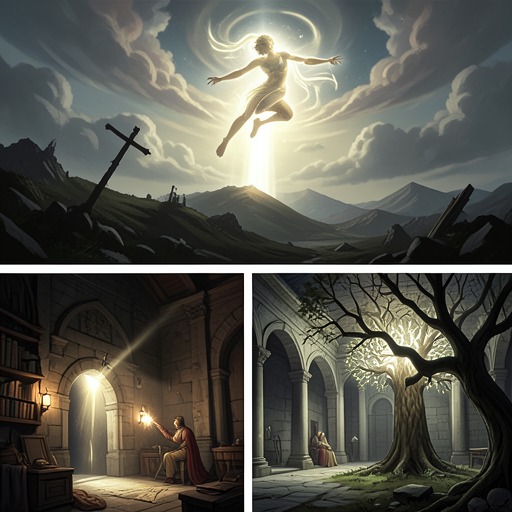
Paradise LostAtonement is the poem’s central answer to the problem created by human disobedience. Because Adam’s transgression brings guilt and death upon himself and his posterity, reconciliation cannot be achieved by regret alone or by humanity’s own resources. It requires a willing substitute whose life can satisfy justice, whose merit can be shared by those who receive it in faith, and whose victory over death can open the way from the fallen condition to restored life.
Guilt, Debt, and the Demand of Justice
Humanity’s need for atonement begins with the logic of the Fall. Adam’s offense is presented as an assault on Heaven’s supremacy: by seeking forbidden knowledge and reaching toward Godhead, mankind forfeits its original standing. The penalty is not merely an external punishment but a condition in which Adam and his entire posterity are devoted to destruction. The divine judgment is therefore expressed in the language of obligation and satisfaction: Adam must die, or someone both able and willing must pay the required equivalent, “death for death.”
The poem nevertheless distinguishes justice from arbitrary vengeance. The Creator declares that man will not simply be abandoned, but that fallen powers may be renewed and that grace will be offered to those who pray, repent, and sincerely endeavor to obey. Conscience is placed within human beings as an inward guide, and those who persist in responding to offered grace may attain safety. Yet atonement remains necessary because human effort cannot erase the original forfeiture. Law can expose sin, but human beings possess no adequate offering of their own; the moral debt exceeds their capacity to discharge it.
The poem also places this human crisis within a larger history of rebellion. The fallen angels, whose heavenly names have been erased, later corrupt mankind by disguising devils as deities and filling the world with idolatrous rites. Their rebellion thus reproduces itself in human history, making atonement an answer not only to one ancestral act but also to the continuing spread of sin, deception, and death.
The Son of God’s Voluntary Offering
The decisive act of atonement begins when the Son of God responds to the silence of Heaven. No angel offers to assume mankind’s forfeiture; the Son alone volunteers to become mortal, leave the Father’s presence, and bear the consequences of human crime. He offers “life for life,” asking that divine anger fall upon him and accepting death freely for Adam’s sake. The exchange is therefore not coerced payment but an act of filial obedience and self-giving love.
The Father accepts this proposal while defining its full scope. The Son must join human nature to divine nature, become man through the wondrous birth from Virgin seed, and stand in Adam’s place as the head of a new human lineage. Adam is the root through whom mankind falls; the incarnate Son becomes a second root through whom those who are restored may receive new life. The structure of atonement is consequently representative and participatory: Adam’s crime makes his descendants guilty, while the Son’s merit may absolve those who renounce self-reliance, live in him, and receive life from him.
This descent does not diminish the Son’s divine status. The Father presents his humiliation as the very reason for his exaltation. Though equal with God and enthroned in the highest bliss, the Son gives up glory to save the world; because love abounds in him more than the desire for honor, his assumed humanity will be raised with him. He will reign as both God and man, and all powers in Heaven, Earth, and Hell will ultimately bow before him.
Incarnation, Obedience, and Death
Michael explains that the promised victory is not a simple duel in which the Son physically destroys Satan. Satan’s earlier fall from Heaven has not prevented him from inflicting death upon humanity. The Son instead defeats Satan by undoing his works in Adam and Adam’s seed. This requires the obedience that Adam lacked: the redeemer must fulfill God’s law through obedience and love, and must endure the death imposed as the penalty of transgression.
The atonement therefore joins active and passive obedience. The Son lives under hatred, blasphemy, seizure, judgment, and condemnation; he is nailed to the Cross by his own nation and suffers a shameful, cursed death. Yet the Cross is also depicted as the place where the powers arrayed against humanity are fastened and neutralized. The law standing against mankind and the sins of the world are crucified with him, so that they need no longer injure those who rightly trust in his satisfaction.
The poem’s economic language makes the exchange vivid without reducing it to a simple commercial transaction. The Son pays the ransom with his own life, but the value of that payment rests on willing love, spotless merit, and divine-human identity. Hell destroys easily; heavenly love answers by giving itself at a far greater cost. Atonement is thus an economy in which loss is not denied but transformed: the Son accepts the debt’s full burden so that death may cease to be the final claimant.
Resurrection and the Reach of Redemption
Death cannot retain the Son. He rises before the third dawn, fresh as morning light, and his resurrection confirms that the ransom has been paid. His victory does more than cancel Adam’s sentence: it wounds Death itself, crushes Sin and Death as Satan’s principal powers, and changes the meaning of mortality for the redeemed. For them, death may become like sleep, a passage toward immortal life rather than an irrevocable descent into loss.
The Son remains on Earth only for a time after rising, appearing to his Disciples and commissioning them to teach all nations. Baptism signifies the washing away of guilt and the passage into purified life. Salvation is no longer confined to the physical descendants of Abraham; it extends to the sons of Abraham’s faith throughout the world. In this universal reach, atonement fulfills the promise that all nations will be blessed through the woman’s seed.
The victory continues through the Son’s Ascension. He passes triumphantly through the air, binds and confounds the Serpent, and takes his seat at God’s right hand. From there he will return at the dissolution of the present world to judge the living and the dead, punish the unfaithful, and receive the faithful into bliss. Atonement thus has a present foundation in the Cross, a continuing consequence in the life of faith, and a final completion in judgment and renewal.
From Fallen History to New Creation
The poem repeatedly sets inadequate human remedies against the future sacrifice. Adam initially fears that death can be escaped through self-destruction or through childlessness, but he rejects both as acts of despair and defiance. He recalls instead the promise that his seed will bruise the Serpent’s head. Michael’s later vision of Cain murdering Abel shows why individual repentance or ritual cannot by itself heal the human condition: violence emerges even among Adam’s descendants, when envy turns one brother against another.
The history of Israel further clarifies the limits and uses of law. God gives laws and rites at Mount Sinai, establishes the Tabernacle, and places the Ark and the testimony within a sanctuary where divine presence dwells among mortal people. Yet the sacrifices of bulls and goats are only shadowy expiations. They reveal sin without removing it and point toward the more precious blood required for mankind. The law therefore prepares recognition of atonement rather than replacing it.
Atonement finally becomes the principle by which evil is turned toward good. Adam learns that the Son’s suffering will produce greater glory to God, greater goodwill toward humanity, and the triumph of grace over wrath. At the end of the predicted history, the perverted world is dissolved, and from the purifying conflagration arise new Heavens and a new Earth founded on righteousness, peace, and love. The movement from guilt to satisfaction, from death to resurrection, and from the ruined creation to renewal makes atonement the poem’s governing pattern of transformation.
For Adam, the lesson is ethical as well as doctrinal. After hearing Michael’s account, he recognizes obedience as the highest wisdom, dependence upon Divine Providence as the proper human posture, and suffering for truth as a form of courage. Faith must be joined to virtue, patience, temperance, and charity; knowledge without corresponding deeds is insufficient. Atonement therefore does not license passive reliance on another’s merit. It creates the possibility of a restored life in which received grace becomes faithful action and, ultimately, “A Paradise within thee.”