Beelzebub
Paradise LostBeelzebub is Satan’s nearest companion in power and crime, a fallen leader whose counsel transforms the defeated Rebel Angels from a scattered remnant into an organized opposition. He appears first in Hell beside Satan after the heavenly revolt, shares the devastation of the fall, and becomes the chief voice through which military defeat is reinterpreted as a political problem. His decisive contribution is the proposal to attack humanity, the favored new race through which Satan and his followers hope to injure God indirectly.
Identity and Fall
Beelzebub is introduced as the spirit who stands next to Satan in rank and guilt after the rebellion. He is identified as a figure later known in Palestine by that name, while Satan addresses him as the companion with whom he once shared a mutual league, united counsels, equal hope, and danger in the enterprise against God. The relationship therefore predates Hell: Beelzebub is not a late recruit but one of the principal partners in the original revolt.
The fall has destroyed his former glory and happy state, but not his inward strength. Beelzebub acknowledges that the rebels have lost Heaven and that their once-glorious host has been brought low, yet he also recognizes that mind and spirit remain invincible and that their vigor may return. His response is more sober than Satan’s defiant vaunting. He sees that the conqueror may have preserved their strength not as a gift but as an instrument of continued punishment or forced service, and he asks what such endurance can finally accomplish under eternal pain.
Counsel After Defeat
Beelzebub’s defining function is to interpret circumstances and convert them into policy. When Satan declares that the lost field does not mean that everything is lost, Beelzebub answers by measuring the cost of the defeat. He accepts that God’s power must be regarded as overwhelming, since only such power could have subdued their forces, but he refuses to treat survival as freedom. The fallen spirits remain subject to divine jurisdiction even in their remote prison, and their apparent distance from Heaven does not release them from the rule of its King.
His reasoning shifts the infernal response from immediate renewed assault to enduring hostility. Since open war has already brought irreparable loss and no terms of peace have been offered, he argues that the rebels can return only hatred, reluctance, and revenge, pursued slowly and persistently. The aim is not necessarily to invade Heaven’s secure walls, which cannot be stormed from the Deep, but to discover a more vulnerable enterprise whose consequences will trouble the conqueror.
This is where Beelzebub reveals the existence of another world, the future home of a new race called Man. Humanity will be less powerful and excellent than the angels but more favored by God. Beelzebub proposes that the fallen host investigate these creatures, learn their substance, powers, and weaknesses, and determine whether they can be overcome by force or subtlety. The plan offers several possible outcomes: Hell may destroy the new creation, seize it, drive its inhabitants away, or seduce them into the rebel cause so that God might become the enemy of his own works.
Political Intelligence and Leadership
Beelzebub’s speech gives the Infernal Council a language of empire, jurisdiction, and strategic opportunity. He does not merely express resentment; he identifies a target, assesses its defenses, considers methods of attack, and defines success as an injury to God’s joy and authority. The proposed assault on humanity is therefore revenge translated into statecraft. It seeks to mingle Earth with Hell and to make the creation itself the theatre of the continuing war.
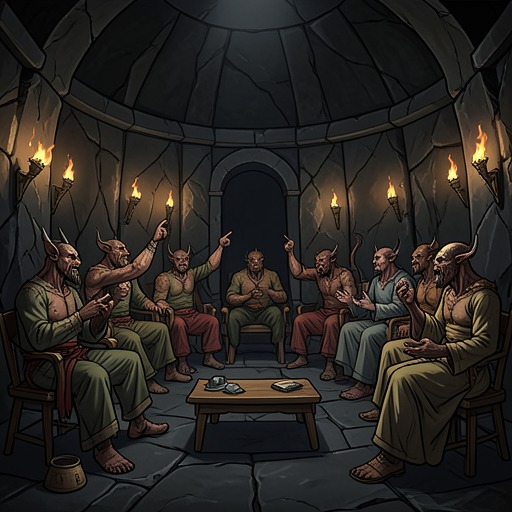
When he rises to speak, his appearance signifies deliberation and public responsibility. His face bears deliberation and care, his bearing resembles a pillar of state, and his shoulders seem fit to carry monarchies. These images distinguish him from the more openly theatrical energy of Satan. Beelzebub supplies the gravity of government: he speaks to the assembly as a statesman addressing powers who must decide whether to continue fighting, settle in Hell, or pursue a new campaign.
The assembled fallen powers accept his proposal. Their assent turns a private design, first devised by Satan and partly presented through Beelzebub, into a collective resolution. Satan then praises the council’s judgment and asks who will undertake the dangerous journey through the Abyss to find the new world. Beelzebub thus functions as the hinge between Satan’s private malice and the public decision of the infernal polity.
Relationship with Satan
Beelzebub is subordinate to Satan but not insignificant beside him. Satan is the arch-enemy and the dominant imagination of revolt; Beelzebub is his closest compeer, second in power after him, and the one whose judgment can command the attention of the assembly. Their relationship combines shared history, loyalty, and political dependence. Satan initiates the larger revenge, while Beelzebub gives it an intelligible program that others can adopt.
Their exchange also establishes a contrast between two styles of resistance. Satan insists that an unconquerable will, immortal hate, and refusal to submit can preserve freedom even in Hell. Beelzebub recognizes the emotional force of that posture but presses toward a clearer account of their actual condition. He knows that the rebels have not escaped God’s sovereignty, and he therefore proposes not a fantasy of independence but a calculated campaign against a vulnerable part of creation.
The contrast does not make Beelzebub morally moderate. His proposal is explicitly directed toward seduction, destruction, and the corruption of Man. His prudence serves malice. He is the planner who makes evil durable by giving it patience, organization, and an object beyond its immediate grievance.
Theological and Narrative Significance
Beelzebub’s counsel demonstrates the irony governing the fallen enterprise: the rebels intend to oppose divine providence, yet their actions remain within a larger order that can turn evil toward good. God permits Satan to remain at large so that repeated crimes may heap damnation upon him, while the malice directed against humanity becomes the setting for grace and mercy. Beelzebub’s strategy therefore carries consequences that exceed his intention. His effort to damage God through Man becomes part of the history through which salvation will be revealed.
The later revelation of redemption makes his earlier proposal retrospectively significant. The Son of God offers life for human life, accepts incarnation and death, and rises again to defeat Sin and Death. Beelzebub’s intended corruption of humanity consequently becomes the occasion for a greater display of divine justice, mercy, and restorative power. The attempt to make God’s favored creatures share the rebels’ ruin instead helps establish the possibility that humanity may be restored through the Son.
Beelzebub’s narrative role is therefore concentrated but foundational. He does not receive the solitary journey assigned to Satan, nor does he become the principal tempter of Eve. His importance lies in the council scene where defeat becomes design. As Satan’s closest lieutenant, he turns rebellion into policy; as a speaker, he gives the infernal host its target; and as a strategist, he helps launch the chain of events that leads from the war in Heaven to the temptation and fall of humanity, and ultimately to the promised defeat of Satan’s works.