Belial
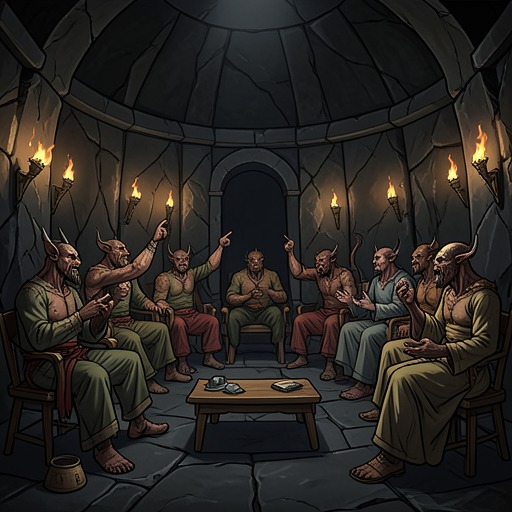
Paradise LostBelial is the last of the principal fallen spirits to speak in the Infernal Council, and his defining power is rhetorical rather than martial. The poem presents him as outwardly graceful, dignified, and composed for high achievement, yet inwardly false, hollow, timid toward noble action, and industrious only in vice. His speech offers the most seductive alternative to renewed rebellion: not reconciliation with God, and not genuine peace, but the preservation of self-interest through submission, endurance, and retreat.\n\n## Identity and Introduction\nBelial is introduced among the chief powers of Hell as a spirit distinguished by beauty of appearance and persuasive speech. No temple is dedicated to him, but his influence is said to appear wherever worship becomes corruption: in temples and at altars when priests turn atheistic, in courts and palaces, and in luxurious cities where riot, injury, and outrage rise above the towers. His presence is therefore less a localized cult than a social and moral condition. He governs through vice that has become ordinary, especially among the insolent and drunken figures who emerge into the streets at night.\n\nThe poem associates Belial with religious profanation and civic disorder at once. The corruption of Eli's sons within the house of God, the violence of Sodom, and the night at Gibeah, when hospitality fails to protect women from threatened rape, serve as examples of the world he inhabits and encourages. Unlike spirits whose false worship is represented by a particular altar or idol, Belial requires no formal shrine: his dominion is visible wherever authority, pleasure, and social power are emptied of justice.\n\n## Counsel in the Infernal Council\nBelial rises after the proposal that the fallen host should renew direct war against Heaven. He declares that he would favor open war if the arguments for it did not themselves reveal the likelihood of failure. The strongest military advocate has grounded his courage in despair and imagined revenge rather than in a credible prospect of victory; Belial turns that uncertainty into the foundation of his own position.\n\nHis practical objections are formidable. Heaven is filled with armed watch, its borders are guarded by legions, and scouts range through the surrounding darkness, making surprise improbable. Even if the Rebel Angels broke through by force and all Hell rose behind them, God would remain incorruptible upon his throne. Heaven's ethereal substance, he argues, could purge away the baser fire of rebellion, while the attackers would merely provoke the Almighty to a destruction that might abolish them altogether. Belial thus makes the fear of annihilation, as well as the certainty of endless punishment, an argument against action.\n\nHe recalls the stages of defeat already suffered: flight beneath Heaven's pursuing thunder, refuge in Hell, and the chains endured upon the burning Lake of Fire. He imagines still worse punishments if God should renew his vengeance: the fires of Hell suddenly intensified, cataracts of fire falling from above, rebels hurled upon rocks by whirlwinds, or sunk beneath a boiling ocean in chains and everlasting groans. Since both force and guile are visible to an all-seeing enemy, he concludes that open and concealed war are equally futile.\n\nBelial's reasoning culminates in resignation. If the decree of the victorious power cannot be escaped, suffering may be as much within the fallen spirits' capacity as action. Endurance, he suggests, might eventually cause God's anger to slacken. The fires may lose their force; the spirits' purer essence may overcome their poisonous vapor; or their nature may gradually conform to the heat until the pain becomes familiar and disappears. Time itself becomes his proposed strategy: the fallen should wait to see what future days and changing circumstances might bring.\n\n## False Peace and Political Rhetoric\nBelial's speech is powerful because it borrows the language of prudence, realism, and liberty while directing those concepts toward inactivity. He does not advocate peace as reconciliation or moral restoration. His counsel is described as ignoble ease and peaceful sloth, not peace. The distinction exposes the gap between a stable order and a just one: Belial wants the rebels to stop risking further punishment, but he offers no recovery of virtue, no acknowledgment of guilt, and no change in their relation to God.\n\nThe argument also reveals a political tension within the fallen host. Belial treats continued existence, even under suffering, as preferable to annihilation and regards adaptation to Hell as a possible form of self-preservation. Yet the proposed freedom is passive. It consists in accepting the conditions imposed by the conqueror and hoping that punishment will become bearable. His rhetoric converts defeat into a reason not to act, presenting accommodation as wisdom while concealing the fear that makes it necessary.\n\nIn this respect Belial's counsel contrasts with the more openly defiant rhetoric of Satan and Mammon. Satan's language makes revenge the measure of dignity; Mammon's prefers independence in Hell to submission in Heaven and imagines labor, art, and endurance as means of creating prosperity from adversity. Belial goes further toward surrender. He does not seek to transform Hell into a rival kingdom or to recover power through construction. He seeks only to make the present punishment tolerable.\n\n## Relations and Conflicts\nBelial is aligned with the general interests of the Rebel Angels, but his position is not identical with Satan's. Satan's larger strategy depends on renewed opposition to God, whereas Belial recognizes the hopelessness of challenging an enemy who sees every motion and frustrates every plot. His apparent moderation therefore functions as an internal counterforce to Satanic militancy. It delays decisive action without challenging the underlying rebellion.\n\nHis relation to Mammon is especially revealing. Both reject renewed war, and both receive approval from the assembly, which dreads another field of battle more than Hell itself. Mammon's speech follows Belial's and makes the case for establishing a powerful order in Hell rather than accepting splendid vassalage in Heaven. Belial, however, has prepared the emotional ground for that response by teaching the council to value safety over honor and endurance over risk. The assembly's murmur of applause shows that his rhetoric has converted fear into collective policy.\n\nBelial's later political meaning is sharpened by Michael's account of human history. The future tyrant who claims dominion over his brethren repeats the same contradiction that marks the fallen spirits' language: he invokes liberty and equality while seeking rule over others. Michael explains that true liberty belongs with right reason, whereas disordered desire subjects the individual internally and makes external servitude possible. Belial's argument anticipates this pattern. It speaks of self-preservation and reasonable restraint, but its practical result is submission to a corrupt condition rather than freedom ordered by truth.\n\n## Change, Ending, and Narrative Role\nBelial does not undergo a redemptive change. His visible movement is from elegant presentation to ideological exposure. At first he appears fair, dignified, and capable of mature counsel; as the speech proceeds, the narrative reveals that his apparent reason is a garment covering sloth. His words can make the worse appear the better reason, but the polish of the argument does not alter its moral substance.\n\nHis immediate success is real. The assembly applauds his recommendation of peace, because the rebels fear the thunder and the Sword of Michael. Yet the response also marks the limitation of his influence: he can shape the council's mood, but he cannot provide a constructive future. His proposed settlement is a postponement of conflict and an adaptation to punishment. The subsequent development of Hell into a realm of organized ambition demonstrates that Belial's counsel does not end rebellion; it redirects it into political and material forms.\n\nBelial's importance lies in the poem's refusal to equate eloquence with wisdom or moderation with virtue. He is neither the loudest rebel nor the most spectacular power, but he exposes a subtler form of resistance: the attempt to preserve pride and pleasure by calling cowardice prudence. His rhetoric turns defeat into a livable philosophy, and in doing so helps define the moral landscape of Hell as a place where freedom is repeatedly invoked, yet where reason, virtue, and responsibility have been displaced by self-interest.