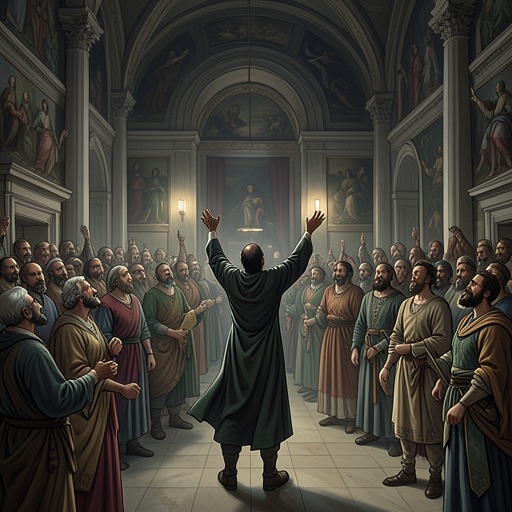
Better to reign in Hell than serve in Heaven
Paradise Lost“Better to reign in Hell than serve in Heaven” is Satan’s defining declaration of rebellious selfhood. Spoken after his fall, when he rises from the Lake of Fire and confronts the infernal landscape, the expression turns defeat into a claim of sovereignty: Hell becomes preferable if it permits him to remain himself, rule others, and reject service to God. Yet the poem steadily exposes the contradiction within that claim, because Satan’s language of liberty conceals ambition, self-enslavement, and the reproduction of tyranny.
Origin in Defeat and Exile
The expression arises immediately after Satan and Beelzebub recover from the Lake of Fire. Satan recognizes that the region is a mournful replacement for Heaven, but refuses to let place or time determine his identity. He insists that the mind can transform its surroundings, making “a Heav’n of Hell, a Hell of Heav’n,” and treats constancy of will as a substitute for lost blessedness. The sentence therefore does not describe a neutral preference between two locations. It is a declaration that inward defiance can preserve rank after outward defeat.
Satan’s reasoning depends on a political contrast. Heaven represents the authority of the Almighty, while Hell appears to offer a space where the rebels may be free, secure, and unaccountable. He imagines sovereignty as compensation for suffering: even in the infernal world, ruling would satisfy ambition more fully than serving in Heaven. The expression’s memorable balance gives this argument the shape of a maxim, making a desperate condition sound like a chosen constitutional order.
Liberty as Rebellion’s Public Language
The same principle returns in the council of Hell. Belial recommends endurance, hoping that time might soften the anger of the victorious God, but Mammon rejects both renewed submission and the hope of overthrowing Heaven. He argues that even if God offered pardon on the condition of renewed obedience, the rebels would have to endure humiliating worship before a sovereign they hate. He therefore prefers to seek their good from themselves and to live free from accountability, choosing “Hard liberty” over an easier yoke.
The expression thus becomes more than Satan’s private consolation: it supplies the vocabulary through which the fallen angels organize their collective future. Mammon proposes that labor, endurance, and infernal resources can convert pain into strength and darkness into magnificence. The applause that follows shows how effectively the rhetoric works. The assembly fears another battle more than Hell itself, and the preference for reign over service becomes a practical counsel of settlement rather than merely a cry of defiance.
The Contradiction of Self-Rule
The poem complicates the slogan by showing that Satan’s liberty is inseparable from hierarchy. When Satan later addresses the angelic powers before the campaign against Heaven, he presents the Son of God’s authority as an intolerable yoke. He claims that the angels are equal in freedom and asks whether beings who were made to govern should instead bend the knee. The argument sounds republican: it invokes equality, opposition to monarchy, and the right of free beings not to serve.
Abdiel exposes the weakness in that reasoning. He distinguishes service to the worthiest ruler from servitude to an unworthy rebel. To serve God, who creates and orders the heavenly powers, is not degradation; to serve Satan, who has rebelled against a superior, is the condition that most clearly resembles enslavement. Abdiel therefore redirects the expression against its speaker: Satan may reign in Hell, but he is not free, because he is enthralled to himself. The maxim’s apparent political clarity collapses into a moral distinction between ordered liberty and arbitrary will.
Satan’s later vision of human history confirms the danger. He condemns the usurper who claims dominion over fellow human beings and destroys their natural equality, yet that condemnation mirrors his own ambition to rule. The poem presents this recurrence as a structural pattern: rebellion against rightful authority can announce itself as liberation while preparing a new empire. The rhetoric changes sides, but the appetite for mastery remains.
From Maxim to Theological Reversal
The expression also stands against the poem’s account of salvation. In Heaven, the Son of God does not seek equality through refusal of service; he accepts the role required to redeem humanity. Faced with the impossibility of satisfying divine justice through any other advocate, he offers life for life, agrees to become man, and accepts suffering and death. His obedience is voluntary, loving, and restorative rather than coerced.
That contrast gives the slogan its deepest counterpoint. Satan defines dignity as ruling rather than serving, whereas the Son’s willing service becomes the means by which humanity is restored. The Son fulfills the law through obedience and love, bears the punishment due to human transgression, rises from death, and defeats Sin and Death. What Satan calls service becomes the path to exaltation; what Satan calls reign produces only rebellion, corruption, and renewed bondage.
Consequences and Literary Significance
As an expression, “Better to reign in Hell than serve in Heaven” is powerful because it compresses several conflicts into a single antithesis: freedom against obedience, selfhood against dependence, ambition against rightful order, and chosen identity against imposed place. Its cadence makes Satan’s argument memorable before the narrative has fully demonstrated its costs. The line functions as persuasion, self-defense, and political program at once.
Its final significance is therefore ironic rather than simply heroic. Satan’s insistence that the mind can make Heaven out of Hell is partly a testimony to resilience, but it also reveals the mind’s capacity to rename punishment as independence and bondage as sovereignty. The expression survives as the emblem of a will that would rather command in ruin than participate in a just order, while the poem’s larger movement argues that genuine freedom is not the absence of all authority. It is the disciplined capacity to recognize the good, obey it freely, and serve a worthier power without becoming servile.