Bridge of Sin and Death
Paradise LostThe Bridge of Sin and Death is the monumental passage built by Sin and Death across the abyss of Chaos. Extending from Hell to the outer boundary of the world, it gives material form to the consequences of Satan’s movement and to the new traffic between the infernal realm and mortal existence. What begins as a difficult route becomes a broad, permanent way by which the powers of sin and death can reach humanity.
Origin and Purpose
The bridge is conceived after Satan has passed from Hell through Chaos and reached the outside of the world. Sin, sensing an irresistible attraction toward the new world where her father has prevailed, proposes to make a path over the gulf so that the return journey will no longer be impeded. The project is not merely practical. It is intended as a monument of infernal merit, easing future passage from Hell and enabling intercourse or transmigration according to the lot of those who use it.
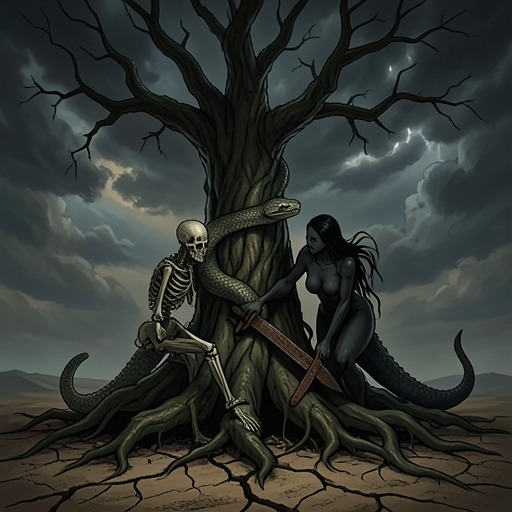
Death immediately recognizes the opportunity. His nature draws him toward the smell of mortal change on Earth, and he promises Sin equal assistance. Their cooperation joins two forces that the poem treats as inseparable: Sin opens the way morally and genealogically, while Death supplies the appetite for mortal destruction. The bridge therefore arises from both an architectural plan and a secret affinity among destructive powers.
Construction Across Chaos
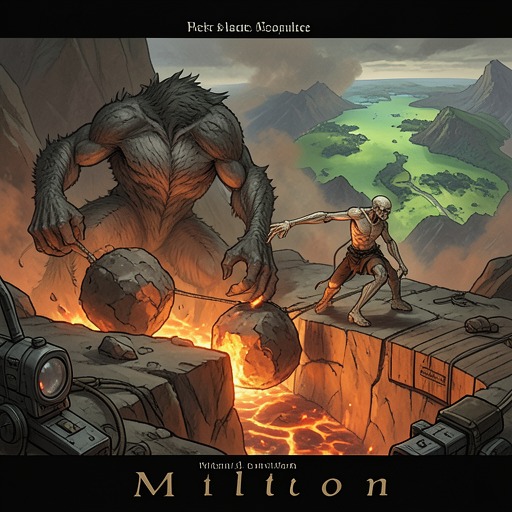
Sin and Death fly out from the Gates of Hell into the dark anarchy of Chaos and drive together whatever the turbulent waters cast up, whether solid or slimy. The gathered material is not naturally stable; it is chaotic matter forced into an ordered structure. Death strikes the aggregate with his petrifying mace, fixing it as firmly as the once-floating island of Delos, while his gaze binds the remainder with Gorgonian rigidity and asphaltic slime.
From this hardened mass they build a beach and then an immense mole, broad at the gate and deep to the roots of Hell. The causeway rises in an arch over the foaming deep and joins the immovable wall of the now-unfortified world to Hell. Its scale is emphasized through comparison with the bridge attributed to Xerxes, who crossed the Hellespont to join Europe and Asia. Yet the comparison also marks the infernal work as a darker version of imperial engineering: it does not unite peoples for ordinary passage, but joins Hell, Earth, and Chaos under the power of mortality.
The bridge follows Satan’s track to the exact place where he first landed after flying out of Chaos. Adam later learns that three distinct destinations can be seen from it: Empyrean Heaven, the world, and Hell, with the bridge stretching between these formerly separated domains. Its construction thus alters the structure of the cosmos. Boundaries that once protected the created world from the infernal realm become traversable, and the bridge turns distance into access.
Sin, Death, and Infernal Dominion
The bridge enables Sin and Death to escape the confinement of the Gates of Hell. Sin describes it as the achievement that frees them from their former limits, while also attributing the work’s conception and first impulse to Satan. Their joy at the bridge is therefore inseparable from their claim that Satan’s apparent defeat in Heaven has become a new kind of victory on Earth. He lost the war, but his wisdom and destructive enterprise have produced an avenue through which his power can extend.
The bridge gives Death a route toward living creatures and gives Sin a domain beyond Hell. It makes possible the movement of infernal spirits to and from the mortal world, allowing them to tempt or punish mortals except where God and good angels provide special protection. The causeway consequently functions as a mechanism of recurring action rather than as a one-time construction. It institutionalizes the connection between Hell and human history.
Its political meaning is equally strong. Sin declares that Satan has won what he did not build: the world becomes his dominion through the consequences of his deed. The bridge translates influence into territory and moral corruption into spatial possession. Hell no longer remains a sealed destination for the condemned; it becomes an active power with a road into the world.
Relation to the Fall and Redemption
The bridge is constructed in anticipation of the Fall of Adam and Eve, but its full significance emerges only after humanity’s disobedience. Once man falls, Sin and Death follow Satan’s track, and Heaven’s will causes a broad, beaten way to be paved across the dark abyss. The structure therefore appears as a cosmic consequence of the transgression: the moral breach in the created order receives a physical counterpart.
The bridge also embodies the poem’s language of debt and satisfaction. Human disobedience creates a forfeiture that requires death, while the Son of God offers life for life and undertakes the penalty owed by humanity. Against this economy of ransom and atonement, the bridge represents the expanded reach of the powers that profit from sin and death. It is the route by which the consequences of Adam’s crime can spread, while the Son’s obedience offers the counter-movement by which those consequences can ultimately be defeated.
Michael explains that the Son will not overcome Satan simply through a direct duel or by destroying Satan’s person. Instead, he will defeat Satan’s works in humanity, fulfilling the Law, suffering death, and rising again. The Son’s death will crush Sin and Death, described as Satan’s two principal arms, even though the bridge itself remains the material image of their access to the world. Redemption thus does not erase the history represented by the bridge; it overturns the powers that made that history deadly.
Symbolic and Narrative Significance
As a structure, the Bridge of Sin and Death fuses the sublime with the terrifying. Its prodigious length, adamantine pins, chains, petrified matter, and arch over the foaming abyss produce wonder through scale, but the same engineering precision makes the connection between Hell and Earth more dreadful. Chaos is not merely a wilderness surrounding the bridge; it is the raw medium from which an infernal order is manufactured.
The bridge also reverses the usual meaning of a passage. A bridge normally joins separated places and promises safe movement, but this one makes temptation and punishment easier. Its smooth and inoffensive road descends to Hell, turning damnation into an accessible destination. The apparent triumph of construction is therefore morally perverse: order, durability, and convenience serve destruction.
Its path remains active as Satan later travels toward the mortal world, and it becomes the route through which Sin and Death can follow. Yet the bridge’s final significance is not that evil has achieved an absolute victory. The narrative repeatedly places its power under divine permission and within a larger providential design. Satan’s malice can produce an avenue for misery, but the poem’s theology insists that the same history will become the setting for grace, redemption, and the eventual renewal of the world. The bridge is consequently both an instrument of the Fall and a monument to the unstable limits of infernal triumph.