Creation of the World
Paradise LostCreation of the World is the foundational event of the poem: God converts the dark, disordered Deep into a bounded universe, fills it with light and life, and finally creates Adam and Eve as rational beings made in God’s image. The account is not merely a beginning in time but a definition of order itself. Creation proceeds by command, separation, naming, generation, and blessing, while its meaning is interpreted as a triumph in which God brings greater good from the rebellion and loss caused by Satan and the Rebel Angels.
Revelation and Cosmic Purpose
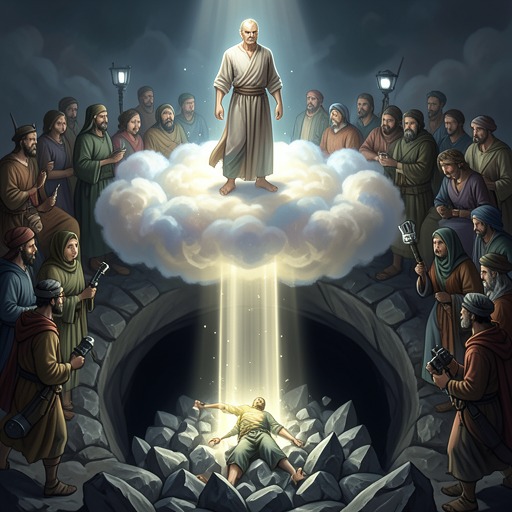
The event is narrated within a later scene of instruction rather than presented as an unmediated chronicle. Adam asks Michael to explain how Heaven and Earth first began, how the Creator worked in Chaos, and how the world was completed. Michael accepts the request only with a limit: created minds may seek knowledge that glorifies the Maker, but they must not demand what God has kept unrevealed. Knowledge must be governed by temperance, because an excess of understanding can turn wisdom into folly. Creation therefore enters the poem as sanctioned instruction, shaped to enlarge Adam’s gratitude while reminding him that divine omniscience exceeds human comprehension.
Michael places creation after Lucifer’s fall. Lucifer, once brighter than the stars, has fallen with his flaming legions into his appointed place, while the Son has returned victorious with the faithful saints. God sees that the loss of Heaven’s rebellious spirits does not diminish his power. He can repair the apparent damage by creating another world and, from one man, an innumerable race destined eventually to rise through merit and long obedience. Earth is thus both a new realm and an answer to Satan’s attempted diminution of divine worship: out of evil, God creates a better race and extends goodness through worlds and ages.
Ordering Chaos into a World
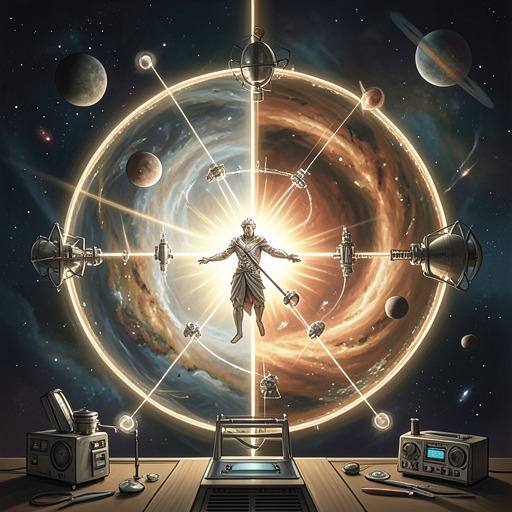
The Son appears for the expedition clothed in divine power, radiance, majesty, wisdom, and love, accompanied by Cherubim, Seraphim, Thrones, Virtues, and other members of the Heavenly Host. Heaven opens its everlasting gates to release the King of Glory and his Word and Spirit toward the unmeasured Abyss. Chaos is figured as a violent sea, dark, wasteful, and driven by surging winds, but the Son commands the troubled waves to cease. Carried on Cherubim into the world unborn, he takes golden compasses from God’s eternal store and marks the universe’s circumference, giving the previously boundless Deep a just boundary.
The first material condition is unformed matter and profound darkness covering the Abyss. The Spirit of God broods over the watery calm, infusing it with vital power and warmth while purging the cold, infernal dregs hostile to life. Matter is founded, gathered, balanced, and divided: like things are joined, unlike elements are assigned separate places, air is spun between them, and Earth hangs self-balanced at its center. The sequence makes physical arrangement inseparable from moral and metaphysical order. Creation is not an accidental emergence but a measured act in which separation makes habitation possible.
The Six Days of Creation
On the first day God commands light to appear. Ethereal light springs from the Deep before the Sun exists, travels through the air in a radiant cloud, and is divided from darkness by the hemisphere. God names the two conditions Day and Night, and the first evening and morning complete the day. The Heavenly Quires celebrate this first birth of Heaven and Earth with song and harps, making praise part of the created order from its opening moment.
On the second day, God makes the Firmament, a transparent expanse of elemental air that divides the waters below from the waters above. The world is built upon calm circumfluous waters, while the unruly extremes of Chaos are held far enough away not to disturb the frame. The Firmament is therefore both a physical structure and a protective partition, a clear boundary between regions that might otherwise collapse into disorder.
On the third day, the waters under Heaven gather into one place and dry land appears. Mountains rise into the clouds, while a broad hollow becomes the basin of the waters. Rivers carve channels through the soft ground, and the dry land is named Earth while the gathered waters are named Seas. At God’s command, the once-bare surface immediately produces grass, seed-bearing herbs, fruit trees, vines, gourds, reeds, shrubs, bushes, blossoms, and forests. The Earth becomes so richly clothed that it seems almost like Heaven, though rain has not yet fallen and a dewy mist waters the ground. The day closes with God seeing that the work is good.
On the fourth day, the lights of Heaven are appointed to divide Day from Night and to mark signs, seasons, days, and circling years. God makes the Sun to rule the day, the Moon to rule the night, and the stars to illuminate the Earth. The Sun is established as a great sphere and fountain of light, while the Moon receives and reflects the Sun’s radiance. The stars are scattered thickly across the firmament, and the Morning Planet, Dawn, and the Pleiades accompany the celestial arrangement. Evening and morning crown the fourth day, establishing the astronomical measures by which created time will later be experienced.
On the fifth day, the waters generate living creatures in abundance and birds fill the open Firmament. Fish swarm through creeks, bays, lakes, rivers, and the mid-sea; they glide beneath green waves, feed among seaweed and coral, and display shining scales. Dolphins play, seals move across the water, and Leviathan stretches across the Deep like a promontory, drawing in water through its gills and spouting it from its trunk. Birds hatch from eggs, quickly become feathered and capable of flight, and occupy cliffs, cedar tops, woods, lakes, rivers, and the high air. Eagles and storks build their eyries, cranes migrate in ordered formations, smaller birds sing through the woods, and the nightingale continues its music after evening. God blesses the waters and the birds with the command to be fruitful and multiply.
On the sixth day, the Earth brings forth cattle, creeping things, and beasts of every kind. Wild animals emerge from forests, thickets, brakes, and dens; cattle rise in herds from fields and meadows; and the Lion, Tiger, Stag, Behemoth, River Horse, Crocodile, insects, worms, and winged serpents appear in mature and finished forms. The creation of insects emphasizes the breadth of the generative act: the provident ant, the communal bee, and innumerable other forms display distinct natures already known and named by God. Even the Serpent, described as the most subtle beast of the field, is at this stage not harmful but obedient to God’s command.
Adam, Eve, and Human Dominion
The final work of the sixth day is humanity. Unlike the brute creatures, the human being is endowed with reason, upright stature, self-knowledge, and the capacity to govern the rest of creation. God declares the intention to make Man in his image and likeness, and forms Adam from the dust of the ground, breathing into his nostrils the breath of life so that he becomes a living soul. Adam’s bodily origin joins him to Earth, while the divine breath and rational nature distinguish him from the animals.
God creates Adam male and creates Eve as his female consort for the continuation of the race. Humanity receives the command to be fruitful, multiply, fill the Earth, subdue it, and hold dominion over the fish of the sea, the birds of the air, the beasts of the field, and every living thing that moves upon the ground. Dominion is presented as a vocation grounded in reason and gratitude rather than as license for arbitrary violence: the intended human ruler is to acknowledge from whom his good descends and to direct heart, voice, and eyes in devotion to the supreme Creator.
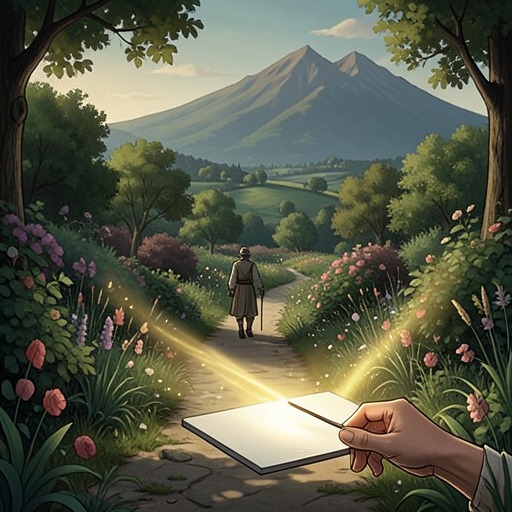
Adam is brought into the Garden of Eden, a delicious grove planted with the trees of God and supplied with every variety of fruit for food. Yet creation includes a prohibition as well as abundance. Adam may eat from the pleasant fruits of the garden, but not from the Tree of Knowledge of Good and Evil. Eating from it will bring death. The prohibition makes freedom morally meaningful: within a world of generous provision, humanity must govern appetite and remain obedient rather than treating knowledge as possession without limit.
Completion, Sabbath, and the Created Order
At the end of the sixth day, God views everything that has been made and finds it entirely good. Heaven shines, Earth smiles in its rich attire, and air, water, and land are filled with beings that fly, swim, and walk. God then returns to Heaven with the Son, accompanied by angelic acclamation, while the newly made world is seen from the divine throne as an addition to God’s empire. The ascent does not signal abandonment. God intends to visit the dwellings of just men and to send winged messengers on errands of grace.
The seventh evening rises in Eden as the Son takes his place beside the Father. God rests from the work of creation, blesses and hallows the seventh day, and establishes the Sabbath. Rest is not silence: harps, pipes, dulcimers, strings, voices, and incense fill the holy mount as the Heavenly Hierarchy sings the acts of the six days. The Sabbath therefore completes creation by turning accomplished work into worship and ordered time into sacred time.
The celebration also interprets the event politically and theologically. The Heavenly Host praises God’s just vengeance against the apostate spirits, but insists that creating is greater than destroying. Satan and the Rebel Angels attempted to lessen God by removing worshippers; their attempt instead reveals more fully the divine power that can use evil as the occasion of greater good. The new world, founded near Heaven and spread beneath the clear crystalline sea, contains stars that may themselves be worlds and establishes Earth as the pleasant dwelling of humanity.
Consequences and Long Historical Reach
Creation defines humanity as especially favored but conditionally secure. Adam and Eve are created in God’s image, granted dominion, placed in a beautiful world, and warned that happiness depends upon perseverance in uprightness. The account therefore contains the future of the poem in compressed form: abundance stands beside prohibition, freedom beside obedience, and created goodness beside the possibility of corruption. Later visions disclose that the Fall will bring death, disease, violence, predation, seasonal extremity, and the Flood, but those consequences are intelligible only against the original completeness of the created order.
The event also becomes the standard against which later history is measured. After Adam’s transgression, Michael shows him Cain killing Abel, human disease and death, the Flood preserved through Noah’s Ark, the covenant signified by the rainbow, the Law given through Moses, and the sanctuary in which God dwells among mortal men. These later scenes do not replace creation; they repeat its central pattern of judgment followed by preservation and renewed order. The rainbow covenant promises that the Earth will not again be destroyed by flood, while the promised Messiah and the eventual renewal of Heaven and Earth extend the original creative purpose toward restoration.
Creation thus supplies both the cosmology and the moral grammar of the poem. Its movements from darkness to light, confusion to boundary, barrenness to generation, and dust to rational life establish a pattern that later redemption will revisit on a larger historical scale. The world begins as a bounded gift, humanity begins as a worshipping steward, and time begins its sacred rhythm with six days of making followed by Sabbath rest.