Creation week
Paradise LostCreation week is the foundational temporal sequence through which God transforms the unformed Deep into Heaven, Earth, living nature, and humanity. The sequence is not merely a catalogue of origins: it establishes an ordered universe against Chaos, assigns creatures their places and functions, gives Adam and Eve their vocation and prohibition, and ends by making the seventh day holy. In this pattern, creation becomes both a demonstration of divine power and the first measure of sacred time.
Cosmic Beginning and Divine Order
The account begins after Lucifer and his flaming legions have fallen from Heaven and after the Son of God has returned victorious with the faithful host. God rejects the fear that rebellion has diminished his kingdom: he declares that he can repair the loss by creating another world and an innumerable race from one man. The new world will be Earth, a place where humanity may dwell, worship, and, through long obedience and merit, eventually find a way upward toward Heaven. Creation week therefore answers the revolt of the fallen angels not by restoring the lost spirits, but by producing a new order and a new race capable of freely acknowledging its source.
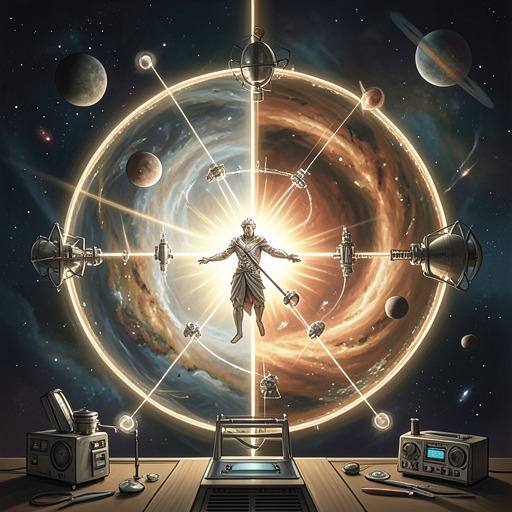
The Son of God receives the commission to make this purpose effective. Accompanied by Cherubim, Seraphim, Thrones, Virtues, and other members of the Heavenly Host, he rides into Chaos, where dark and violent waters surge like mountains against Heaven. His command quiets the troubled Deep. He then uses golden compasses from God's eternal store to establish the universe's circumference, assigning bounds to the created world while leaving Chaos boundless beyond it. This act gives Creation a measurable form: the cosmos is not an accidental emergence but a space circumscribed by will, proportion, and intention.
The Spirit of God broods over the watery mass, infusing it with vital power and warmth while purging the cold infernal dregs hostile to life. Like is gathered with like; the remaining matter is separated and assigned its proper place; Air is spun out, and Earth hangs balanced at its center. The first command produces ethereal Light before the Sun exists. Light is divided from Darkness, and their alternation establishes the first Day and Night. Even at this earliest stage, temporal order arises together with material order.
The Six Creative Days
On the second day, God makes the Firmament, a transparent elemental expanse that divides the waters above from the waters beneath. The separation protects the new frame of the world from the violent extremes of Chaos, which has been pushed far away. On the third day, the waters beneath Heaven gather into one place, revealing dry Land. Mountains rise, a broad basin receives the congregated waters, and the Seas receive their name. Earth then produces grass, seed-bearing herbs, shrubs, vines, gourds, reeds, bushes, blossoms, and fruit trees. The formerly bare surface becomes a richly varied landscape, likened to Heaven as a place where divine beings might delight to dwell, although no human cultivator yet exists and the ground is watered by dew and mist.
The fourth day introduces the great lights that regulate the visible calendar. God makes the Sun to rule the Day, the Moon to rule the Night, and the stars to illuminate Earth and mark signs, seasons, days, and circling years. The Sun is first formed as an ethereal sphere and becomes the great palace and source of light; the Moon borrows and reflects that light, while the stars fill the hemisphere. Their rising and setting establish the recurring rhythm of morning and evening and give Creation week a cosmic duration rather than a merely terrestrial one.
On the fifth day, the waters generate living creatures in abundance, including fish, birds, and the great whales. Seas, lakes, streams, creeks, and bays teem with life. Fish move in shoals beneath the green waves, among coral groves and pearly shells, while birds hatch, feather, fly, migrate, sing, bathe, and build nests on cliffs, cedar tops, lakes, and rivers. Leviathan appears as the largest of the creatures of the Deep, so immense that he resembles a moving land when he rises or spouts water. God blesses these creatures and commands them to be fruitful and multiply.
The sixth day brings terrestrial life. The Earth opens its fertile womb and produces cattle, wild beasts, insects, worms, and serpents in complete, full-grown forms. Herds occupy fields and meadows; solitary animals emerge from forests, thickets, brakes, and dens. Lions, tigers, leopards, the swift stag, Behemoth, the hippopotamus, and the crocodile display the range from familiar pastoral life to overwhelming animal magnitude. Insects appear in intricate colors and forms; the ant embodies provident communal labor, and the bee builds honey-filled cells. The Serpent is called the most subtle beast of the field, yet at this stage it is not harmful and remains obedient to God's command.
Humanity, Vocation, and Prohibition
After the heavens, waters, air, earth, fish, birds, and beasts have been completed, one work remains: a creature not prone and brutish like the others, but endowed with reason, upright stature, self-knowledge, and the capacity to correspond with Heaven. God therefore announces the making of Man in his image and likeness. He forms Adam from the dust of the ground and breathes into his nostrils the breath of life, making him a living soul. Humanity's dignity lies in this double condition: Adam is earthly in substance yet bears the divine image in form and spiritual capacity.
Humanity also receives a governing vocation. Adam and his female consort are blessed with the command to be fruitful, multiply, fill the Earth, subdue it, and exercise dominion over fish, birds, beasts, and every living thing that moves upon the ground. Dominion is joined to gratitude and worship: the rational creature is expected to recognize that every good descends from God and to direct heart, voice, and eyes back toward the supreme Creator. The command to multiply thus belongs within a larger order of worshipful stewardship, not mere possession.
God brings Adam into the Garden of Eden, a delicious grove planted with the trees of God and filled with every kind of pleasant fruit. All its variety is freely given as food except the fruit of the Tree of Knowledge of Good and Evil. The prohibition is precise: Adam may not eat from that tree, and death is the imposed penalty for eating. Appetite must therefore be governed before sin surprises humanity. The rule gives the State of Innocence a moral shape, making obedience possible and preserving Free Will as a real condition rather than a decorative attribute.
Completion and the Seventh Day
At the close of the sixth day, God surveys everything he has made and finds it entirely good. The Son of God ascends with angelic acclamation along a golden road paved with stars, returning to God's eternal house. The movement from the Deep to the completed world is thereby framed by divine procession: the creative work begins in the presence of the Heavenly Host and ends with Heaven celebrating the finished cosmos.
The seventh evening rises in Eden after the Sun has set. At the throne of God, the Son of God sits with his Father, and God rests from the work of Creation. Rest does not mean silence. Harps, pipes, dulcimers, strings, voices, and incense fill the holy mountain while the celestial orders sing of the six days' acts. They praise God's power to create good out of evil and insist that creation is greater than destruction: the rebellion intended to diminish divine worship has instead become the occasion for a new world and a new race.
The seventh day is therefore blessed and hallowed as Sabbath. It is a temporal sanctuary in which labor gives way to musical praise and contemplation of the completed work. The day also promises recurrence: God will visit the dwellings of just men, send angelic messengers, and maintain intercourse between Heaven and the created world. Creation week thus closes not with abandonment but with a continuing relationship between the Creator and the world he has made.
Narrative and Thematic Significance
The Creation week is narrated as revealed history rather than as an event witnessed by Adam. Adam asks the angelic historian to explain how Heaven and Earth began, and the answer is deliberately limited to knowledge that human beings can bear. The angel warns that knowledge requires temperance: excess turns wisdom into folly, just as nourishment becomes wind when consumed beyond measure. Creation is consequently both disclosure and discipline, an account that satisfies legitimate wonder while preserving mysteries known only to God.
The sequence also establishes the causal background for later history. Adam's image-bearing status, his dominion, his command to multiply, and his prohibition against the Tree of Knowledge explain both the promise of human greatness and the gravity of disobedience. When Michael later shows Adam the murder of Abel, he identifies the violence as a consequence of the original sin transmitted from Adam, although Abel never touched the forbidden tree. The revelation turns Creation week's good order into the standard against which corruption, death, disease, law, sacrifice, and redemption will be measured.
Finally, Creation week offers the poem's central counterclaim to the fallen angels' attempt to diminish God. God's response to rebellion is generative rather than defensive: he creates Earth, appoints humanity to rule within it, and promises that a race may one day rise by obedience. The cosmos therefore bears an irony that the heavenly choirs explicitly celebrate: evil, while remaining evil, is made to serve a greater good. The ordered days, the moral command, and the hallowed Sabbath together present a universe whose material structure, human vocation, and sacred calendar arise from one coherent divine purpose.