Damnation
Paradise LostDamnation is the state of being condemned to unending misery under divine justice. The poem presents it not merely as physical pain but as a total condition of exclusion: the damned lose bliss, rest, hope, and communion with God, while their immortal existence continues as the very medium of punishment. Against this apparently final order, the promise of the Son of God’s atonement establishes redemption as the possibility that can interrupt the fate otherwise inherited by humankind.
Definition and Setting
Damnation first appears as the punishment reserved for Satan and the Rebel Angels after their revolt against God. Cast from Heaven, Satan and his host fall into Hell, where they lie defeated yet immortal. Their overthrow does not end their existence; instead, their survival makes possible an eternity of pain, rebellion, and frustrated memory. Satan’s recollection of lost happiness intensifies the sentence, because the damned retain enough consciousness to measure their present misery against the glory from which they have fallen.
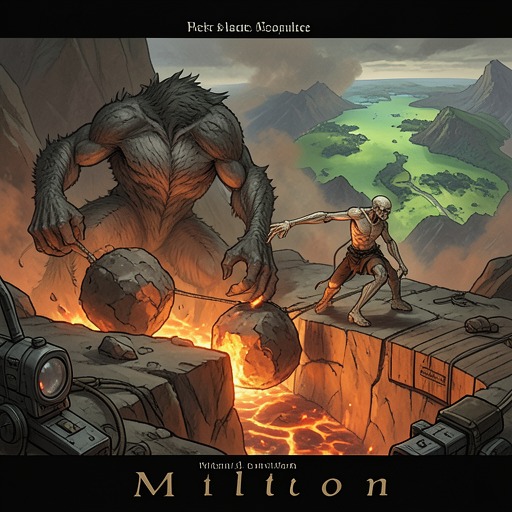
Hell is represented as a prison prepared by Eternal Justice. It is a dungeon of sorrow and perpetual torment, surrounded by fire that burns without being consumed. The flames illuminate nothing; they produce a “darkness visible” in which suffering can be seen without becoming intelligible or hopeful. Hell is therefore not simply a place of heat. It is an inverted creation, removed from God and the light of Heaven, a domain where peace and rest cannot dwell and where hope never arrives.
Punishment and Experience
The central characteristic of Damnation is its endlessness. The damned are not purified by suffering, brought to repentance, or released by the duration of their sentence. Their pain continues without end, and the fiery flood fed by unconsumed sulphur becomes an image of punishment that renews itself. The distance separating Hell from God is described as immense, extending from the center to the outermost pole; spatial remoteness thus expresses spiritual alienation.
The punishment also operates through violent alternation. The damned are carried at recurring intervals from beds of raging fire to a frozen continent beaten by perpetual storms and hail. There, the air burns with cold, and they remain immovable in ice before being hurried back into the flames. The change does not relieve suffering but makes each extreme more severe by contrast. Even Lethe, the river whose waters could erase memory, cannot provide escape: the stream withdraws from any living creature, and Medusa guards its ford with Gorgon terror. Forgetfulness is desired as release, but fate prevents the damned from obtaining even that small mercy.
This structure makes Damnation an existence in which death would seem preferable to continued being. Moloch argues that annihilation would be better than eternal pain, yet the fallen spirits fear that their divine substance cannot cease. Their immortality, which once signified glory, becomes the condition that prevents extinction. The poem therefore turns being itself into a burden: the damned possess consciousness, power, and memory, but none can restore the lost state.
Relation to Rebellion and Freedom
Damnation is the consequence of disobedience, but the poem connects it to a prior exercise of freedom. The Rebel Angels could have remained obedient; their fall is presented as a voluntary revolt against God’s authority. Satan’s defiance after the defeat reveals the psychological persistence of the sentence. Pain does not produce humility in him. Instead, lost happiness and lasting punishment harden his pride, hate, and desire for revenge.
Satan consequently treats Hell as the setting for continued opposition rather than repentance. He imagines that the fallen can convert their torments into weapons and preserve themselves through an eternal war against Heaven. Yet this rhetoric does not cancel Damnation. His defiance merely shows how the damned remain trapped within the logic of their punishment: every plan for freedom repeats the rebellion that caused their exile, and every assertion of self-rule confirms their separation from God.
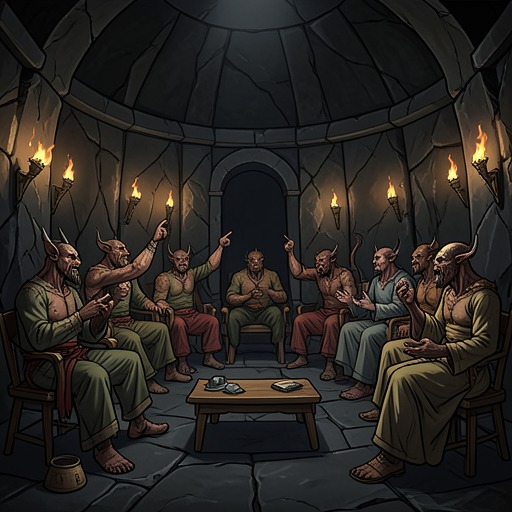
The same political logic recurs in the Infernal Council. Satan accepts a throne in Hell and presents leadership as a recovered inheritance, while Moloch demands open war and Belial counsels delay. Their debate gives Damnation a collective and institutional form. It is not only a private anguish but also a society organized around resentment, hierarchy, strategy, and the refusal to submit. The council’s apparent unity is therefore founded on a shared deprivation rather than restored freedom.
Human Damnation and the Threat of Death
For humanity, Damnation begins as the legal consequence of the Fall. God declares that Adam’s disobedience places him and his posterity under death. Once the divine command has been violated, the human race has no adequate offering with which to satisfy the penalty. Without an able and willing substitute, all mankind would be adjudged to Death and Hell.
Adam’s fall demonstrates how this sentence enters human history. He reasons that God may not destroy His favored creatures, but the possibility of Damnation remains attached to the forbidden act. His assumption that the Serpent lives after tasting the fruit cannot overturn the divine prohibition, and his choice to share Eve’s fate binds his own destiny to hers. Their union turns individual transgression into a common human condition: the loss of innocence carries death into the world and threatens the whole race with permanent separation from divine life.
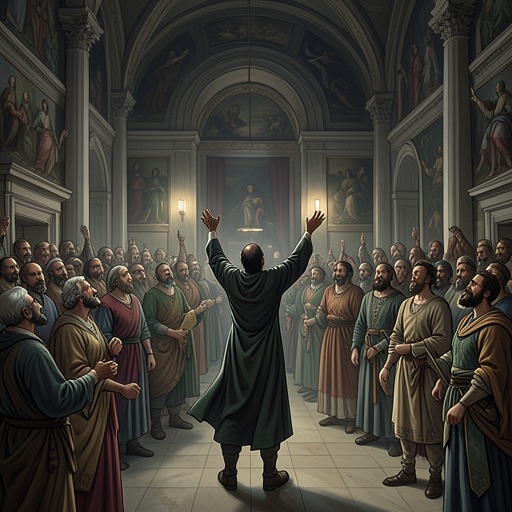
The later history shown to Adam develops the social consequences of this fallen condition. Human beings lose the inward freedom joined to right reason, and disordered desire allows violent rulers to enslave outward liberty. The tower built in defiance of God and the confusion imposed on its builders present collective pride as another form of self-exclusion. Damnation is thus anticipated not only in Hell but in the political and moral disorders produced when creatures claim authority that belongs to God.
Atonement and the Possibility of Escape
The finality of Damnation is challenged by the Son of God. When Heaven remains silent before the question of who will become mortal to redeem human crime, the Son offers life for life. He agrees to leave the Father’s presence, assume human nature, suffer death, and bear the anger due to mankind. His willingness supplies what fallen humanity cannot supply for itself: a satisfying payment for the transgression and an act of love equal to the demands of justice.
The Father explains that the Son will become Man through a wondrous birth and serve as a second root of humanity. As Adam’s crime makes his descendants guilty, the Son’s merit can absolve those who renounce their own deeds and receive new life through him. Damnation is therefore not erased by denying justice; it is opposed through substitution, obedience, death, and the imputation of merit by faith.
Michael’s account of the future makes the pattern explicit. The Son will fulfill the Law, endure a reproachful life and cursed death, and be nailed to the Cross by his own nation. His death becomes the ransom that redeems humanity from the death deserved by sin. He will rise before the third dawning, defeat Sin and Death, and later ascend into Heaven. Salvation is offered beyond the descendants of Abraham to all who share Abraham’s faith, while faithful believers are promised reception into bliss.
Theological and Narrative Significance
Damnation gives the poem’s account of disobedience its ultimate scale. The fall is not a temporary loss of comfort but a rupture in the relation between creature and Creator, extending from the Rebel Angels through Adam and Eve into the history of nations. Its imagery joins physical extremes, political subjection, memory, and metaphysical distance so that punishment is experienced simultaneously in body, mind, society, and eternity.
At the same time, Damnation defines the drama of redemption by marking what the Son of God must overcome. The Son does not defeat Satan merely by destroying him; he defeats the works of Satan in humanity, especially Sin and Death. His obedience answers the disobedience that generated the sentence, and his death transforms the apparent triumph of punishment into the means of liberation. The poem’s moral architecture therefore holds justice and mercy in tension: Damnation remains the serious consequence of revolt, but grace provides a way out for those who accept the offered redemption rather than persist in disobedience.