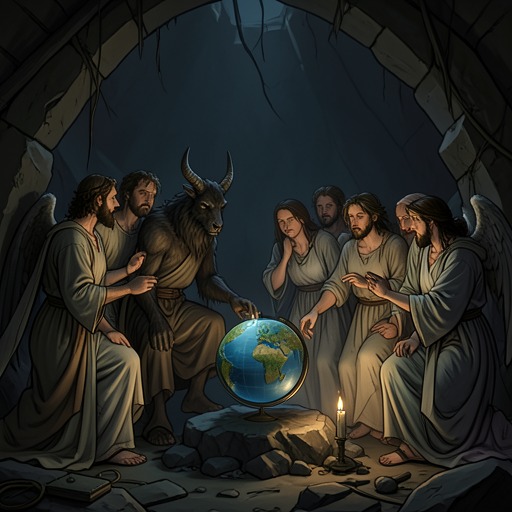
Divine Providence
Paradise LostDivine Providence is the governing theological principle of Paradise Lost: God’s wisdom and justice order the universe without abolishing the freedom of created beings. The poem presents providence not as arbitrary prevention of evil, but as the power that permits free choice, judges rebellion, limits its consequences, and ultimately turns catastrophe toward redemption. Its decisive significance lies in the poem’s stated ambition to “justifie the wayes of God to men,” showing how creation, fall, history, and restoration belong to one intelligible design.
Definition and Cosmic Order
Divine Providence first appears as the poem’s interpretive purpose. The Heavenly Muse is invoked to illuminate what is dark and raise what is low so that the speaker may assert eternal providence and explain God’s ways to humanity. This appeal places providence above the immediate action: the poem is not merely recounting rebellion and disobedience, but asking how divine justice can remain compatible with a world in which immortal spirits and human beings can fall.
Providence is visible from the beginning in the relation between creation and Chaos. The Son of God rides into Chaos, commands the troubled waters to cease their discord, and uses golden compasses to mark the universe’s circumference. God then separates and arranges the elements, brings light from the abyss, divides day from night, and establishes the firmament between the waters. Creation is therefore presented as ordered activity rather than accidental emergence. The same divine governance that gives the world its boundaries also supplies the metaphysical setting in which freedom, disorder, judgment, and renewal can occur.
The creation of Adam and Eve defines the providential relation between human freedom and human responsibility. God forms Adam from dust, breathes life into him, creates him in the divine image, and gives humanity dominion over the animals and the earth. He blesses humanity with the command to be fruitful, multiply, fill the earth, subdue it, and govern the living world. Yet this generous authority is accompanied by one restraint: the Forbidden fruit must not be eaten, because eating from the Tree of Knowledge of Good and Evil carries death as its penalty. Providence thus establishes both abundance and limit, offering rational creatures a genuine field in which obedience can be freely chosen.
Freedom, Rebellion, and Judgment
The poem’s most explicit defense of Divine Providence comes through God’s account of the Rebel Angels and humanity. God declares that the beings who stood did so freely, and those who fell fell freely. Without freedom, obedience would be compelled rather than sincere, and would therefore possess neither moral praise nor the substance of love. Reason itself is described as choice; to deprive created beings of will and understanding would be to reduce them to necessity rather than preserve them as responsible agents.
This principle governs the judgment of Satan and his followers. Satan’s pride and ambition lead him to seek equality with God, and he raises war in Heaven with the Rebel Angels. God hurls him and his host from Heaven into Hell, where they lie in fiery punishment. Yet the punishment does not erase their agency. Satan remains capable of deliberation, persuasion, and renewed revolt; the very continuation of his activity demonstrates that providence does not need to destroy freedom in order to defeat evil.
The same distinction appears in the debate over the Son of God’s authority. Satan presents monarchy and obedience as an assault on liberty, claiming that the heavenly powers are equal in freedom and should not bend the knee. Abdiel answers that God’s decree is legitimate because the Son of God receives royal authority by right, and because the Son is the agent through whom the Father created the heavenly powers. His rule does not diminish their glory but unites and increases it. The exchange differentiates providential order from tyranny: hierarchy is just when it derives from the Creator’s authority and serves the created order, whereas Satan’s rhetoric of equality conceals a will to self-exaltation and domination.
Providence and Human Fallenness
When God sees Satan approaching the newly created world, He foresees that humanity will be tested and will transgress the sole command. God nevertheless insists that the fault will be humanity’s own, because Adam was created just and sufficient to stand while remaining free to fall. Foreknowledge does not cause the offense; it knows what free creatures will choose without compelling that choice. This is the poem’s central answer to the charge that predestination or divine foreknowledge makes rebellion necessary.
Human disobedience also exposes providence as a structure of moral consequence. After Eve tastes the Forbidden fruit, Adam reasons that the threat of death may not be absolute and that the Serpent’s survival appears to support the possibility of a higher condition. He fears that God would be frustrated if humanity were destroyed, and he chooses to share Eve’s fate rather than live without her. His reasoning is emotionally powerful but providentially mistaken: love and anxiety do not cancel the moral reality of deliberate transgression.
The consequences spread beyond the private act. Sin and Death enter Paradise, and God explains that the destructive powers have been admitted through human folly, not because divine providence has abandoned creation. Sin infects humanity’s thoughts, looks, words, and actions, while Death seeks humanity as its final prey. Yet God also foresees the eventual removal of Sin, Death, and the Grave through the victorious action of the Son of God. Evil is permitted to act within history, but it is not granted final sovereignty over the world.
Providence likewise interprets political oppression as both consequence and judgment. Adam is told that human freedom is inseparable from right reason; when reason is obscured or disobeyed, disordered passions enslave the person from within. God may then subject outward freedom to violent rulers, not as an excuse for tyrants but as a judgment upon inward corruption. The lesson is applied to the future human usurper who claims dominion over his brethren and builds a tower in defiance of Heaven. Human beings receive dominion over beasts, fish, and birds, but not over other human beings by natural right. Providence therefore distinguishes legitimate authority from ambitious usurpation and links political tyranny to the prior loss of rational self-government.
Grace, Atonement, and Redemption
Divine Providence does not leave fallen humanity without recourse. God declares that humanity will not be wholly lost: some will be saved by grace, their damaged powers renewed and upheld so that they can stand against their mortal foe. Grace is offered through warning, repentance, prayer, and obedience. Conscience serves as an internal guide, and those who use the light granted to them and persist to the end may arrive safely. Those who neglect and scorn this patience become harder and more blind, so exclusion from mercy is associated with deliberate rejection rather than with an arbitrary refusal of aid.
Justice nevertheless requires satisfaction for human treason. Humanity has nothing adequate to offer for itself, and the heavenly choir provides no patron or intercessor willing to assume the deadly forfeiture. The Son of God then offers life for life. He will leave the Father’s bosom, take human nature, endure death, and rise again because death cannot permanently possess him. The offer is both sacrificial and providential: the Son accepts the penalty while preserving the possibility that divine justice and divine mercy can meet without either being annulled.
God confirms that the Son must join divine nature to human nature and become Man among men, made flesh through a wondrous birth from Virgin seed. As humanity perishes in Adam, those restored will be restored through the Son as a second root. His merit will be imputed to those who renounce reliance upon their own righteousness and unrighteousness and live in him. Providence therefore gives the fall a redemptive structure without calling the fall good in itself: the evil remains an offense, but God’s response produces a greater good through obedience, sacrifice, grace, and renewed life.
The promised course of redemption includes the Son’s obedient life, rejection, blasphemy, seizure, judgment, crucifixion, and resurrection before the third dawn. His death defeats Sin and Death, while faith joined to works receives the benefit of his satisfaction. After appearing to his disciples, he ascends and leaves them the charge of teaching all nations. Salvation consequently extends beyond the descendants of Abraham to the descendants of Abraham’s faith throughout the world. The Spirit of God will strengthen believers, write the Law of Faith upon their hearts, and give the Apostles gifts of tongues and miracles, while the later corruption of teachers and the alliance of spiritual claims with secular power become further stages within the history providence has revealed.
Historical Direction and Final Restoration
Providence gives human history a direction that reaches beyond individual punishment. The future includes the Flood, the dispersal and confusion associated with Babel, the selection of Abraham from idolatry, the rise of a nation through his seed, the Babylonian Captivity and return, the covenant associated with David, and the birth of the Messiah. These episodes are not isolated exempla. They form a sequence in which judgment, preservation, covenant, failure, and renewed promise repeatedly succeed one another.
The final horizon is the Last Judgment and the renewal of creation. The Son of God will return with glory and power to judge the living and the dead, condemn the unfaithful, and receive the faithful into bliss. Earth itself will become Paradise, happier than Eden. Adam responds with wonder that good can emerge from evil and that grace can abound over wrath. This recognition is the poem’s ultimate providential resolution: the world’s history is not a straight denial of suffering, but a design in which creation’s original goodness is surpassed by restoration, and in which the defeat of Sin and Death prepares a purified order that can receive no further stain.