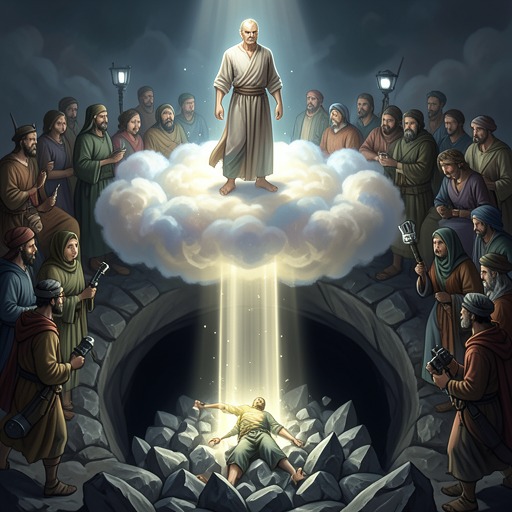
Evil be thou my Good
Paradise Lost“Evil be thou my Good” is Satan’s declaration of moral reversal after the Fall. It marks the point at which frustrated ambition, despair, and refusal to submit harden into a deliberate creed: having rejected repentance, he will treat evil as his chosen good and seek power through resistance to God.
Crisis of Repentance
Satan reaches the expression while considering whether repentance could restore his former state. He recognizes that submission is the only possible route to pardon, yet pride makes submission unbearable, especially before the spirits whom he had seduced after boasting that he could subdue the Omnipotent. His imagined repentance therefore appears unstable even to himself: restored rank might revive the same ambitious thoughts, while vows made under pain might be revoked as soon as suffering ceased. He concludes that reconciliation cannot grow where deadly hatred has opened such deep wounds, because a temporary peace would merely prepare a worse relapse and a heavier fall.
This reasoning gives the phrase its immediate force. Satan does not claim that evil has objectively become good; he announces that he will install evil in the place where good has been rejected. The declaration follows his farewell to hope, fear, and remorse, all of which he says are lost to him. It is thus both a judgment on his condition and a decision about how to inhabit it.
Meaning and Rhetorical Form
The expression is a compressed imperative addressed to evil itself. Its grammar resembles a blessing, dedication, or coronation: evil is summoned and assigned the role of good. That inversion exposes the gap between Satan’s language and the moral structure of the poem. The words promise mastery over values, but the surrounding narrative shows a being whose ambition has already reduced him to misery. The sentence therefore operates as a performative act of self-definition while also revealing the impoverishment of the world he chooses.
The line depends on antithesis. Good and evil, hope and despair, Heaven and Hell, submission and dominion are arranged as opposing terms, but Satan’s choice does not dissolve the opposition; it intensifies it. His proposed “divided Empire” with Heaven’s King is likewise an admission that his power remains parasitic upon the order he contests. He can claim a realm through evil, but he cannot create an independent moral order equal to God’s.
From Private Despair to Public Objective
Satan’s declaration turns inward torment into outward strategy. He imagines that through evil he may hold a divided empire and perhaps rule more than half, once Mankind and the new World are drawn into his conflict with God. The immediate target is therefore not only personal consolation. Mankind becomes the field on which Satan intends to convert exclusion into revenge and transform the creation given to God’s new delight into evidence against its Creator.
The phrase also exposes the logic of his ambition. He does not simply suffer defeat; he interprets defeat as a reason to redefine victory. If he cannot regain Heaven or obtain pardon without submission, he will pursue dominion through corruption. Evil becomes “good” only in the instrumental sense that it promises him agency, rivalry, and revenge. His choice is a refusal to accept dependence, even though the refusal leaves him dependent upon the order and creatures he seeks to damage.
Contrast with Redemption
The declaration stands in sharp opposition to the Son of God’s offer of redemption. When God asks where a willing substitute can be found to satisfy the penalty for Man’s crime, Heaven remains silent until the Son of God offers life for life. He accepts incarnation, death, and the burden of human transgression, trusting that death will not retain him and that his resurrection will defeat Sin and Death. In that economy, love produces obedience, payment, restoration, and new life.
Satan’s alternative is not an equivalent sacrifice but a counter-economy of loss and retaliation. He cannot provide atonement for himself, and he refuses the submission through which pardon might be sought. The Son of God gives himself to restore others; Satan converts his own ruin into a reason to ruin others. Against the Son of God’s obedience, whose merit can be imputed to those who receive it by faith, Satan offers self-exaltation and moral inversion.
Consequences and Thematic Significance
The declaration foreshadows Satan’s approach to Eden and his assault upon Mankind. His inward conflict is visible in the repeated changes of his face—pale anger, envy, and despair—but he smooths those passions into outward calm and becomes an artificer of fraud, concealing deep malice beneath a saintly appearance. The phrase therefore names not a passing mood but the principle governing his subsequent deception.
Its tragic irony becomes clearer when Adam and Eve later violate the prohibition against eating from the Tree of Knowledge of Good and Evil. Adam, hearing Eve’s account, reasons that the forbidden fruit may not be fatal because the Serpent has tasted it and remains alive, and he chooses to share her fate rather than be separated from her. Eve presents the result as enlarged life, opened eyes, new hopes, and new joys. Yet the promised elevation produces guilt, death, and the need for redemption rather than godhead. Satan’s declared “good” thus works through a counterfeit promise of ascent: what appears to offer freedom and enlargement becomes bondage to sin.
Michael’s later explanation completes the phrase’s larger counterpoint. The Son of God will not defeat Satan merely by destroying him, but by destroying his works in Mankind and in Mankind’s descendants. Through obedience to God’s law, suffering, death, resurrection, and ascension, he will bruise Satan’s head, crush Sin and Death, and make possible the restoration of those who receive his life. “Evil be thou my Good” consequently defines the negative pole of the poem’s moral architecture: a will that makes rebellion its value is permitted to act, yet its apparent triumph is ultimately folded into the larger work by which good is brought out of evil.