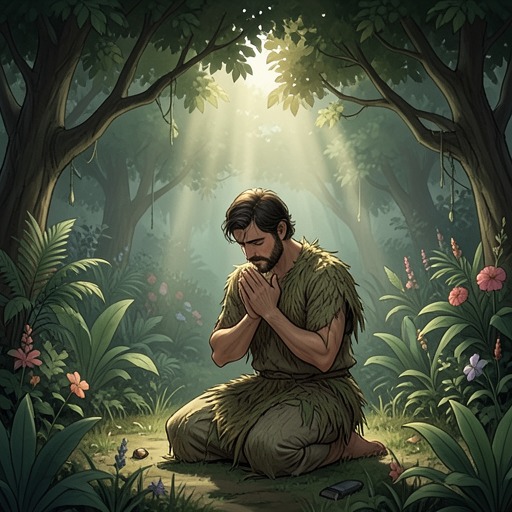
Fall and Restoration
Paradise LostFall and Restoration names the central movement of Paradise Lost from the first disobedience of Adam and Eve to the promised recovery of humanity and the created order. The Fall is presented as a rupture with God that introduces death and woe, destroys Edenic happiness, and spreads corruption through human history. Restoration answers that rupture not by denying guilt or simply returning humanity to its first condition, but through the Son of God’s willing incarnation, obedience, death, resurrection, and eventual return, by which grace can overcome the consequences of sin and creation can be renewed.
The Fall as Rupture and Inheritance
The poem begins by defining the Fall through “Mans First Disobedience” and the forbidden fruit whose mortal taste brought Death into the world, together with all human woe and the loss of Eden. The catastrophe is therefore both an act and a condition: Adam and Eve transgress a divine restraint, and their act changes the circumstances of every generation that follows. The poem’s stated purpose is to assert Divine Providence and to justify the ways of God to men, so the Fall becomes the problem through which the whole moral architecture of the poem must be tested.
The immediate cause is traced to Satan, whose pride and envy have already produced rebellion and expulsion from Heaven. The infernal serpent deceives Eve, but the resulting disorder is not confined to the private choice of two individuals. When the Rebel Angels later wander through the world, they corrupt much of mankind through falsehood, idolatry, and religions that transform created or brutish images into objects of worship. The Fall thus repeats itself historically: the original disobedience becomes a pattern of spiritual displacement in which human beings abandon God and mistake visible power, ritual splendor, or created forms for divine reality.
Adam’s response makes the Fall at once a moral failure and a crisis of relationship. Horrified by Eve’s transgression, he nevertheless decides that he cannot be separated from her, declaring that her fate must be his and that they are one flesh. His reasoning includes fear of death, hope that the threat may not be carried out, and anxiety that their destruction would allow the Adversary to mock God’s government. His choice is loving in its attachment but disobedient in its consequence: he knowingly shares Eve’s guilt rather than remain obedient apart from her. The poem therefore presents restoration against a background in which love itself has been confused with the surrender of rightful obedience.
Judgment, Death, and the Promise of Return
Divine judgment exposes the structure of the transgression. Adam admits that Eve gave him the fruit and that he ate; Eve admits that the Serpent beguiled her. The judgments that follow make the Fall visible in bodily, social, and earthly forms. Eve’s conception and childbirth will be marked by multiplied sorrow, and her relation to Adam will be placed under his rule. Adam’s labor will meet a cursed ground, thorns, and thistles; bread will be earned in the sweat of his face; and the human body will return to the dust from which it was taken.
Yet the sentence is accompanied by delay and pity rather than immediate annihilation. God clothes the naked pair with skins and covers their inward nakedness with a robe of righteousness. This act does not cancel the judgment, but it introduces the first sign that justice and mercy will operate together. The Fall leaves humanity exposed, guilty, and mortal, while restoration begins as an undeserved covering and a promise that the sentence of death is not the final word.
The oracle spoken against the Serpent establishes the pattern of conflict and reversal on which the later history depends. Enmity will stand between the Serpent and the Woman, and between their respective seed; the Woman’s Seed will bruise the Serpent’s head, while the Serpent will bruise his heel. The prophecy is later interpreted through Jesus, son of Mary, who is identified with the promised deliverer. The decisive victory will not be a simple duel in which Satan is destroyed by a stronger physical blow. Instead, the Son of God will defeat Satan’s works in humanity by fulfilling the obedience Adam failed to give and by enduring the death imposed by divine justice.
Atonement as Willing Restoration
The logic of restoration is stated in Heaven before it is enacted on Earth. Because disobedience has incurred a debt that humanity cannot pay, mankind would be lost to Death and Hell unless another being both able and willing could offer “death for death.” The Heavenly Quire offers no volunteer. The Son of God alone steps forward, offering life for life and consenting to leave the bosom and glory of the Father, assume human nature, and die for humanity’s mortal crime.
The Son’s offer joins love to obedience. He does not merely request that the penalty be waived; he accepts the full burden of human punishment, while trusting that death will not retain him permanently. His death will be followed by resurrection, the defeat of Death, and the captivity of Hell’s powers. Restoration consequently has an economic and juridical shape—the debt is paid, satisfaction is rendered, and the forfeiture is answered—but its deepest motive is filial obedience and immortal love offered freely for mortal beings.
God’s response defines the relation between Adam and the Son of God as two roots of human destiny. Adam’s crime makes his descendants guilty, while the Son’s merit can absolve those who renounce reliance on their own righteousness and receive new life in him. The Son is to become Man among men, made flesh of Virgin seed and placed in Adam’s room as the Head of mankind. What was lost through the first human head can therefore be restored through a second root, although restoration belongs only to those who are restored through him.
Historical Fulfillment and Universal Scope
Michael explains that the promised victory proceeds through the Son’s perfect obedience, not through brute force. The Son will fulfill the Law by obedience and love, live under hatred and blasphemy, be seized and judged, and die a shameful death on the Cross. In that death he will nail the Law standing against humanity and the sins of mankind to the Cross with him, so that they will no longer injure those who rightly trust in his satisfaction. The resurrection before the third dawn completes the reversal: the grave cannot hold the one who accepts death, and the ransom paid for humanity becomes the means of redemption from death.
Restoration then expands beyond a single people or territory. After appearing to his Disciples, the risen Son of God will leave them the charge to teach all nations and to baptize believers, making salvation available not only to the sons of Abraham’s physical line but also to the sons of Abraham’s faith wherever they live. The promise that all nations will be blessed in Abraham’s seed thus becomes universal in reach, while faith is not detached from action: the benefit is received by faith that is not void of works.
The history of Israel supplies an earlier pattern of deliverance, law, mediation, worship, failure, and renewed mercy. Under Moses, the chosen people escape Egypt, pass through the divided sea, receive laws from God on Mount Sinai, and are given a Tabernacle containing the Ark and the testimony of the Covenant. These institutions make divine presence tangible among mortal people, but they also reveal that sin continues among those whom God dwells among. The sacrificial ceremonies can expose and symbolically address guilt, yet they cannot remove it; they therefore point toward a more precious blood, offered for the unjust by one who is just.
From Restoration to New Creation
The restored community remains vulnerable after the Son of God’s Ascension. The Spirit of God will be sent as a Comforter, writing the Law of Faith through love on believers’ hearts and equipping the Apostles to resist Satan’s assaults. Their ministry will reach many nations, but later teachers will corrupt sacred mysteries for profit and ambition, join spiritual claims to secular power, and impose laws on consciences that are not written in the promised inward faith. Persecution will follow against those who continue to worship in spirit and truth, while outward rites and formal religion will often be mistaken for genuine faith.
This decline shows that restoration unfolds within history before it reaches its final completion. The promise does not mean that every institution or every visible religious form is automatically renewed. Truth may retreat, faith may become rare, and the world may groan under its own weight; nevertheless, the future return of the Woman’s Seed will expose and end Satan’s perverted world. The pattern is therefore neither a simple return to Eden nor an uninterrupted ascent. It moves through recurrence of sin, endurance under suffering, preservation of faith, and a final act of judgment.
At the end, the Son of God returns in glory to judge the living and the dead, punish the unfaithful, and receive the faithful into bliss. The Earth itself will be purged and refined rather than abandoned: new Heavens and a new Earth will be founded in righteousness, peace, and love. The restored world will be more blessed than Eden, so that restoration exceeds mere recovery. Creation, first brought from darkness into light, is finally renewed through the passage from evil to good.
Human Knowledge and the End of Exile
Adam’s education under Michael turns the doctrine of restoration into a change in understanding. He sees Cain and Abel, the first human death, and learns that original crime generates further violence among descendants who did not personally eat the forbidden fruit. He witnesses the spread of disease, war, idolatry, captivity, and persecution, but he also receives the history of deliverance and the promise of the Messiah. The sequence teaches him that mortality is not an isolated punishment but the condition through which humanity must learn dependence, patience, faith, and moral discernment.
At the close of the vision, Adam recognizes that obedience is the highest wisdom and that suffering for truth can become the path to victory. Death, for the faithful, is taught as the gate of life. Michael therefore directs him toward an inward restoration: knowledge must be joined to faith, virtue, patience, temperance, and love, so that a Paradise may be possessed within rather than merely mourned as a lost external place.
The final expulsion preserves the tragedy of the Fall while opening its restored future. Adam and Eve leave Eden under the blazing sword, looking back at the guarded gate and shedding natural tears, but they do not depart without hope. The world lies before them, Providence as their guide, and Eve carries the consolation that the Promised Seed will restore what her willful crime has lost. Their slow movement through Eden is thus both exile and beginning: the old Paradise is closed, yet the history through which a greater Paradise will come has opened.