Fallen state
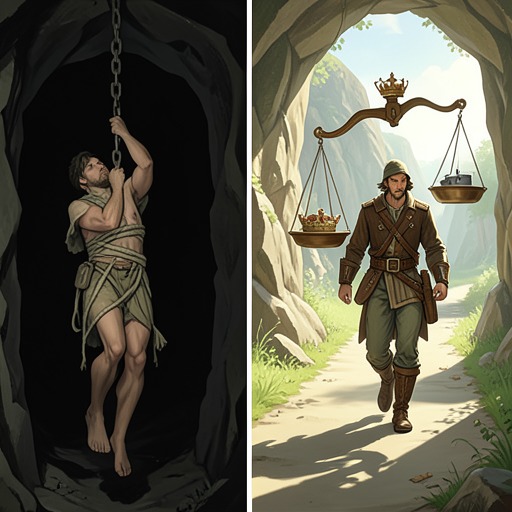
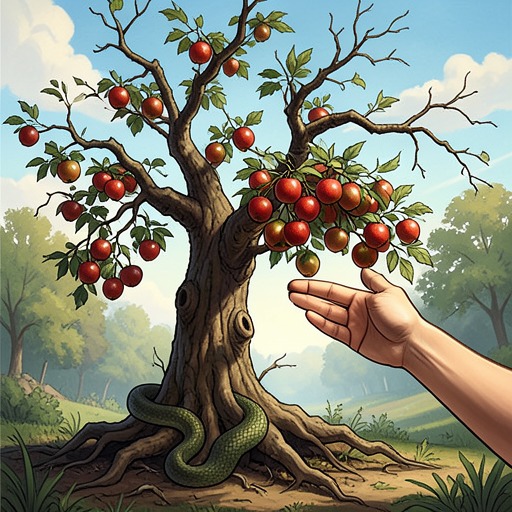
Paradise LostThe Fallen state is the condition into which Adam and Eve enter after eating the forbidden fruit, and it transforms every dimension of human existence at once. Their loss is inward and outward: innocence becomes shame, desire becomes disordered, the ground becomes resistant, immortality is withdrawn, and life is placed under the sign of death. Yet the condition also becomes the setting in which repentance, prayer, faith, and eventual restoration can begin. Fallenness therefore names both a deprivation and a historical mode of existence, one marked by suffering but not closed to mercy.
The Loss of Innocence
The decisive change appears immediately after Adam eats from the fruit Eve has given him. The fruit does not grant the divine enlargement they imagine. Its first visible operation is to inflame carnal desire, and the pair, newly intoxicated by its effects, turn toward sexual pleasure. Their mutual love is no longer simply an expression of innocent fellowship; it becomes entangled with guilt, appetite, and the attempt to console themselves through one another. The scene joins bodily exhilaration to spiritual disorientation, making desire one of the first signs that the old order has been broken.
When the fruit’s vapor has passed and sleep releases them from its immediate effects, Adam and Eve discover that their eyes are open while their minds have darkened. Innocence had functioned as a veil protecting them from the knowledge of evil; once that veil is gone, they possess knowledge as a burden rather than as a power. Their native righteousness, confidence, honor, and purity have disappeared, leaving them exposed to guilty shame. The contrast is not merely between clothed and unclothed bodies. Their former naked glory has become an accusation, and the body now registers an inward rupture that neither can simply undo.
Their response is concealment. Adam fears the sight of God and the angels and imagines withdrawing into a wilderness of dense trees where sunlight and stars cannot reach him. Instead, he and Eve select the broad leaves of a fig tree and sew them around their waists. The narration enlarges this act through its descriptions of branching shade, Indian herdsmen sheltering from heat, and leaves broad as an Amazonian shield; the elaborate natural imagery makes clear that the covering is materially ingenious but spiritually vain. It can hide the body’s most exposed parts, but it cannot remove guilt or restore the first naked glory.
Judgment and the New Human Condition
The Fall becomes a juridical condition when God questions the accused. Eve confesses that the Serpent beguiled her, but the confession does not cancel her responsibility. The Serpent is cursed, and enmity is established between it and the Woman, between its seed and her Seed. The curse gives the Fallen state a future-directed structure: the present wound will recur through history, but the enemy’s apparent victory already contains the prophecy of a final defeat, when the Woman’s Seed will bruise the Serpent’s head even as the Serpent bruises his heel.
Eve’s sentence multiplies sorrow in conception and childbirth and places her under her husband’s rule. Adam’s judgment reaches beyond the private scene of disobedience to the material conditions of human life. Because he listened to his wife and ate from the prohibited Tree, the ground is cursed for his sake; it will produce thorns and thistles, and food will be gained through the sweat of his face. Labor is no longer a transparent participation in a generous creation but a necessity imposed by a resistant world. The Fallen state is thus social, bodily, ecological, and temporal rather than merely psychological.
The sentence also introduces mortality as the unavoidable horizon of human life. Adam is reminded that he was taken from the ground and will return to dust. Death is denounced as the consequence of sin, but the later divine judgment gives it a more complex function. Adam and Eve had been created with happiness and immortality; once happiness is lost, immortality would only prolong misery. Death consequently becomes a final remedy within the fallen order, limiting the duration of corruption and preparing the possibility of a second life after suffering, faith, and faithful works have refined the person.
Mercy Within Fallenness
Judgment does not exhaust the divine response. The Son, described as both Judge and Saviour, does not reverse the sentence, but he pities the pair standing naked before him. He assumes the form of a servant and clothes their outward nakedness with skins of beasts. More significantly, he covers their inward nakedness with a robe of righteousness, shielding them from the Father’s sight. This double covering distinguishes divine mercy from the improvised fig leaves: human concealment masks shame, while the Son’s action addresses the condition beneath it.
The same mediating role appears when Adam and Eve repent. Their prayer rises from hearts softened by prevenient Grace, and their sighs are treated as the first fruits of Grace implanted in humanity. The Son carries their prayers, mingled with incense, before the Father and interprets their inarticulate contrition. His intercession does not erase death or restore the pair immediately to Paradise; it obtains reconciliation within the limits of the sentence. The Fallen state therefore becomes a condition in which human beings cannot save themselves by knowledge, appearance, or eloquence, but can nevertheless be received through repentance and mediation.
The Father accepts the Son’s request because it accords with his own decree. Adam and Eve cannot remain in Paradise, since the pure immortal elements reject what sin has corrupted, and continued access to the Tree of Life might allow fallen humanity to live forever in misery. Their expulsion is therefore both punishment and containment. The removal from the Garden prevents the tainted pair from converting immortality into endless woe, while the promise of renewal keeps exile from becoming a final abandonment.
Exile, Labor, and Renewed Hope
Michael is commanded to drive the sinful pair from Paradise with a cohort of Cherubim and to place a flaming sword on the eastern side of the Garden, guarding every approach to the Tree of Life. The boundary makes the Fallen state spatially visible: humanity remains connected to its lost origin but cannot re-enter it by force, ingenuity, or nostalgia. Paradise becomes a guarded memory and a prohibited future, while the world outside becomes the arena in which fallen life must unfold.
Before the expulsion, however, Adam and Eve pray and receive new hope. Adam understands that a human prayer, even a single sigh, can reach the seat of God, and he recalls the promise that the Woman’s Seed will bruise their foe. He therefore interprets death as no longer the whole of their future. Eve answers with humility, rejecting the title Mother of all Mankind because she brought death upon all, yet accepting that the Judge’s pardon has made her the source through which life will continue. Her response holds the central paradox of fallenness: the one who first opened the way to death is also placed within the history by which life will be renewed.
Their final attitude is not triumphant restoration but chastened endurance. Eve promises not to leave Adam’s side as they work under the new command of labor, and she imagines that even a fallen life may remain bearable in the pleasant walks outside the Garden. The morning initially appears indifferent to their sleepless grief, continuing its rosy progress, but natural signs soon darken: the air is eclipsed, and animals pursue one another. The world itself now bears the marks of instability. Their departure is consequently both a private separation from Paradise and the beginning of a universal condition in which creation, desire, work, and death are all altered.
Theological and Narrative Significance
The Fallen state gives the poem its governing tension between loss and recovery. The knowledge Adam and Eve sought is exposed as a bad exchange: they know Good and Evil, but Good has been lost and Evil acquired. Knowledge without obedience does not produce divinity; it produces shame, fear, and the awareness of deprivation. The narrative’s irony lies in the gap between their expectation of rising and their actual descent into dependence, labor, and mortality.
At the same time, fallenness is not represented as a static identity. Repentance changes the pair from concealment to prayer, and Grace changes their hardened hearts into living flesh capable of contrition. Their future remains burdened by sorrow and death, but it is no longer without direction. Through the Son’s intercession, the Woman’s Seed, and the prospect of a renewed life after trial, the Fallen state becomes the middle condition between innocence and restoration: a realm of irreversible consequence in which faith and faithful works can still prepare humanity for redemption.