Gabriel
Paradise LostGabriel is the chief guardian of Paradise and one of the Heavenly Host’s principal military leaders. His decisive significance lies in the union of watchfulness and force that he represents: he preserves the boundary of Eden, recognizes the danger posed by Satan’s intrusion, answers defiance with moral authority, and then carries the same loyalty into the open war that drives the Rebel Angels from Heaven.
Identity and Office
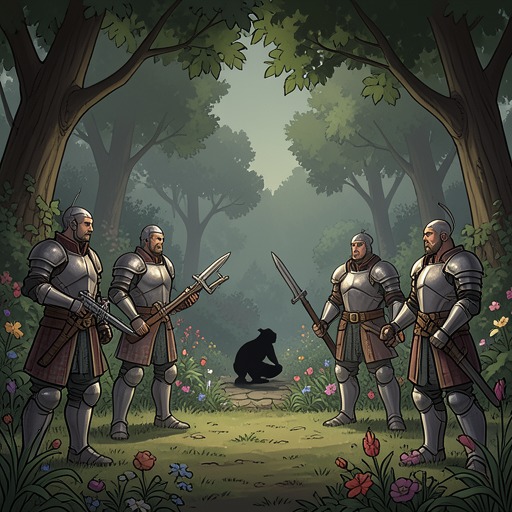
Gabriel is stationed at the eastern gate of Paradise, a highly visible natural fortress formed by alabaster rock piled to the clouds. The gate has one ascent accessible from Earth, while the remaining sides rise as craggy, overhanging cliffs that cannot be climbed. Between its rocky pillars Gabriel sits as chief of the angelic guards, awaiting night and overseeing the protection of the blessed place. Around him, the unarmed youth of Heaven exercise in heroic games, while the nearby celestial armoury displays shields, helmets, and spears hung with diamond and gold. His position makes him both a threshold guardian and the immediate representative of Heaven’s vigilance.
Gabriel’s office is not merely ceremonial. Uriel reports that a spirit, apparently eager to learn more of God’s works and especially of Man, came to his sphere at noon, then revealed an appearance alien to Heaven after landing on the mountain north of Eden. Uriel lost sight of the stranger under cover of shade and feared that one of the banished crew had escaped from the deep to create new trouble. Gabriel answers that no creature has passed through the guarded entrance since midday, but he acknowledges that spiritual substance cannot be excluded by a corporeal barrier if it has deliberately crossed the earthly bounds. He nevertheless promises that, if the intruder is hidden anywhere within the circuit of the walks, he will discover him by dawn.
Guardian of Paradise
When night arrives, Gabriel organizes the watch with exact military clarity. He orders Uzziel to draw off half the guards and patrol the south, while the other half circles the north, their routes meeting in the west. He then summons Ithuriël and Zephon and commands them to search the entire Garden, leaving no nook unexamined but giving particular attention to the bower where Adam and Eve are sleeping. The warning from Uriel has transformed the peaceful night watch into an active search: an infernal spirit has crossed the bars of Hell, and the guards are to seize and bring him in if they find him.
The search discovers Satan crouched beside Eve’s ear in the shape of a toad. He is attempting through devilish art to reach the organs of her imagination, forge phantasms and dreams, and infect the animal spirits so that discontented thoughts, vain hopes, inordinate desires, and pride may arise. Ithuriël touches him lightly with his spear, and the celestial weapon forces the false shape to reveal the Fiend’s true form. Gabriel’s defensive system therefore succeeds before Satan can act directly upon the sleeping pair. The episode also establishes Gabriel’s vigilance as a form of prevention: the guardian interrupts temptation at the moment when it is still being prepared.
Confrontation with Satan
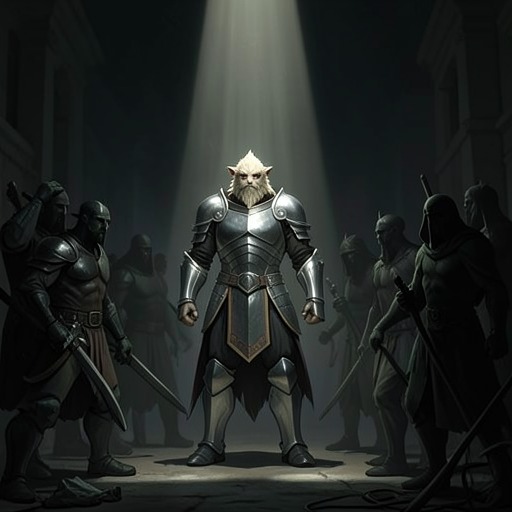
After Ithuriël and Zephon bring Satan before the assembled guards, Gabriel identifies him by his regal bearing and faded splendour as the Prince of Hell. He orders the angelic ranks to stand firm, correctly anticipating that Satan will not leave without contest. Once the Fiend is brought forward, Gabriel directly demands an explanation for breaking the bounds prescribed for his transgressions and disturbing the charge of those who guard the dwelling God has planted in bliss. The accusation is precise: Satan has entered without authorization and has attempted to violate the sleep and safety of Adam and Eve.
Satan answers with contempt. He argues that anyone condemned to Hell would escape pain if a way were available, and he claims that he sought in Paradise a change from torment to ease. He denies that his presence implies violence or harm, though the circumstances already reveal his hostile purpose. Gabriel replies by treating Satan’s supposed wisdom as the product of folly, insisting that escape from punishment cannot evade the anger provoked by such flight. He further challenges Satan’s claim to courage: if pain was the reason for his escape, why did he come alone rather than lead the whole of Hell out with him?
The exchange gives Gabriel a strength more significant than physical intimidation. Zephon has already exposed Satan’s diminished appearance, telling him that the glory he possessed in Heaven departed when he ceased to be good and that his present form resembles the sin and place of his doom. Gabriel’s confrontation continues this moral exposure. Satan remains proud and outwardly undaunted, but Gabriel and his guards force him to face the difference between former heavenly splendour and present rebellion. Their authority rests not only on superior power but on the legitimacy of the order they defend.
Military Command and the War in Heaven
Gabriel’s guardianship of Eden is linked to a wider role in the celestial conflict. After Abdiel returns to Heaven from the hostile host, the divine voice praises him for maintaining the cause of Truth against revolted multitudes and commands Michael, Prince of the Celestial Armies, together with Gabriel, who is next in military prowess, to lead the armed saints. They are to marshal thousands and millions against the Godless crew, assault them with fire and hostile arms, and drive them from the brow of Heaven into the fiery Chaos of Tartarus.
During the battle Gabriel personally fights at the front of the celestial forces. He pierces the deep array of Moloch, the furious king who has defied him and threatened to drag him bound at his chariot wheels while blaspheming against the Holy One of Heaven. Gabriel answers that challenge decisively: Moloch is cleft to the waist, his arms are shattered, and he flees bellowing in extraordinary pain. The scene reverses Moloch’s boast before it can become a deed. The rebel commander who imagined himself capable of humiliating Gabriel is instead broken and driven from the field.
Gabriel’s action forms part of a general collapse among the rebel powers. Uriel and Raphael defeat Adramelec and Asmadai, while Abdiel strikes Ariel, Arioch, and Ramiel. The contrast between the two armies is moral as well as tactical. The loyal angels advance in an invulnerable cubic phalanx because innocence protects them from wounds and pain, whereas the Satanic host, corrupted by disobedience, becomes vulnerable to fear, flight, and bodily suffering. When night imposes a truce, Michael and his angels hold the field with guarded fires, while Satan and his rebellious forces withdraw into darkness and call a council. Gabriel’s battlefield victory thus belongs to a larger divine reversal in which rebellion loses both its military confidence and its claim to lasting glory.
Narrative Role and Significance
Gabriel functions as the poem’s active boundary between sacred order and disruptive intelligence. At Eden he guards the physical entrance, but the deeper boundary he protects is ethical: the separation between the state of innocence and the schemes that would corrupt it. He does not merely wait for invasion; he receives intelligence, interprets signs, deploys guards, identifies the intruder, and brings the threat into open judgment. His conduct turns Paradise from a passive setting into a defended moral space.
His exchange with Satan also clarifies the poem’s contrast between authority and self-authorized rebellion. Satan presents escape, risk, and defiance as forms of courage, but Gabriel exposes the evasiveness within that rhetoric by asking why the supposed champion of endurance has fled alone. The guardian’s firmness therefore counters Satan’s theatrical self-presentation. Gabriel neither imitates the Fiend’s vanity nor allows argument to obscure the concrete fact of trespass.
Across the larger narrative, Gabriel’s role broadens from sentinel to commander. He protects Adam and Eve before the Fall, confronts the tempter at the edge of his first assault, and defeats Moloch in the heavenly war. The same qualities govern both scenes: alertness, ordered command, courage under provocation, and confidence that rightful power need not depend on display. Through Gabriel, the poem presents loyalty as an active discipline that watches, interprets, resists, and, when necessary, acts with overwhelming force.