God and Mankind
Paradise LostGod and Mankind names the poem’s governing relation between the Creator and the human race: a bond of gift, command, freedom, judgment, compassion, and promised restoration. God gives Man life, reason, dominion, and the possibility of obedience; Man’s fall converts those gifts into guilt and mortality, but does not cancel the divine purpose. The relation therefore develops not as simple authority opposed to rebellion, but as a drama in which justice exposes sin while grace creates a path back to life.
Creation and Human Vocation
God creates Man as the culminating work of the sixth day, distinct from the beasts through reason, sanctity, upright stature, and the capacity to recognize the source of his good. Speaking with the Son, God declares the intention to make Man in the divine image and appoints him to rule over fish, birds, beasts, the Earth, and every creeping thing. He forms Adam from dust, breathes life into his nostrils, and makes him a living soul; Eve is created as his female consort, and God blesses the human race with the command to be fruitful, multiply, fill the Earth, subdue it, and exercise dominion over its living creatures.
The gift is generous but not unrestricted. In the Garden of Eden, God provides every pleasant fruit for food except the fruit of the Tree of Knowledge of Good and Evil. The prohibition functions as the sole visible pledge of human obedience: eating from the tree will bring death. Humanity’s appointed rule over creation therefore rests beneath a higher sovereignty. Adam and Eve may govern the world, but they do not govern the terms of their own being; appetite must remain subject to reason, and reason to God’s command.
This structure separates legitimate dominion from human mastery over other humans. Later, Adam condemns the usurper who claims authority over his brethren and insists that God gave Man dominion over beasts, fish, and birds, not lordship over human beings. The relation between God and Mankind thus includes a political principle: human freedom is a divine donation, while tyranny is an illicit extension of creaturely power.
Freedom, Disobedience, and Judgment
God’s foreknowledge does not compel the Fall. When He explains the coming ruin of Adam’s race, He emphasizes that Man was made just and sufficient to stand, yet free to fall. Freedom is indispensable because without the power not to obey, human allegiance would be necessity rather than sincere faith, love, or praise. Adam and Eve therefore remain responsible authors of their choice, just as the fallen spirits are responsible for theirs; the distinction is that the angels self-tempted themselves, whereas Man is deceived by the tempter.
After the forbidden fruit is eaten, God’s justice follows the announced law rather than cancelling it. He declares that Man has broken allegiance, sinned against Heaven’s supremacy, and forfeited life. Adam’s judgment brings a curse upon the ground: labor, thorns, thistles, sweat, and eventual return to dust. Eve’s sentence multiplies sorrow in conception and childbirth and places her under her husband’s rule. The immediate stroke of death is deferred, but the penalty remains real, entering human existence as mortality, toil, pain, and the loss of the State of Innocence.
The divine response also exposes the relational consequences of sin. Adam and Eve hide from God, and Adam attempts to distribute blame by pointing to Eve, while Eve points to the Serpent. Their former openness gives way to shame, evasion, and fractured responsibility. Yet judgment is not pure abandonment. The Son, sent as Judge and Intercessor, clothes their nakedness with skins and covers their inward shame with a robe of righteousness, an act that joins the severity of the sentence to compassion for the sentenced creatures.
Mercy, Mediation, and Redemption
Before humanity’s fall, God has already declared that Man will not be wholly lost. He will renew humanity’s lapsed powers, uphold those who respond to grace, and place conscience within them as a guide. Those who sincerely pray, repent, and endeavor to obey may receive increasing light and arrive safely through perseverance. Grace is freely offered rather than earned, while the refusal and scorn of grace harden the person who rejects it.
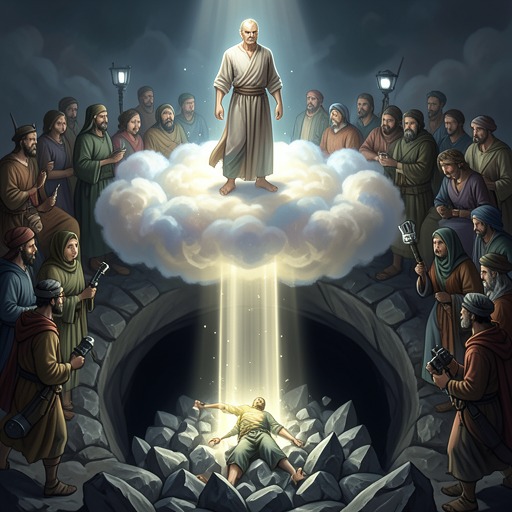
Justice nevertheless requires satisfaction. Since Man has disobeyed and incurred death, either humanity must die or another must pay the penalty of death for death. No member of the Heavenly Host volunteers to assume the forfeiture. The Son alone offers Himself: He will leave the Father’s bosom, become Man, endure death, and give life for human life. His willingness establishes mediation as the decisive form of the God-and-humanity relation. Humanity cannot offer an adequate atonement for itself while dead in sins, but the Son’s voluntary sacrifice supplies what fallen humanity lacks.
God accepts this mediation by appointing the Son to join divine and human nature, become flesh through a virgin birth, and stand in Adam’s place as the Head of Mankind. As all perish in Adam, so those who are restored are renewed from the Son as a second root. The Son’s merit may be imputed to those who renounce reliance on their own righteousness and unrighteousness, live in him, and receive new life from him. Divine love thereby exceeds the destructive force of Hellish hate: the same judgment that reveals human guilt becomes the ground for redemption.
Law, Grace, and the Human Future
The relation continues through a distinction between law and grace. God gives law to reveal humanity’s natural depravity by setting sin against a clear standard. Ritual sacrifices, including the blood of bulls and goats, cannot finally remove guilt; they point toward the more precious blood required for Man, the just suffering for the unjust. The law therefore disciplines humanity toward a better covenant, moving from shadow to truth, flesh to spirit, servile fear to filial acceptance, and works of law to works of faith.
The Son fulfills the divine law through obedience and love, then bears the death due to human transgression. His crucifixion is presented as the defeat not only of death but of Sin and Satan’s power. He rises before the third dawn, and His resurrection transforms death for the faithful from final destruction into a passage toward immortal life. His salvation is then extended beyond Abraham’s physical descendants to all nations and to all who share Abraham’s faith.
The post-resurrection relation is not left without guidance. The Son ascends and sends the promised Comforter, whose Spirit writes the Law of Faith upon believers’ hearts, guides them into truth, and arms them against Satan’s assaults. The Apostles receive the Spirit first and then carry the message to the nations, baptizing believers as a sign of cleansing from guilt. Even when persecution, false teachers, superstition, and the coercive misuse of spiritual authority corrupt outward religion, the relation remains grounded in faith and conscience rather than merely imposed forms.
Exile, Prayer, and Restoration
Humanity’s continued access to Eden is impossible after the Fall. God removes Adam from the Garden lest he also eat of the Tree of Life and perpetuate a fallen immortality. Death thus becomes a final remedy rather than only a punishment: after life has been tested through tribulation and refined by faith and faithful works, death yields the person to a second life in the renovation of the just. Exile from Eden is consequently both deprivation and preparation for a more complete restoration.
After the judgment, contrition reopens communication between God and Man. Prevenient grace removes the stone from human hearts, and prayer rises toward Heaven as the first fruit of grace. The Son presents these sighs and prayers before the Father as Advocate and propitiation, interpreting the inarticulate repentance of fallen humanity and attaching His own merit to human works. The Father accepts the request, not by abolishing earthly mortality or reversing the law, but by reconciling humanity to Him for the duration of its mortal life and preparing it for better life beyond death.
The final horizon is the renewal of creation. The Son will return in glory to judge the living and the dead, dissolve Satan and his corrupted world, and raise new Heavns and a new Earth founded in righteousness, peace, and love. God and Mankind are therefore joined by a movement from image to fall, from command to judgment, from judgment to mediation, and from mortality to restored life. The relation reaches its most inward form when Adam learns that obedience, faith, patience, temperance, and love can establish a Paradise within the human heart even before the renewed world appears.