Hell
Paradise LostHell is the destination of Satan and the Rebel Angels after their defeat in Heaven and the dark counter-world from which their subsequent designs proceed. It is defined by distance from God and heavenly light, but it is not merely an inert landscape: it contains prisons, councils, palaces, furnaces, and routes of passage, turning spiritual exile into a fully organized infernal polity. The location therefore gives physical form to the poem's central paradox that rebellion seeks liberty while reproducing hierarchy, command, and coercive power.
Definition and Physical Condition
Hell first appears as the place into which the Almighty hurled Satan and his host after their impious war in Heaven. They fall flaming from the ethereal sky into bottomless perdition, where they lie vanquished for nine times the span that measures day and night for mortal beings. Although the fallen spirits remain immortal, Hell binds them in adamantine chains and penal fire, making their supernatural endurance itself a condition of prolonged punishment rather than release.
The setting is a dungeon horrible, a region of sorrow and doleful shades where peace and rest never dwell and hope never comes. It resembles one immense furnace, but its flames produce no illuminating radiance; instead, they create darkness visible, a paradoxical light that reveals suffering without dispelling the surrounding obscurity. The fiery deluge is fed by ever-burning sulphur that remains unconsumed, while Eternal Justice has fixed the rebels' portion as far from God and Heaven's light as the center of the world is from its outermost pole. Hell is thus measured not only by fire and depth but by theological distance: its defining pain is separation from the source of order, goodness, and light.
Inhabitants and Infernal Government
Satan's closest companion in Hell is Beelzebub, described as next to him in power and next to him in crime. Their companionship recalls the mutual league, shared counsels, equal hope, and common hazard that once joined them in the celestial enterprise, but Hell transforms that fellowship into an alliance formed within equal ruin. Satan's address to Beelzebub also establishes Hell as a place where former rank survives defeat: the fallen retain memories of their earlier brightness, authority, and military organization even after their expulsion.
That retained hierarchy becomes visible when Satan sits exalted upon a royal throne, raised to a bad eminence by merit and free choice and confirmed there by the consent of his followers. He presents the infernal settlement as a secure throne and argues that the rebels can recover their inheritance by unity, firm faith, and firm accord. Hell consequently has a political structure rather than a merely punitive one. Its ruler claims legitimacy through leadership in war, while its assemblies debate whether to pursue open warfare or covert guile against Heaven.
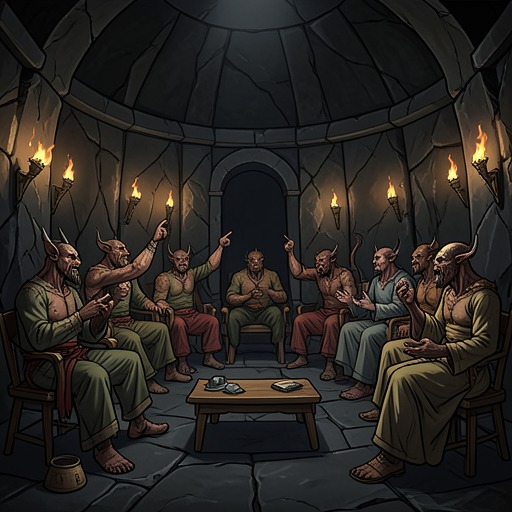
The most important institutional expression of this order is Pandemonium, Hell's high capital and the site of the solemn council summoned by winged heralds. Regiments arrive in disciplined formations, and the crowded halls recall both a military gathering and a civic or royal court. The fallen spirits, immense when viewed in the open, reduce their bodies to the smallest forms so that innumerable incorporeal beings can occupy the hall, while the great Seraphic lords and Cherubim remain in their own dimensions in a secluded conclave. Hell therefore combines mass politics with concentrated aristocratic authority: a multitude is gathered, but deliberation is shaped by the most powerful leaders.
Hell as a Political Ideal and Its Contradictions
The infernal council exposes competing interpretations of what life in Hell should mean. Belial counsels passive endurance, hoping that time may soften the fires and that the spirits may become accustomed to their new element. Mammon rejects both submission to Heaven and the hope of restoring their former place there, because worship under the victorious sovereign would amount to splendid vassalage. He prefers hard liberty in Hell, where the rebels can seek their own good from themselves, remain accountable to none, and turn adversity into prosperity through labor and endurance.
This rhetoric makes Hell sound like a refuge of autonomy, but its political meaning is unstable. Satan's throne, the ordered regiments, the council, and the demand for collective loyalty reproduce the very structures of rule that the rebels denounce in Heaven. Abdiel identifies the contradiction directly when he tells Satan that a rebel who rules others is not free but enthralled to himself, and that Satan's supposed kingdom should yield chains rather than realms. Hell thus becomes the spatial emblem of liberty detached from right reason: its inhabitants reject the rightful authority of God, yet their resistance produces a new dominion centered on one ambitious will.
Satan's own language intensifies this contradiction. He treats defeat as compatible with unconquerable will, revenge, immortal hate, and courage never to submit, while refusing repentance or a request for grace. In Hell, mental defiance becomes a substitute for actual freedom. The rebel can preserve an inward posture of resistance, but he cannot escape pain, confinement, or the consequences of separation from Heaven. The location gives material grandeur to that posture while continually exposing its limits.
Architecture, Labor, and False Magnificence
Hell is also a place of infernal construction. After the fallen host gathers, the spirits build Pandemonium through astonishingly rapid and coordinated labor. Liquid fire is drawn from the Lake of Fire into underground veins; ore is separated and refined; molds are formed; and the molten metal is conveyed through the ground to fill the structure's hollows. The building rises like an exhalation and takes the form of a temple, with pilasters, Doric pillars, golden architraves, cornices, sculpted roofs, and lamps fueled by naphtha and asphaltus.
The scale and splendor of the capital are explicitly compared with the monuments of Babel, the Memphian kings, Babylon, and Alcairo. Its magnificence can rival the shrines of Belus or Serapis and the palaces of ancient imperial wealth, yet its materials emerge from fire and its purpose is rebellion. The architecture therefore converts punishment into spectacle. Hell's inhabitants answer the ugliness of their prison with art, ceremony, and gold, but the resulting beauty remains a form of infernal imitation: a counterfeit Heaven assembled within a realm whose essential condition is darkness.
The builder is identified with Mulciber, known in ancient Greece and Ausonia through a mistaken story that Jupiter cast him from Heaven onto Lemnos. The poem corrects that myth by insisting that he fell with the rebellious host long before the classical tale and that his skill did not save him from being sent to Hell to build for the very power that had been defeated. His craftsmanship gives Hell grandeur, but it also demonstrates that technical brilliance cannot overcome moral or political subordination.
Routes, Expansion, and Relation to the Human World
Hell is not sealed off permanently from creation. Satan leaves its confines and passes through Chaos, where the old Anarch recognizes him as the mighty angel who led the war against Heaven. Hell's frontier has already been weakened by the arrival of Heaven and Earth, another world suspended in a golden chain above its realm. The old Night describes the new creation as an encroachment upon his dominion, while Satan treats the region as a passage toward his revenge.
Satan's journey establishes a later connection between Hell and Earth. After the Fall of Adam and Eve, Sin and Death follow his track and pave a broad road over the dark Abyss, constructing a bridge of wondrous length from Hell to the outermost sphere of the created world. Through this passage the perverse spirits can travel back and forth to tempt or punish mortals, except where God and good angels protect them by special grace. Hell consequently changes from a remote prison into an active base of influence, linked materially to human history and to the spread of sin and death.
The location also stands in an inverse relation to the Garden of Eden. Hell is the realm of penal fire, visible darkness, and separation from God; the Garden is a place of created abundance, divine visitation, and ordered dominion. Yet the bridge between them makes the contrast dynamic rather than absolute. Satan carries Hell's hostility outward, and human disobedience allows infernal consequences to enter the world. Hell's influence is therefore spatially expansive even when its inhabitants remain theologically excluded from Heaven.
Narrative and Thematic Significance
Hell functions as the poem's principal image of punishment, but its deeper significance lies in the way it stages the politics of rebellion. It is at once prison and kingdom, furnace and palace, exile and headquarters. The rebels' speeches transform suffering into a test of will and deprivation into an argument for self-rule, while the setting repeatedly answers that rhetoric with chains, darkness, pain, and dependence on the very order they oppose.
The later doctrine of redemption places Hell within an even larger economy of justice and mercy. Without an able and willing substitute, humanity would be adjudged to Death and Hell; the Son of God offers life for life, accepts mortal suffering, and promises to rise victorious over Death. The predicted work of the redeemer defeats Sin and Death, the two chief powers associated with Satan, and makes possible the restoration of those who receive salvation by faith. Hell is therefore not the final horizon of the poem's universe. It is the realm from which rebellion radiates, the destination threatened by judgment, and the darkness against which the poem measures the possibility of renewed life.